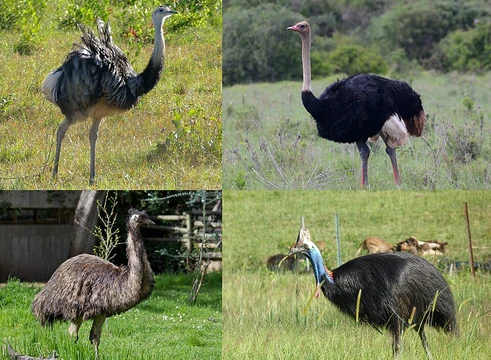
Ratite
Flightless birds without a keeled sternum, mostly from former Gondwana.
Last updated
Ratites are a polyphyletic group of flightless birds within the infraclass Palaeognathae, lacking a keel on their sternum. They are mostly large, long-necked, and long-legged, though the kiwi are the only nocturnal extant ratites. The group includes ostriches, emus, cassowaries, rheas, kiwis, and extinct forms such as moa and elephant birds.
Quick Facts
- Largest living ratite
- African ostrich, up to 2.8 m tall and 156 kg / 344 lb
- Smallest ratite
- Little spotted kiwi, 0.9 kg (1.98 lb) and 35 cm (1 ft 2 in) tall
- Heaviest bird ever known
- Aepyornis maximus, over 400 kg (882 lb) and up to 3 m tall
- Tallest known ratite
- Giant moa Dinornis robustus, 3.7 m tall and about 230 kg / 507 lb
- Earliest known ratite fossils
- Paleocene epoch, about 56 million years ago
Facts from the source article.
Species
The African ostriches are the largest living ratites, reaching nearly 2.8 m tall and 156 kg, and can outrun a horse. The Australian emu is next in height at up to 1.9 m and about 50 kg, a fast-running bird of open plains and woodlands. Three cassowary species, native to Australia and northern islands, are shorter but heavier (up to 1.8 m and 85 kg), preferring thick tropical forest and possessing razor-sharp talons; in New Guinea, their eggs are collected and chicks raised for food.
South America has two rhea species, large fast-running birds of the Pampas, with the larger American rhea about 1.4 m tall and usually 15 kg. The five kiwi species from New Zealand are chicken-sized, shy, and nocturnal, nesting in burrows and using a keen sense of smell to find insects; they lay eggs that may equal 15 to 20 percent of the female's body mass, with the little spotted kiwi the smallest at 0.9 kg and 35 cm tall. At least nine moa species lived in New Zealand before human arrival, ranging from turkey-sized to the giant Dinornis robustus at 3.7 m and about 230 kg, extinct by A.D. 1400 due to hunting by Māori settlers.
Aepyornis maximus, the elephant bird of Madagascar, was the heaviest bird known at over 400 kg and up to 3 m tall, accompanied by three other Aepyornis species and three Mullerornis species; all declined after human arrival around 2,000 years ago and were extinct by the 17th or 18th century. Two taxonomic approaches exist: one groups ratites as families in Struthioniformes, the other elevates them to separate orders.
Evolution
The longstanding hypothesis held that ratites share a common flightless Gondwanan ancestor, isolated by continental drift. Some morphological, immunological, and DNA studies supported monophyly, and Cracraft's 1974 vicariance hypothesis proposed ancestral flightless paleognaths were widespread in Gondwana during the Late Cretaceous, carried by plate movements to current positions. The earliest known ratite fossils date to the Paleocene about 56 million years ago, with more primitive paleognaths known earlier, and some early ratites occur in Europe.
Molecular phylogenies generally place ostriches as basal, rheas second, and Australo-Pacific ratites last, with both latter groups monophyletic; early mitochondrial studies that failed to make ostriches basal were compromised by rapid early radiation and long branches. A 2008 nuclear gene study shows ostriches branching first, then rheas and tinamous, then kiwi splitting from emus and cassowaries. More recent studies place moas and tinamous as sister groups, and elephant birds as most closely related to New Zealand kiwi, with morphological support for the latter.
Description
Ratites generally have underdeveloped breast muscles, no keeled sterna, almost absent wishbones, and simplified wing skeletons and musculature. Their legs are stronger and lack air chambers except in the femurs; tail and flight feathers have retrogressed or become decorative plumes. They have no feather vanes, no preen glands, no separation of pterylae and apteria, and palaeognathous palates. Ostriches show the greatest dimorphism; rheas show some dichromatism during breeding; emus, cassowaries, and kiwis show some size dimorphism.
Ostriches have only two toes, cassowaries have long inner toenails used defensively, and ostriches and rheas have prominent wings used in courtship and predator distraction. Ratite chicks can swim and dive. Paleognaths generally have smaller brains than neognaths on an allometric basis, but kiwis are an exception with proportionally larger brains comparable to parrots and songbirds, though evidence for advanced cognitive skills is lacking.
Behavior and ecology
Ratite chicks tend to be more omnivorous or insectivorous; adults vary in diet and digestive tract length. Ostriches, with the longest tracts at 14 m, are primarily herbivorous; rheas, with tracts of 8–9 m and caeca, are mainly herbivores on broad-leafed plants but eat insects opportunistically. Emus have 7 m tracts and a more omnivorous diet including insects and small animals; cassowaries have tracts of 4 m; kiwi have the shortest tracts and eat earthworms, insects, and similar creatures.
Moas and elephant birds were the largest native herbivores in their faunas. Some extinct ratites like Diogenornis and Palaeotis may have had animalivorous diets. Ratites have thick eggshells, and their young hatch more developed and can run or walk soon after. Most have communal nests; ostriches and great spotted kiwis share incubation duties, with males incubating at night.
Cassowaries and emus are polyandrous, with males incubating and rearing chicks; ostriches and rheas are polygynous, with male rheas building nests and incubating, while ostrich males incubate only at night. Kiwis have extended monogamous strategies with male or both sexes incubating a single egg. Male ratites have a phallus inserted into the female's cloaca during copulation.
Did You Know?
- Ratite hides are popular for leather products like shoes.
- The USDA's FSIS began a voluntary ratite inspection program in 1995, made mandatory in April 2001.
More in Ratites
Sources
Compiled from Wikipedia and the sources listed below. Text from Wikipedia is available under CC BY-SA 4.0; this entry is adapted from it.
- Wikipedia: Ratite (CC BY-SA 4.0).
- Word definitions: the , each quoted from its Wikipedia article.
Spotted an error? Know more?
Reader corrections go straight into our review queue. Suggest an edit · How this site is sourced