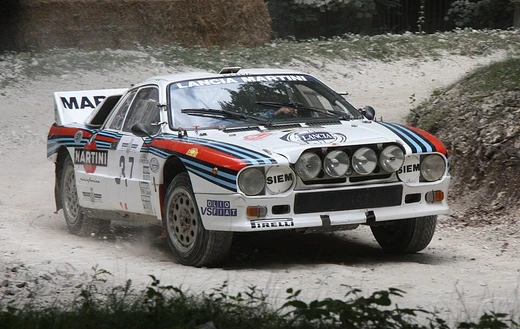
Lancia ECV
A prototype Group S rally car banned before it could race.

The Lancia ECV (Experimental Composite Vehicle) was a prototype Group S rally car developed by Lancia to replace the Lancia Delta S4 in World Rally Championship competition for the 1988 season. It never raced because Group B and Group S cars were banned by the FIA in late 1986. Lancia instead developed the Group A Lancia Delta.
- Engine
- 1759 cc twin-turbocharged TriFlux
- Power
- over 600 hp (448 kW) originally; Group S rules would have limited output to 300 hp (224 kW)
- Weight
- 930 kg
- Materials
- Kevlar and carbon fibre
- Color scheme
- Martini red-based scheme (replacing the S4's white)
- Designer (ecv 2)
- Carlo Gaino of Synthesis Design
Lore & Background
The Lancia ECV was built to replace the Lancia Delta S4 for the 1988 World Rally Championship season. Its engine, christened TriFlux, was a 1759 cc twin-turbocharged unit built in an unusual fashion: the valves were crossed so that each side of a cylinder had an intake and an exhaust valve, allowing two separate manifolds to feed the two turbochargers. A single manifold carried the intake air, giving the engine its name from the three separate air ducts. The car originally produced over 600 horsepower, though Group S rules would have artificially limited output to 300 hp to limit speeds.
The car made extensive use of composite materials Kevlar and carbon fibre to save weight and add strength, resulting in a total weight of 930 kg. It featured a new Martini colour-scheme with red-based bodywork, replacing the S4's white; Lancia used this scheme on its competition cars in 1987.
Despite the cancellation of Group S, Lancia improved the ECV with the 1988 ECV 2. The ECV 2 used the same carbon-fibre chassis as the first ECV, the TriFlux engine, and improved aerodynamics. The designer of the ECV 2 was Carlo Gaino of his newly created design studio Synthesis Design.
Reader's Guide
The Lancia ECV represents a what-if moment in rally history: a technologically advanced Group S prototype that never competed due to the FIA's ban on Group B and Group S cars in late 1986. Its TriFlux engine, with crossed valves and twin turbochargers fed by separate manifolds, was an unusual engineering solution that produced over 600 hp, though Group S rules would have capped it at 300 hp. The car's extensive use of Kevlar and carbon fibre kept weight to 930 kg, and its Martini red-based livery marked a visual shift from the earlier Delta S4.
After the ban, Lancia developed the Group A Lancia Delta instead. The ECV 2, built in 1988, refined the original with improved aerodynamics and the same TriFlux engine, but it too never raced. The restored ECV1, rebuilt from original parts, was displayed at the Rally-Legend Event in San-Marino in October 2010 by owner Giuseppe Volta, with the TriFlux engine re-prepared with help from original designer Ing. Claudio Lombardi and modern turbo-engine expert Claudio Berri. The car remains a notable example of a prototype that pushed materials and engine design but was stopped by regulatory change.
Did You Know?
- The ECV's TriFlux engine had crossed valves, with intake and exhaust valves on each side of the cylinder.
- The car originally produced over 600 hp, but Group S rules would have limited it to 300 hp.
- The ECV 2 was designed by Carlo Gaino of Synthesis Design.
Frequently Asked Questions
What is the Lancia ECV?
The Lancia ECV, short for Experimental Composite Vehicle, was a Group S prototype rally car built by Lancia as the intended successor to the Delta S4 for the 1988 WRC season. It was designed as a next-generation competition machine but never saw a single competitive start.
Why did the Lancia ECV never race?
In late 1986 the FIA banned both Group B and Group S categories from WRC competition, effectively killing the ECV's racing career before it could debut. Lancia pivoted to developing a Group A version of the Delta instead.
What engine and power output did the Lancia ECV have?
Under the hood sat a 1759 cc twin-turbocharged TriFlux engine producing over 600 hp in its unrestricted form. Group S regulations would have capped the output at 300 hp for competition use.
What materials was the Lancia ECV constructed from?
The body and chassis relied heavily on Kevlar and carbon fibre composites, keeping the total weight to just 930 kg. This lightweight construction was central to its 'Experimental Composite Vehicle' name.
Who designed the Lancia ECV and what did it look like?
The second ECV prototype was styled by Carlo Gaino of Synthesis Design. It wore a Martini red-based livery, a deliberate departure from the white scheme of the Delta S4 it was meant to replace.
More in Rally Cars, Part 4 1-24
Spotted an error? Know more?
Reader corrections go straight into our review queue. Suggest an edit · How this site is sourced