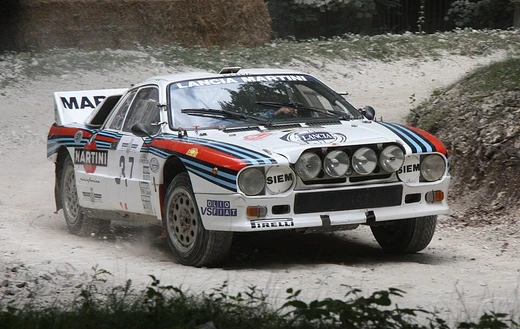
Lancia Ypsilon Rally2 HF Integrale
Lancia's Rally2 contender, returning the brand to WRC victory after 34 years.

The Lancia Ypsilon Rally2 HF Integrale is a rally car built by Lancia to FIA Group Rally2 specifications. It is derived from the Lancia Ypsilon road car and made its competitive debut at the 2026 Monte Carlo Rally in the WRC2 Championship, ending Lancia’s multi-decade absence from the World Rally Championship.
Development began in 2025, with Stellantis unveiling the car during testing in August and September of that year. The car uses a 1.6-litre turbocharged petrol engine, along with an upgraded version of the engine and gearbox found in the Citroën C3 Rally2. On 27 February 2026, Stellantis announced that Italian multiple rally champion Andrea Crugnola would drive the car in the 2026 Italian Rally Championship, having contributed to its development.
In the FIA WRC2 Championship, the car runs under the name Lancia Corse HF, operated by PH Sport. Two factory-backed entries are entered, driven by Yohan Rossel and Nikolay Gryazin. At the 2026 Monte Carlo Rally—considered one of the most challenging editions due to weather—the car won eight special stages and the shakedown. Gryazin won the shakedown and SS1, while Rossel took SS6, SS10, SS11, SS14, SS15, SS16, and the final SS17. On 12 April 2026, the car claimed its first WRC2 victory at the 2026 Croatia Rally, with Rossel and co-driver Arnaud Dunand. The car finished 4th (Rossel/Dunand) and 6th (Gryazin/Konstantin Aleksandrov) overall, behind only Rally1 cars. This victory marked Lancia’s first World Rally Championship win in 34 years.
In the FIA European Rally Championship, the car competes with Lancia Corse HF, driven by Andrea Mabellini and Virginia Lenzi, as well as with the Finnish team Rautio Motorsport, driven by Tuukka Kauppinen and Topi Luhtinen. On 19 April 2026, at the 43rd Andalucía Rally, Mabellini and Lenzi finished sixth, 51.6 seconds behind the winner.
In the Italian Rally Championship, the car runs with the E.A. Sport Investment team, driven by Andrea Crugnola and Luca Beltrame. It won the first rally of the championship—Lancia’s first victory in the series in over 30 years. The brand’s previous win came at the 1993 Rally Il Ciocco e Valle del Serchio, when Gilberto Pianezzola and Loris Roggia won in a Lancia Delta Integrale, exactly 33 years earlier.
In the French Rally Championship, the car competes with the Trajectus Motorsport team, driven by Yoann Bonato and Benjamin Boulloud.
Quick Facts
- Car Name
- Lancia Ypsilon Rally2 HF Integrale
- Category
- Rally2
- Constructor
- Lancia
- Team
- Lancia Corse HF
- Drivers
- FRA Yohan Rossel / BUL Nikolay Gryazin
- Length
- NNNN mm
- Capacity
- 1598 cc
- Configuration
- Straight-four engine
- Turbo/Na
- turbocharged
- Gears
- five-speed
- Differential
- 4-wheel drive
- Weight
- 1230 kg
Facts from the source article.
Lore & Background
The Rally2 version of the car is powered by a 1.6-litre turbocharged petrol engine and features an upgraded version of the engine and gearbox used by the Citroën C3 Rally2. Development took place in 2025, and the car was unveiled during testing in August and September 2025 by Stellantis. On 27 February 2026, Stellantis announced that Italian driver Andrea Crugnola, multiple Italian rally champion, would participate in the 2026 Italian Rally Championship with the car, which he helped develop.
In competition, the car was announced as the entry for the 2026 WRC2 Championship under the name Lancia Corse HF, operated by PH Sport. Two factory-backed entries were entered, with Yohan Rossel and Nikolay Gryazin under contract. At the 2026 Monte Carlo Rally, the car won eight special stages and the shakedown, with Gryazin winning the shakedown and SS1, and Rossel winning SS6, SS10, SS11, SS14, SS15, SS16, and SS17. On 12 April 2026, the car achieved its first WRC2 victory at the 2026 Croatia Rally, driven by Yohan Rossel and co-driver Arnaud Dunand, marking Lancia's return to victory in the World Rally Championship after 34 years.
The car also competes in the 2026 European Rally Championship with Lancia Corse HF (driver Andrea Mabellini, co-driver Virginia Lenzi) and with Finnish team Rautio Motorsport (driver Tuukka Kauppinen, co-driver Topi Luhtinen). In the Italian Rally Championship, it competes with E.A. Sport Investment (Andrea Crugnola, Luca Beltrame), winning the first rally of the championship—Lancia's first victory in that championship in over 30 years, since Gilberto Pianezzola and Loris Roggia won in a Lancia Delta Integrale at the Rally Il Ciocco e Valle del Serchio in 1993. In the French Rally Championship, the car competes with Trajectus Motorsport (Yoann Bonato, Benjamin Boulloud) and also won its first rally of the season.
Reader's Guide
The Lancia Ypsilon Rally2 HF Integrale is significant as the car that brought Lancia back to the World Rally Championship after decades away, and it achieved the brand's first WRC victory in 34 years at the 2026 Croatia Rally. Its debut at the 2026 Monte Carlo Rally, one of the most challenging editions due to environmental and weather conditions, demonstrated the car's speed and competitiveness, winning eight special stages and the shakedown. The car's first WRC2 victory, by Yohan Rossel and Arnaud Dunand, confirmed its quality as a fast, precise, and reliable machine, with the Ypsilon finishing 4th and 6th overall in Croatia behind only Rally1 cars. Beyond the world championship, the car immediately proved successful in national championships, winning the opening rounds of both the Italian and French Rally Championships in 2026—a double debut victory that highlighted its performance. For Lancia, the car marks a return to rallying heritage, with its first Italian championship victory coming 33 years after the last Lancia win in that series, achieved by a Delta Integrale. The car's development was aided by multiple Italian champion Andrea Crugnola, and its competition program includes entries in the WRC2, European, Italian, and French championships, underscoring its broad competitive role.
Did You Know?
- The car uses an upgraded version of the engine and gearbox from the Citroën C3 Rally2.
- It won eight special stages and the shakedown on its debut at the 2026 Monte Carlo Rally.
- The car won the opening rounds of both the 2026 Italian and French Rally Championships.
Architectural Vision and Engineering DNA
The first-generation Ypsilon was the product of a focused, well-funded development cycle. Enrico Fumia sketched the design in 1992, and the project consumed roughly 24 months and approximately 400 billion Italian lira before the car was unveiled in Rome in January 1996. Fumia's signature move was a series of bold arches that wrapped around every side of the body, giving the 3.72-metre supermini a sculptural identity that set it apart from its Y10 predecessor, which it was 33 centimetres longer than. Underneath, the Ypsilon shared its structural platform with the Fiat Punto 176 and the Barchetta, but Lancia engineers shortened the wheelbase and fitted an all-independent suspension layout: MacPherson struts up front and trailing arms at the rear. Inside, the cabin featured five seats, a soft-touch plastic dashboard, and a distinctive centre-mounted instrument cluster that would later influence the Musa and the 2003 Ypsilon. Buyers could choose from a Kaleidoscope palette of one hundred body colours, a level of personalisation unusual for the segment at the time.
The SuperFIRE Revolution
The powertrain story of the first-generation Ypsilon is one of incremental innovation that ultimately put Lancia at the forefront of small-engine technology. The initial range drew on the FIRE family of engines, a lineage that had first appeared in the Y10 back in 1985 and subsequently powered various Fiat and Lancia models. Early options included 1,108 and 1,242 cc eight-valve overhead-camshaft units, while the range-topping 1.4-litre twelve-valve Pratola Serra engine, carried over from the Fiat Bravo and Brava, delivered 59 kW (80 PS). That unit proved only moderately successful, and Lancia quickly moved to replace it with what became known as the SuperFIRE: a four-valves-per-cylinder design with multipoint fuel injection. The Ypsilon was the very first car to receive this evolved engine. The 1,242 cc SuperFIRE produced 63 kW (86 PS) at 6,000 rpm and 113 Nm of torque at 4,500 rpm. Remarkably, that same engine was still being offered on the 2013 Ypsilon, the 2013 Ford Ka, and the Fiat 500, a testament to its durability. The 1.2 eight-valve variant could also be paired with an ECVT automatic transmission.
Elefantino Rosso: A Nod to Rally Glory
The most spirited expression of the first-generation Ypsilon was the Elefantino Rosso, a name translating to Tiny Red Elephant and directly referencing the emblem of Lancia's historic HF sports cars, which collected numerous rally victories. Positioned as the sports variant and the sister car to the Fiat Punto Sporting, the Elefantino Rosso wrapped its cabin in grey Alcantara, with seats accented by dark grey fabric insets that echoed the exterior paint. The steering wheel and gearshift lever were trimmed in grey leather with red stitching, and the car received 15-inch wheels shod with 195/50R15 tyres—the only model in the entire lineup to wear that combination. Titanium-look rear-view mirrors, a dedicated centre console, and standard air conditioning rounded out the equipment list. Mechanically, a shorter gearbox ratio sharpened acceleration from standstill to 100 km/h and in top gear, while a lowered, stiffened suspension with larger roll bars and more direct power steering gave the car a planted, responsive feel. Top speed reached 177 km/h. For buyers preferring a more refined ride, the LX and LS trims could also be specified with the SuperFIRE engine, matching the Pratola Serra versions' top speed.
Italian Dominance and a Long-Running Legacy
Although the Ypsilon never achieved the global recognition of some Fiat Group siblings, its home-market performance was extraordinary. Between 1995 and 2005, the Melfi plant in the Potenza region rolled out more than 870,000 units, and by 2019 cumulative Italian sales of the Y and Ypsilon had surpassed 1.6 million. The launch was an instant commercial triumph: over 42,000 cars found buyers in just the first two months, and Quattroruote, after pushing the 16-valve LX beyond its usual urban duties, praised its generous power reserves and the comfort level it delivered for its price. The model's longevity is remarkable—by 2023, despite its age, it still commanded the highest market share in Italy's B-segment. As of 2024, the fourth-generation Ypsilon remains Lancia's sole model. The brand's international footprint was more limited: Lancia had exited right-hand-drive markets two years before the Y's launch, so no RHD version was ever built. The third generation, sharing its platform with the Fiat 500, was briefly sold as the Chrysler Ypsilon in the UK, Ireland, and Japan, with 2,000 units moving in 2014 before the variant was discontinued in 2015.
Frequently Asked Questions
What is the Lancia Ypsilon Rally2 HF Integrale?
It is a rally car Lancia developed to FIA Group Rally2 regulations, based on the Ypsilon road car. The project was created to bring the brand back to World Rally Championship competition after more than three decades of absence.
What powertrain does the Lancia Ypsilon Rally2 HF Integrale use?
The car is driven by a 1.6-litre turbocharged petrol engine mated to a gearbox, both of which are upgraded versions of the unit already proven in the Citroën C3 Rally2. Sharing this Stellantis architecture keeps development costs down while still meeting Rally2 performance thresholds.
When and where did the Lancia Ypsilon Rally2 HF Integrale make its competitive debut?
It first raced at the 2026 Monte Carlo Rally as part of the WRC2 Championship. Development kicked off in 2025, with Stellantis running test sessions in August and September before the car was ready for competition.
Who scored the first WRC2 victory in the Lancia Ypsilon Rally2 HF Integrale?
Yohan Rossel and co-driver Arnaud Dunand took the win at the 2026 Croatia Rally. That result marked the car's first top step of the podium in WRC2 competition.
Why is the Lancia Ypsilon Rally2 HF Integrale a big deal for rally fans?
It ended Lancia's roughly 34-year gap without a WRC victory, reviving a name that once dominated the sport in the Group A and early WRC eras. In its debut season the car also claimed first wins in both the Italian and French national rally championships, proving it could compete on multiple fronts.
More in Rally Cars, Part 4 1-24
Spotted an error? Know more?
Reader corrections go straight into our review queue. Suggest an edit · How this site is sourced