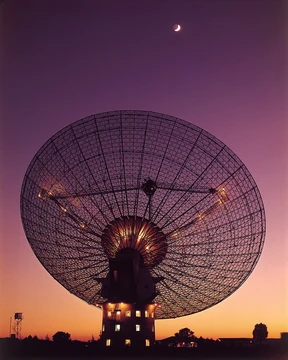
Allen Telescope Array
A radio array for astronomy and SETI, pioneered by Paul Allen.
The Allen Telescope Array (ATA), originally called the One Hectare Telescope (1hT), is a radio telescope array at the Hat Creek Radio Observatory in Shasta County, California, used for astronomical observations and a simultaneous search for extraterrestrial intelligence (SETI). It was developed jointly by the SETI Institute and the University of California, Berkeley, with major funding from Paul G. Allen. The array became operational on 11 October 2007 with 42 antennas.
Quick Facts
- Location
- Hat Creek Radio Observatory, Shasta County, 290 mi northeast of San Francisco, California
- First light
- 11 October 2007
- Number of antennas (initial)
- 42
- Antenna diameter
- 6.1 m (20 ft)
- Frequency range
- 0.5 to 11.2 GHz
Facts from the source article.
Did You Know?
- The ATA offered to provide the mooncast data downlink for contestants in the Google Lunar X Prize, covering S-band and X-band without modifications.
- An instrument called 'Fly's Eye' was developed to search for bright radio transients with the ATA, with observations from February to April 2008.
- The signal detection hardware and software in 2009, called Prelude, used rack-mounted PCs with custom accelerator cards based on DSP and FPGA chips.
Overview
The ATA was first conceived by SETI pioneer Frank Drake and had been a long-standing goal of the SETI Institute. Research and development began in early 2001 after an $11.5 million donation from the Paul G. Allen Family Foundation. Following a three-year R&D phase, a three-tier construction plan was unveiled in March 2004, with construction starting immediately thanks to a $13.5 million pledge from Paul Allen. The telescope was named in his honor, and his total contributions exceeded $30 million. The ATA is a centimeter-wave array that implements the Large-Number Small-Diameter concept, using many small dishes instead of a single large one to reduce cost. Declining electronics costs made the necessary high-performance signal combination affordable, a strategy described as 'replacing steel with silicon'. The array offers a wide field of view (2.45° at the hydrogen line wavelength), complete instantaneous frequency coverage from 0.5 to 11.2 GHz, multiple simultaneous backends, and active interference mitigation. Its instantaneous imaging area is 17 times that of the Very Large Array, and its frequency coverage of over four octaves is unprecedented in radio astronomy.
History
The ATA was built to test interferometer technology for the Square Kilometer Array. Its design called for 350 dishes, each 6 meters across, to be added in four stages: ATA-42, ATA-98, ATA-206, and ATA-350. The first 42 dishes began regular work on October 11, 2007. The SETI Institute is still looking for money from the Navy, DARPA, the NSF, and private donors to build more antennas. Two correlators, each with 32 inputs for dual polarization imaging, allow radio astronomy and SETI observations to happen at the same time. Three beamformers using the Berkeley Emulation Engine 2 were added in June 2007, and the first pulsar observations came in April 2008 using a dedicated spectrometer. The automated SETI system, SonATA, checks signals in real time and keeps tracking them until they are identified as earthly or the source sets. By 2016, over 200 million signals had been classified, none showing all signs of an extraterrestrial origin. The array went into hibernation in April 2011 due to a lack of funds, but came back on December 5, 2011. Andrew Siemion now leads the project.
Key science goals
The ATA's primary science goals include determining the hydrogen line content of galaxies out to z ~ 0.2 over 3π steradians to measure intergalactic gas accretion and search for dark galaxies. It aims to classify 250,000 extra-galactic radio sources as active galactic nuclei or starburst galaxies to probe star formation and large-scale structure. The array will explore the transient sky to study black hole accretion and find orphan gamma ray burst afterglows. It will survey 1,000,000 stars for SETI signals with sensitivity to detect an Arecibo-class radar out to 300 parsecs from 1–10 GHz, and survey the inner galactic plane's 4×10^10 stars from 1.42–1.72 GHz for powerful transmitters. Other goals include measuring magnetic fields in the Milky Way and Local Group galaxies, detecting the gravitational wave background from massive black holes through pulsar timing, and mapping molecular cloud and star formation properties using new molecular tracers.
Instruments
The ATA-42 configuration provides a maximum baseline of 300 m, with a planned 900 m for ATA-350. Each antenna uses a cooled log-periodic feed designed for a system temperature of ~45 K from 1–10 GHz, with reduced sensitivity from 0.5–1.0 GHz and 10–11.2 GHz. Four separate frequency tunings produce 4 x 672 MHz intermediate frequency bands; two support correlators for imaging and two support SETI observing. All tunings can generate four dual polarization phased array beams, independently pointable within the primary beam, allowing synthesis of up to 32 phased array beams. The wide field of view makes the ATA highly efficient for large surveys; survey speed scales with (ND)^2, so a large array of small dishes can outperform a smaller array with greater collecting area. For point source surveys, ATA-42 is comparable in speed to Arecibo and the Green Bank Telescope but three times slower than the Very Large Array. ATA-350 would be an order of magnitude faster than the VLA for point source surveys and comparable to the Expanded Very Large Array. For brightness temperature surveys, ATA-98 exceeds the survey speed of the VLA-D configuration, and ATA-206 matches Arecibo and the GBT with better resolution.
More in Radio Telescopes
Spotted an error? Know more?
Reader corrections go straight into our review queue. Suggest an edit · How this site is sourced