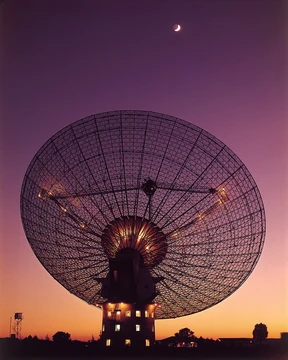
Atacama Large Millimeter Array
66-antenna interferometer observing millimeter and submillimeter wavelengths.
High in Chile's Atacama Desert, on a dry, 5,000-meter plateau, sits ALMA: 66 radio dishes working together as one giant telescope. This location's thin air and low humidity cut through atmospheric interference, letting it capture millimeter and submillimeter light. ALMA peers back to the universe's early star-forming era and zooms in on how stars and planets are born nearby.
Quick Facts
- Built
- 2013
Facts from the source article.
Did You Know?
- ALMA is the most expensive ground-based telescope in operation, costing about US$1.4 billion.
- The ALMA regional centre (ARC) serves as an interface between user communities and the Joint ALMA Observatory.
- The Joint ALMA Observatory (JAO) director since February 2018 is Sean Dougherty.
Overview
The initial ALMA array consists of 66 high-precision antennae operating at wavelengths of 3.6 to 0.32 millimeters (31 to 1000 GHz). It offers much higher sensitivity and resolution than earlier submillimeter telescopes such as the single-dish James Clerk Maxwell Telescope or interferometer networks like the Submillimeter Array and the IRAM Plateau de Bure facility. The antennae can be moved across the desert plateau over distances from 150 m to 16 km, providing a variable zoom similar to that of the Very Large Array in New Mexico. High sensitivity is achieved mainly through the large number of antenna dishes. The European and North American partners each provided twenty-five 12-meter diameter antennae, totaling fifty for the main array. East Asian countries contributed 16 antennae (four 12-meter and twelve 7-meter) as the Atacama Compact Array (ACA), which is part of the enhanced ALMA. The ACA uses smaller antennae to image larger fields of view at a given frequency, and placing them closer together enables imaging of sources with larger angular extent. The ACA works with the main array to enhance wide-field imaging capability. ALMA's conceptual roots lie in three projects: the Millimeter Array (MMA) of the United States, the Large Southern Array (LSA) of Europe, and the Large Millimeter Array (LMA) of Japan. In 1997, the National Radio Astronomy Observatory and the European Southern Observatory agreed to merge the MMA and LSA, combining the LSA's sensitivity with the MMA's frequency coverage and superior site.
Construction
The complex was built primarily by European, U.S., Japanese, and Canadian companies and universities. Three prototype antennae underwent evaluation at the Very Large Array since 2002. General Dynamics C4 Systems provided twenty-five 12 m antennae, while Thales Alenia Space provided the other twenty-five principal antennae. Mitsubishi Electric assembled NAOJ's 16 antennae, delivered from December 2008 to September 2013. Transporting the 115 tonne antennae from the Operations Support Facility at 2900 m altitude to the site at 5000 m, or moving them to change array size, used two custom 28-wheel self-loading heavy haulers made in Germany, each 10 m wide, 20 m long, 6 m high, weighing 130 tonnes, powered by twin turbocharged 500 kW diesel engines. The transporters feature a driver's seat accommodating an oxygen tank for the thin air. The first vehicle was completed and tested in July 2007; both were delivered to the ALMA Operations Support Facility in Chile on 15 February 2008. On 7 July 2008, a transporter moved an antenna for the first time from the assembly building to a pad for testing. During Autumn 2009, the first three antennae were transported to the Array Operations Site. By the end of 2009, three antennae were linked at the 5000 m site, completing the first stage of assembly and integration. Commissioning began on 22 January 2010.
Scientific results
By summer 2011, sufficient telescopes were operational for first images during testing before the Early Science phase. The target was the Antennae Galaxies, a pair of colliding galaxies; the result was the best submillimeter-wavelength image ever made of them, showing dense cold gas clouds where new stars form, invisible in visible light. On 11 August 2014, studies using ALMA detailed the distribution of HCN, HNC, H2CO, and dust inside the comae of comets C/2012 F6 (Lemmon) and C/2012 S1 (ISON). In 2014, an image of the protoplanetary disc around HL Tauri showed concentric bright rings separated by gaps, indicating protoplanet formation; most theories did not expect planetary formation in such a young system (100,000–1,000,000 years old), spurring renewed theories. In 2022, ALMA initiated exoALMA, a detailed survey of 15 protoplanetary disk systems to find still-forming exoplanets. ALMA discovered the proto-cluster SPT2349-56 using the Atacama Pathfinder Experiment telescope; it formed 12 billion years ago and was unusually hot for its stage, suggesting incomplete models of galaxy cluster development. ALMA participated in the Event Horizon Telescope project, producing the first direct image of a black hole in 2019. ALMA also participated in the claimed detection of phosphine in the atmosphere of Venus; later reanalyses cast doubt, though later analyses still confirmed the results, and the detection remains controversial awaiting additional measurements.
Project detail
At least 50 antennae of 12 m diameter are located at 5,000 m elevation at Llano de Chajnantor Observatory, enhanced by a compact array of 16 antennae (four 12-meter and twelve 7-meter). The instrument images in all atmospheric windows between 350 μm and 10 mm, with array configurations from about 150 m to 14 km. Spatial resolution is 10 milliarcseconds, 10 times better than the Very Large Array and 5 times better than the Hubble Space Telescope. It can image sources arcminutes to degrees across at one arcsecond resolution, with velocity resolution under 50 m/s. It is the largest and most sensitive instrument at millimeter and submillimeter wavelengths, with point source detection sensitivity 20 times better than the Very Large Array. Data reduction uses CASA (Common Astronomy Software Applications), based on AIPS++. The Atacama Compact Array (ACA), named the Morita Array after Professor Koh-ichiro Morita, consists of 16 closely separated antennae that improve ALMA's ability to study objects with large angular size, such as molecular clouds and nearby galaxies.
More in Radio Telescopes
Spotted an error? Know more?
Reader corrections go straight into our review queue. Suggest an edit · How this site is sourced