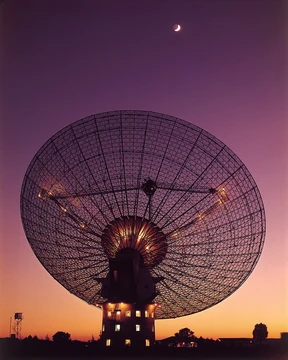
Australian Square Kilometre Array Pathfinder
A radio telescope array using phased-array feed technology for wide-field surveys.
The Australian Square Kilometre Array Pathfinder (ASKAP) is a radio telescope array at Inyarrimanha Ilgari Bundara, the CSIRO Murchison Radio-astronomy Observatory in Western Australia. It began as a technology demonstrator for the international Square Kilometre Array and is operated by CSIRO as part of the Australia Telescope National Facility. The facility is notable for its use of phased-array feed technology, which provides a wide field of view and fast survey speed.
Quick Facts
- Location
- Inyarrimanha Ilgari Bundara, CSIRO Murchison Radio-astronomy Observatory, Mid West region, Western Australia
- Number of antennas
- 36
- Antenna diameter
- 12 m / 39 ft 4 in
- Total collecting area
- approximately 4,000 m²
- Construction started
- 2009
- Construction completed
- 2019
- First light
- October 2012
Facts from the source article.
Did You Know?
- The ASKAP site has been selected as one of the SKA's two central locations.
- The Survey Science Projects occupy at least 75% of the observing time.
Design
ASKAP was built to scan the sky quickly, with a broad view, wide frequency range, and many antenna pairs working at once. Its hardest engineering problem was creating phased array feeds, a technology never before used in radio astronomy, which also produced the highest data rate any radio telescope had ever handled. The telescope sits in Western Australia’s Murchison district, an area so sparsely populated that human-made radio noise is minimal; this quietness is legally protected as a natural asset. Signals from the dishes travel to a supercomputer at the Pawsey Supercomputing Research Centre in Perth, where custom software processes them almost instantly. After the ten ASKAP Survey Science Teams finish quality checks, all data become available to the public.
Observatory Projects
From 2019 onwards, ASKAP conducted a rapid survey of the entire sky up to declination +40°, known as RACS, to provide a shallow model of the radio sky for calibration of subsequent deep surveys and as a valuable resource. With typical rms sensitivity of 0.2–0.4 mJy/beam and spatial resolution of 15–25 arcsec, RACS is significantly deeper and higher resolution than comparable surveys like NVSS and SUMMS, but shallower than EMU. The survey initially mapped three million galaxies in 300 hours, a million of which are new. RACS consists of three sub-projects: RACS-low centred on 887.5 MHz with resolution about 18 × 12 arcsec; RACS-mid centred on 1367.5 MHz with resolution about 10 × 8 arcsec; and RACS-high centred on 1655.5 MHz with resolution about 9 × 6 arcsec. LOTRUN is an observatory-led project using the ASKAP CRACO high-time resolution facility to search for time-variable radio sources at sub-second timescales, probing the Galactic radio sky. It repeatedly observes several tracks towards the inner Galactic plane, spending several hours on each, providing an unbiased survey for studies such as long-period transient searches. All LOTRUN data are placed in the public domain as soon as processed and validated.
Construction and operational phases
Construction of ASKAP started in 2009. Once six antennas were completed and equipped with phased-array feeds and backend electronics, the array was named the Boolardy Engineering Test Array (BETA). BETA operated from March 2014 to February 2016 and was the first aperture synthesis radio telescope to use phased array feed technology, enabling formation of up to nine dual-polarisation beams. Astronomical observations with BETA tested the phased array feeds and aided commissioning of the final telescope. The first prototype phased-array feeds proved the concept but had suboptimal performance. In 2013–2014, while BETA operated, significant sections of ASKAP were redesigned in the ASKAP design enhancement (ADE) to improve performance. Changes included improving the receiver design for a lower system temperature constant across bandwidth; replacing FPGA chips with faster, lower-power chips; replacing the water cooling system with a Peltier temperature stabilisation system; replacing coaxial signal transmission with direct modulation of radio frequency signals onto optical signals over optical fibre; and replacing the complex radio-frequency signal conversion system with a direct sampling system. Although the ADE delayed completion, the resulting system had better performance, lower cost, and higher reliability. The first ADE PAF was installed in August 2014; by April 2016, nine ADE PAFs and the new ADE correlator were installed, with more PAFs added over subsequent years. From 2015 until 2019, a series of ASKAP Early Science Projects were observed across all astrophysics areas, demonstrating capabilities, providing data for technique development, and evaluating system performance. The early science program produced several peer-reviewed papers and helped commission the instrument and guide planning of main survey projects.
More in Radio Telescopes
Spotted an error? Know more?
Reader corrections go straight into our review queue. Suggest an edit · How this site is sourced