Nowruz
Last updated

U.S. Department of State · Public domain
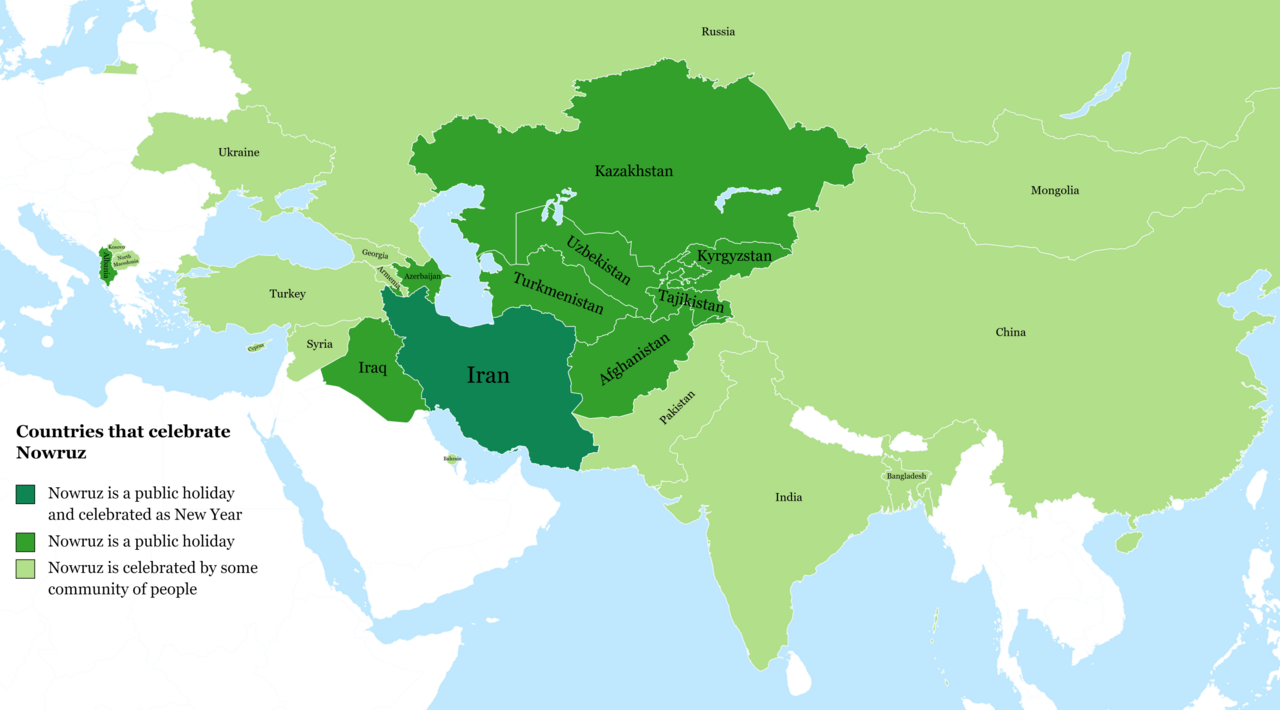
Nowruz is the New Year's Day on the Iranian Solar Hijri calendar, timed to the Northern Hemisphere spring equinox between 19 and 22 March.[1][2] It has been celebrated for over 3,000 years across West Asia, Central Asia, the Caucasus, the Balkans, and South Asia, rooted in Zoroastrianism.[3] In February 2010, the United Nations General Assembly passed Resolution 64/253, which officially recognized an "International Day of Nowruz".[4]
Key facts and history
The mythical Iranian King Jamshid is credited in the Shahnameh with founding Nowruz by constructing a gem-studded throne to save mankind from a killer winter.[5] In Azerbaijan, preparation for Novruz begins a month earlier, with each of four Tuesdays dedicated to water, fire, earth, and wind.[6] Nowruz and the mid-winter festival Sadeh continued to be observed after the Muslim conquest of Persia in 650 CE, and during the Abbasid period Nowruz became the primary royal holiday.[7] The Haft-sin table traditionally contains seven items whose Persian names start with the letter sin (س): sabze (sprouted grains), samanu (sweet wheat pudding), senjed (Persian olive), serke (vinegar), sib (apple), sir (garlic), and somaq (sumac).[8]
What the cited sources add
Shahbazi also noted that in 10th-century Isfahan, people gathered for seven days in the bazaar of Karina, enjoying food and visiting decorated shops.[9] The historian Gardizi, in his work Zayn al-Akhbār, mentioned that Zoroaster highly emphasized the celebration of Nowruz and Mehrgan.[10]
References
- Wikipedia, "Nowruz" (CC BY-SA 4.0), which cites: Foltz, "The 'Original' Kurdish Religion? Kurdish Nationalism and the False Conflation of the Yezidi and Zoroastrian Traditions", Journal of Persianate Studies, 2017, p. 93, 95; Boyce; "What the 3,500-year-old holiday of Nowruz can teach us in 2024", www.bbc.com, 18 March 2024 (original not read by us) en.wikipedia.org
- Wikipedia, "Nowruz" (CC BY-SA 4.0), which cites: "International Nowruz Day", United Nations (original not read by us) en.wikipedia.org
- Wikipedia, "Nowruz" (CC BY-SA 4.0), which cites: "General Assembly Recognizes 21 March as International Day of Nowruz, Also Changes to 23–24 March Dialogue on Financing for Development – Meetings Coverage and Press Releases", UN; J. Gordon Melton, "Religious Celebrations: An Encyclopedia of Holidays, Festivals, Solemn Observances, and Spiritual Commemorations [2 volumes]: An Encyclopedia of Holidays, Festivals, Solemn Observances, and Spiritual C; "What the 3,500-year-old holiday of Nowruz can teach us in 2024", 18 March 2024; "Nowruz: All you need to know about the 3500-yr old Persian festiva en.wikipedia.org
- Wikipedia, "Nowruz" (CC BY-SA 4.0), which cites: "64/253: International Day of Nowruz", undocs.org, 23 February 2010; "International Day of Nowruz", United Nations, 18 February 2010 (original not read by us) en.wikipedia.org
- Wikipedia, "Nowruz" (CC BY-SA 4.0), which cites: "Moazami, M. "The Legend of the Flood in Zoroastrian Tradition." Persica 18: 55–74, (2002) Document Details" (original not read by us) en.wikipedia.org
- Wikipedia, "Nowruz" (CC BY-SA 4.0), which cites: "International Day of Nowruz- 21 March", Azerbaijani Embassy to Kuwait, 17 March 2010; "Nowruz most cheerful, popular holiday in Azerbaijan", Mehr News Agency, March 23, 2022; "Novruz", UNESCO (original not read by us) en.wikipedia.org
- Wikipedia, "Nowruz" (CC BY-SA 4.0), which cites: Dehqān iranicaonline.org (original not read by us) en.wikipedia.org
- Wikipedia, "Nowruz" (CC BY-SA 4.0), which cites: Campo, "Navruz", Infobase Publishing, 2009, p. 524–525 (original not read by us) en.wikipedia.org
- "A. Shapur Shahbazi, "Nowruz: In the Islamic period"", Iranicaonline.org. iranicaonline.org
- Wikipedia, "Nowruz" (CC BY-SA 4.0), which cites: برگرفته از: "گنجينهي سخن"، تأليف دكتر ذبيح الله صفا، انتشارات اميركبير، 1370، جلد يكم، ص 292; Gardīzī, Abu Saʿīd ʿAbd-al-Ḥayy b. Żaḥḥāk b. Maḥmūd in Encyclopedia Iranica by C. Edmund Bosworth Iranica on line; Tārīkh-i Gardīzī / taʾlīf, Abū Saʻīd ʻAbd al-Ḥayy ibn Zahāk ibn Maḥmūd Gardīzī ; bih taṣḥīḥ va taḥshiyah va taʻlīq, ʻAbd al-Ḥayy Ḥabībī. Tihrān : Dunyā-yi Kitāb (we also read that source) en.wikipedia.org
Each numbered sentence above was checked against the source it cites before publication. Sentences citing Wikipedia adapt text from the English Wikipedia article Nowruz (contributors), used under CC BY-SA 4.0; this entry is available under the same licence. Other sources were used for facts only.
More in Public Holidays & Observances
Sources
Compiled from Wikipedia and the sources listed below. Text from Wikipedia is available under CC BY-SA 4.0; this entry is adapted from it.
- Wikipedia: Nowruz (CC BY-SA 4.0).
Spotted an error? Know more?
Reader corrections go straight into our review queue. Suggest an edit · How this site is sourced