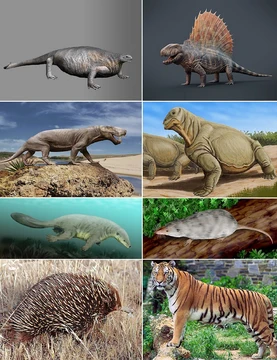
Synapsida
Clade including mammals and their extinct relatives.
Last updated
Non-mammalian synapsids were historically described as mammal-like reptiles in classical systematics.[1][2] All mammals and their extinct relatives constitute the tetrapod vertebrate group Synapsida.[3]
Scientific classification
- KingdomAnimalia
- PhylumChordata
- CladeSynapsida
Named by Osborn, 1903
Sources: Wikipedia taxobox: Synapsida (CC BY-SA 4.0)
Last updated 2026-09-30 from the source article.
Quick Facts
- Earliest appearance
- End of the Carboniferous, around 315 to 307 million years ago
- Dominant period
- Permian (299 to 251 mya)
- Key feature
- Single lower temporal fenestra
- Sister group
- Sauropsida
- Extant members
- Mammals (roughly 6,800 species)
- Notable extinct groups
- Pelycosaurs, therapsids (including dicynodonts and eutheriodonts)
Facts from the source article.
What the cited sources add
The Naish Scientific American Blog Network account notes that the term "mammal-like reptiles" should be avoided because the animals are not part of the reptile lineage.[2] That same source explains that early members of the mammal lineage have often been called pelycosaurs, while more mammal-like members are termed therapsids.[2] The Grossnickle study states that faunivory is the typical ancestral diet of each major radiation within Synapsida.[8] That study also finds that the small-to-large trend in body-size within radiations does not become established until the end-Triassic size bottleneck near the base of Mammaliaformes.[8]
The Tree of Life Web Project provides a phylogenetic diagram showing relationships among Synapsida, Testudines, and Diapsida.[9]
References
- Wikipedia, "Synapsida" (CC BY-SA 4.0), which cites: Carroll, Robert L., "Vertebrate Paleontology and Evolution", W.H. Freeman & Co., 1988, p. 397; D. W. Dilkes, R. R. Reisz, "First Record of a Basal Synapsid ('Mammal-Like Reptile') in Gondwana", Proceedings of the Royal Society B, 1996, p. 1165–1170; Benton, Michael J., "Vertebrate Palaeontology", Blackwell Science Ltd, 2005, p. 122; "Jaws to ears in the ancestors of mammals", evolution.berkeley.edu; "New proto-mammal fossil sheds light on evolution of earliest mammals", University of Chicago, August 7, 2013; Naish, "The Stem-Mammals--a Brief en.wikipedia.org
- Naish, "The Stem-Mammals--a Brief Primer", Scientific American Blog Network. facts only, no text reused. blogs.scientificamerican.com
- Wikipedia, "Synapsida" (CC BY-SA 4.0), which cites: Pough, "Vertebrate Life", Pearson, 2013, p. 448 (we also read that source) en.wikipedia.org
- Wikipedia, "Synapsida" (CC BY-SA 4.0), which cites: Benton, "When Life Nearly Died: The greatest mass extinction of all time", Thames & Hudson, 2006; Cokinos, "The consolations of extinction", 12 October 2007 (original not read by us) en.wikipedia.org
- Wikipedia, "Synapsida" (CC BY-SA 4.0), which cites: Pardo, "Can We Reliably Calibrate Deep Nodes in the Tetrapod Tree? Case Studies in Deep Tetrapod Divergences", Frontiers in Genetics, 2020-10-16 (original not read by us) en.wikipedia.org
- Wikipedia, "Synapsida" (CC BY-SA 4.0), which cites: "Greatest mass extinction responsible for the making of modern mammals", The National Museum [of South Africa], 19 September 2013 (original not read by us) en.wikipedia.org
- Wikipedia, "Synapsida" (CC BY-SA 4.0), which cites: Grossnickle, "Survival of the novel: derived faunivores are the forerunners of major synapsid radiations", Journal of Vertebrate Paleontology, 1 October 2022 (we also read that source) en.wikipedia.org
- Grossnickle, "Survival of the novel: derived faunivores are the forerunners of major synapsid radiations", Journal of Vertebrate Paleontology, 1 October 2022. facts only, no text reused. par.nsf.gov
- "Synapsida: Mammals and their extinct relatives", The Tree of Life Web Project, 2011. facts only, no text reused. tolweb.org
Each numbered sentence above was checked against the source it cites before publication. Sentences citing Wikipedia adapt text from the English Wikipedia article Synapsida (contributors), used under CC BY-SA 4.0; this entry is available under the same licence. Other sources were used for facts only; no text or images are copied from them.
More in Prehistoric Synapsids
Related in Prehistoric Synapsids
Links follow this subject's own source article.
Sources
Compiled from Wikipedia and the sources listed below. Text from Wikipedia is available under CC BY-SA 4.0; this entry is adapted from it.
- Wikipedia: Synapsida (CC BY-SA 4.0).
- Word definitions: the Codexery glossary, each quoted from its Wikipedia article.
Spotted an error? Know more?
Reader corrections go straight into our review queue. Suggest an edit · How this site is sourced