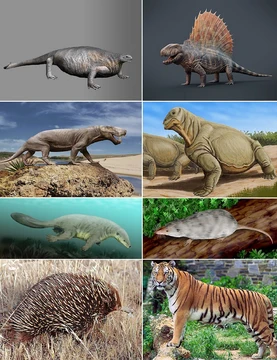
Mammaliaformes
Clade of synapsid tetrapods including mammals and extinct relatives.
Last updated

Theklan FunkMonk Nobu Tamura ( spinops.blogspot.com ) Nobu Tamura ( http: · CC BY 3.0
The clade is defined as originating from the most recent common ancestor of Morganucodonta and the crown group mammals.[1] The clade Mammaliaformes, which includes crown group mammals and their extinct relatives, emerged from probainognathian cynodonts in the Late Triassic.[1]

Scientific classification
- KingdomAnimalia
- PhylumChordata
- CladeSynapsida
- CladeTherapsida
- CladeMammaliaformes
Named by Rowe, 1988
Sources: Wikipedia taxobox: Mammaliaformes (CC BY-SA 4.0)
Quick Facts
- Field
- Paleontology
- Key inclusions
- Morganucodonta
- Docodonta
- Hadrocodium
- crown group mammals
- Time period
- Late Triassic to present (crown group mammals from Jurassic)
Facts from the source article.
What the cited sources add
A 2001 book by Colbert published by Wiley described early mammaliaforms as shrew-like and noted their unique jaw and tooth structure.[8][3] Timothy Rowe's 1988 paper in the Journal of Vertebrate Paleontology introduced Mammaliaformes as a phylogenetic term and distinguished it from Mammalia, which is based on traits.[9][1][2] Ruben and Jones's 2000 paper in American Zoologist linked the harderian gland in early mammaliaforms to the presence of fur.[10][6] Oftedal's 2002 paper in the Journal of Mammary Gland Biology and Neoplasia noted that Sinoconodon, a relatively derived form, appears to have uniquely abandoned milk production.[11][12]
Kemp's 2005 book from Oxford University Press noted that Hadrocodium's lower jaw lacks the multiple bones found in reptiles.[13][14]
References
- Wikipedia, "Mammaliaformes" (CC BY-SA 4.0), which cites: Abdala, "Redescription of Platycraniellus Elegans (Therapsida, Cynodontia) from the Lower Triassic of South Africa, and the cladistic relationships of eutheriodonts", Palaeontology, 2007, p. 591–618; Rowe, "Definition, diagnosis, and origin of Mammalia", Journal of Vertebrate Paleontology, 1988, p. 241–264; Luo, "Analysis of Molar Structure and Phylogeny of Docodont Genera", Bulletin of Carnegie Museum of Natural History, 2007, p. 27–47; Datta, "Earliest mammal with transversely expanded upper molar from the Late Triassic (Carnian) en.wikipedia.org
- Wikipedia, "Mammaliaformes" (CC BY-SA 4.0), which cites: Rowe, "Definition, diagnosis, and origin of Mammalia", Journal of Vertebrate Paleontology, 1988, p. 241–264 (we also read that source) en.wikipedia.org
- Wikipedia, "Mammaliaformes" (CC BY-SA 4.0), which cites: Colbert, "Colbert's evolution of the vertebrates: a history of the backboned animals through time", Wiley, 2001 (we also read that source) en.wikipedia.org
- Wikipedia, "Mammaliaformes" (CC BY-SA 4.0), which cites: Line, "The development and evolution of mammalian enamel: Structural and functional aspects", Brazilian Journal of Morphological Sciences, 2005, p. 67–72 (original not read by us) en.wikipedia.org
- Wikipedia, "Mammaliaformes" (CC BY-SA 4.0), which cites: Panciroli E., Benson RBJ., and Walsh S. 2017. The dentary of Wareolestes rex (Megazostrodontidae): a new specimen from Scotland and implications for morganucodo; Hu, Yaoming; Meng, Jin; Clark, James M. "A New Tritylodontid from the Upper Jurassic of Xinjiang, China". Acta Palaeontologica Polonica. 54 (3): 385–391. . (we also read that source) en.wikipedia.org
- Wikipedia, "Mammaliaformes" (CC BY-SA 4.0), which cites: "Selective Factors Associated with the Origin of Fur and Feathers", American Zoologist, 2000, p. 585–596 (we also read that source) en.wikipedia.org
- Wikipedia, "Mammaliaformes" (CC BY-SA 4.0), which cites: Zofia Kielan-Jaworowska, Richard L. Cifelli, Zhe-Xi Luo, "Mammals from the Age of Dinosaurs: origins, evolution, and structure", Columbia University Press, 2004, p. 216–248; Kielan−Jaworowska, Z. and Hurum, J.H. 2006. Limb posture in early mammals: Sprawling or parasagittal. Acta Palae− ontologica Polonica 51 (3): 393–406. (we also read that source) en.wikipedia.org
- Open Library record, ISBN 9780471384618 ("Colbert's evolution of the vertebrates"). CC0 (metadata); book content not read. openlibrary.org
- Timothy Rowe, "Definition, diagnosis, and origin of Mammalia", Journal of Vertebrate Paleontology (1988), doi:10.1080/02724634.1988.10011708. OpenAlex metadata CC0; paper not read. doi.org
- John A. Ruben, "Selective Factors Associated with the Origin of Fur and Feathers", American Zoologist (2000), doi:10.1093/icb/40.4.585. OpenAlex metadata CC0; paper not read. doi.org
- Olav T. Oftedal, "The Mammary Gland and Its Origin During Synapsid Evolution", Journal of Mammary Gland Biology and Neoplasia (2002), doi:10.1023/a:1022896515287. OpenAlex metadata CC0; paper not read. doi.org
- Wikipedia, "Mammaliaformes" (CC BY-SA 4.0), which cites: Oftedal, "The mammary gland and its origin during synapsid evolution", Journal of Mammary Gland Biology and Neoplasia, 2002, p. 225–252 (we also read that source) en.wikipedia.org
- Open Library record, ISBN 0198507607 ("The origin and evolution of mammals"). CC0 (metadata); book content not read. openlibrary.org
- Wikipedia, "Mammaliaformes" (CC BY-SA 4.0), which cites: Kemp, "The Origin and Evolution of Mammals", Oxford University Press, 2005, p. 149 (we also read that source) en.wikipedia.org
Each numbered sentence above was checked against the source it cites before publication. Sentences citing Wikipedia adapt text from the English Wikipedia article Mammaliaformes (contributors), used under CC BY-SA 4.0; this entry is available under the same licence. Other sources were used for facts only; no text or images are copied from them.
More in Prehistoric Synapsids
Sources
Compiled from Wikipedia and the sources listed below. Text from Wikipedia is available under CC BY-SA 4.0; this entry is adapted from it.
- Wikipedia: Mammaliaformes (CC BY-SA 4.0).
- Word definitions: the Codexery glossary, each quoted from its Wikipedia article.
Spotted an error? Know more?
Reader corrections go straight into our review queue. Suggest an edit · How this site is sourced