Last and First Men (film)
A black-and-white film of Yugoslav memorials, narrated by Tilda Swinton.

Last and First Men is a 2020 science fiction film from Iceland, spoken in English, directed by Jóhann Jóhannsson. He co-wrote the script with José Enrique Macián, adapting Olaf Stapledon’s 1930 novel of the same name. This was Jóhannsson’s only feature film as a director; he was a composer who died from an overdose two years before the film came out. The movie premiered at the 70th Berlin International Film Festival on 25 February 2020, and was released digitally on 30 July in the United Kingdom by BFI Distribution. Critics widely praised it.
Quick Facts
- Director
- Jóhann Jóhannsson
- Producer
- Þór Sigurjónsson
- Screenplay
- Jóhann Jóhannsson / José Enrique Macián
- Based On
- Last and First Men · Olaf Stapledon
- Narrator
- Tilda Swinton
- Music
- Jóhann Jóhannsson / Yair Elazar Glotman
- Cinematography
- Sturla Brandth Grøvlen
- Editing
- Mark Bukdahl
- Studio
- Zik Zak Filmworks / Icelandic Film Centre
- Distributor
- Films Boutique (international) / BFI Distribution (United Kingdom)
- Runtime
- 70 minutes
- Country
- Iceland
Facts from the source article.
Lore & Background
In 2020, a film of this work was released as Jóhann's debut and final directorial work. Composer and sound artist Yair Elazar Glotman completed the work after Jóhann's death in February 2018. The film was shot at numerous World War II monuments and memorials in former Yugoslavia, including locations in Croatia, Bosnia and Herzegovina, Serbia, Kosovo, Montenegro, and others. The film's soundtrack, co-composed by Jóhann and Yair Elazar Glotman, was released by Deutsche Grammophon on 28 February 2020.
Reader's Guide
Last and First Men holds significance as the only feature film directed by acclaimed Icelandic composer Jóhann Jóhannsson, who died two years before its release. The film adapts Olaf Stapledon's 1930 speculative novel, using black-and-white footage of Yugoslav World War II memorials to evoke a future history of humanity. Its critical reception was uniformly positive, with a 100% approval rating on Rotten Tomatoes and a Metacritic score of 80, indicating generally favorable reviews. The film's production was completed posthumously by Yair Elazar Glotman, and its release on 30 July 2020 by BFI Distribution in the United Kingdom brought Jóhannsson's directorial vision to a wider audience. The work stands as a meditation on time, memory, and the legacy of monumental architecture, blending Jóhannsson's compositional background with visual storytelling.
Did You Know?
- The film is based on the 1930 novel of the same name by English author Olaf Stapledon.
- It is the only feature film directed by Jóhann Jóhannsson, who died of an overdose two years before its release.
- The soundtrack was co-composed by Jóhann Jóhannsson and Yair Elazar Glotman, and released by Deutsche Grammophon on 28 February 2020.
Positioning Within the Apocalyptic Canon
The film occupies a space within one of speculative fiction's most enduring subgenres, where the central premise involves either the active collapse of civilization or the aftermath of such a collapse. In this tradition, the triggering catastrophe can take countless forms—whether it is a runaway shift in climate, a collision from space, the detonation of nuclear arsenals, the exhaustion of essential resources, a sweeping pandemic, a theological reckoning, or even scenarios as varied as the rise of sentient machines or the arrival of extraterrestrial forces. What unites these narratives is their focus on the human condition under extremity: the psychological toll on those who endure, the struggle to preserve the species, and the question of how scattered survivors might hold themselves together as a single community. Many such stories, including the one this film draws upon, are set in futures where technology has largely vanished or exists only in fragmented, unreliable traces, forcing characters to confront existence in a world stripped of the structures they once took for granted.
The Ruined Earth and Thematic Breadth
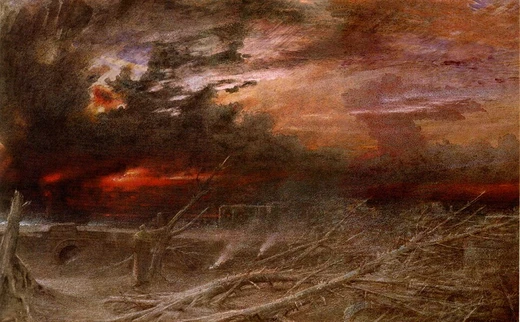
The narrative territory this film inhabits is defined by a remarkable range of possible catastrophes and their lingering aftermath. Beyond the immediate event itself—whether it is a plague, a divine judgment, an ecological unraveling, or a technological runaway—stories in this mode often dwell on the longer reverberations. A particularly powerful visual and conceptual motif is what critics have termed the "ruined Earth": the image of technological artifacts jutting into a far more primitive landscape, serving as haunting reminders of a world that once was. This iconography has been called one of the most potent in all of science fiction. The temporal setting can shift dramatically, from the immediate, raw aftermath where survivors grapple with trauma and the desperate mechanics of survival, to a much later era in which the very existence of the pre-catastrophe civilization has faded into myth or been entirely forgotten. The film's thematic architecture, like the broader genre it belongs to, can also encompass cybernetic uprisings, dysgenic decline, supernatural forces, or the convergence of multiple disaster vectors into a single terminal event.
Mythological Ancestors of the End-of-World Story
Long before the genre was codified in modern literature, the impulse to narrate the end of the world and its renewal was embedded in the mythologies of ancient civilizations. In Mesopotamia, texts dating to roughly 2000–1500 BCE, including the Eridu Genesis and the Epic of Gilgamesh, describe wrathful deities unleashing floods to punish humankind, with a chosen hero and his family spared through divine intervention. The Biblical tradition offers parallel structures: the story of Noah and his ark, in which a corrupt civilization is wiped out and a new world is seeded from a saved remnant, and the destruction of Sodom and Gomorrah, where the daughters of Lot, believing they are the last humans alive, resort to an extreme act to ensure the species continues—a dilemma that echoes directly in modern post-apocalyptic narratives. Hindu scripture, particularly the Matsya Purana, tells of a cosmic deluge from which King Manu is saved by Vishnu in the form of a horned fish, carrying seeds, animals, and sages to repopulate the earth. The Norse Völuspá similarly charts a world consumed by fire and flood in Ragnarök, only for a renewed earth to emerge with a surviving pair. These ancient cycles of destruction and rebirth form the deep structural grammar that the film's genre continues to draw upon.
From Antiquity to Atomic Anxiety: The Genre's Evolution
The trajectory of apocalyptic storytelling reveals a remarkable arc from ancient oral and written traditions to a genre that achieved mass cultural dominance in the twentieth century. While recognizable modern novels in this mode existed as early as the first third of the 1800s—Mary Shelley's The Last Man, published in 1826, is frequently cited as a landmark—the form did not achieve its current ubiquity until the aftermath of the Second World War. The detonation of atomic weapons introduced the very real possibility of total human annihilation into the collective imagination, and with it, an urgent creative response. The genre's earlier iterations, rooted in religious texts like the Book of Revelation or in pagan cosmologies like the Norse Eddas, often carried a tone of divine justice or cyclical renewal rather than existential dread. The post-war shift transformed the apocalypse from a theological or mythological event into a secular, technologically plausible scenario, broadening the genre's emotional palette and its audience. The film exists within this long continuum, inheriting both the ancient structural patterns of destruction-and-rebirth and the modern anxiety about human-made catastrophe that defined the genre's golden age of popular engagement.
Frequently Asked Questions
What is Last and First Men (2020)?
It is a 2020 Icelandic science-fiction film presented in black-and-white, narrated by Tilda Swinton, and composed entirely of footage of Yugoslav memorials. Jóhann Jóhannsson directed the project, adapting Olaf Stapledon's 1930 novel of the same name into a visual meditation on deep time.
Who directed Last and First Men and what is the backstory?
Jóhann Jóhannsson, widely known as a film and classical composer, directed the movie and co-wrote its script with José Enrique Macián. It stands as his only feature-length directorial work, arriving in theaters two years after his death from an overdose.
What is Last and First Men based on?
The film is an adaptation of Olaf Stapledon's 1930 speculative novel, which charts the far-future trajectory of the human species. Jóhannsson translated the book's sweeping, millennia-spanning narrative into a contemplative sequence of monumental architecture and Swinton's spoken narration.
Where and when was Last and First Men released?
It had its world premiere at the 70th Berlin International Film Festival on 25 February 2020. In the United Kingdom, BFI Distribution issued a digital release on 30 July 2020.
How did critics receive Last and First Men?
Reviews were broadly laudatory, with critics singling out the film's meditative pacing and the striking pairing of Swinton's narration against the stark geometry of Yugoslav memorial sites. It is often cited as a haunting, elegiac farewell from Jóhannsson.
More in Post-apocalyptic films 1-18
Spotted an error? Know more?
Reader corrections go straight into our review queue. Suggest an edit · How this site is sourced