Falco (musician)
Austrian pop-rock star known for "Rock Me Amadeus" and "Der Kommissar".
Last updated

via Wikipedia: Falco (musician) · see source
Johann "Hans" Hölzel (19 February 1957 – 6 February 1998), known professionally as Falco—a name he took from Falko Weißpflog—was an Austrian singer. His international hits include "Der Kommissar" (1981), "Rock Me Amadeus", "Vienna Calling", "Jeanny", "The Sound of Musik", "Coming Home (Jeanny Part II, One Year Later)", and the posthumous single "Out of the Dark".
In 1986, "Rock Me Amadeus" became the only German-language song ever to reach number one on the U.S. Billboard charts. His estate reports that he sold 20 million albums and 40 million singles, making him the best-selling Austrian singer of all time. Falco died in a car crash at age 40 in 1998.

Lore & Background
Johann Hölzel was born on 19 February 1957 to Maria (née Saurer) and Alois Hölzel. Maria said that she had been pregnant with triplets. As it was a dizygotic pregnancy, she had a miscarriage of the identical twins during the third month and Falco, who was conceived via a separate ovum, survived. He began school in 1963 at a Roman Catholic public school; at age ten he switched to the Rainergymnasium.
His father left the family when he was a child, and he was raised by his mother. He showed early musical talent, keeping time with drumbeats as a toddler, and received a child's grand piano at age four and a record player at age five. At 16 he attended the Vienna Conservatoire but left frustrated. He then began an apprenticeship with the Österreichische Bundesbahnen, which also lasted a short time.

Early career
At seventeen he entered military service in the Austrian army for eight months. In the late 1970s he played bass guitar in several bands under pseudonyms including "John Hudson" and "John DiFalco". From 1977 to early 1979 he was bassist of the Hallucination Company, during which he adopted his stage name Falco, from Falko Weißpflog. In 1979 he joined Drahdiwaberl, then became a member of Spinning Wheel, where he began singing.
Solo artist
In May 1979 he recorded demos from which a single was released posthumously 28 years later. His performance of "Ganz Wien" led to manager Markus Spiegel signing him in 1981. He became a solo artist in 1981. His first single "Helden von heute" was set aside in favor of B-side "Der Kommissar", which became a number-one success in several countries.

His album Einzelhaft topped charts in Austria and the Netherlands. His second album Junge Roemer (1984) charted only in Austria. He then worked with Rob and Ferdi Bolland, recording "Rock Me Amadeus" (1986), which reached No. 1 in over a dozen countries including the US, UK, and Japan. His album Falco 3 peaked at No. 3 on the Billboard album charts. "Vienna Calling" peaked at No. 18 on the Billboard Charts. "Jeanny" was controversial in Germany and the Netherlands.
The album Emotional (1986) included "Coming Home (Jeanny Part II, One Year Later)", "The Kiss of Kathleen Turner", and "Kamikaze Capa". In 1987 he went on the Emotional world tour and sang a duet with Brigitte Nielsen, "Body Next to Body". He released Wiener Blut in 1988. His 1992 album Nachtflug was successful only in Austria.

A Working-Class Boy with a Pop Star's Ambition
Johann Hölzel was born on 19 February 1957 in Margareten, a working-class district of Vienna. His mother, Maria née Saurer, worked as a laundry branch manager in Burgenland; his father, Alois, was a machine factory foreman from Lower Austria. By Maria's telling, the pregnancy was originally a triplet one, but the dizygotic twins were lost in the third month, leaving only the separately conceived Johann to survive.
His father left the family while he was still a young child, and Maria raised him on her own. Musical aptitude surfaced almost before he could walk: as a toddler he tapped along to drumbeats on the radio, and his fourth birthday brought a small grand piano. A year later he received a record player and devoured records by Elvis Presley, Cliff Richard, and the Beatles. The desire to become a pop star was fixed from that age.

At sixteen he tried the Vienna Conservatoire but abandoned it in frustration. His mother steered him toward an apprenticeship at the Austrian employee pension insurance institute, which also ended quickly. At seventeen he completed eight months of Austrian army service, an episode that would later influence his sharp, clean-cut stage persona.
Vienna's Underground and the Birth of a Sound
In the late 1970s, Hölzel plunged into Vienna's nocturnal subculture, where music, striptease, performance art, and political satire collided in a celebration of chaos. He played bass under pseudonyms such as "John Hudson" and "John DiFalco," and from 1977 into early 1979 he anchored the Austrian rock group the Hallucination Company, where he first adopted the stage name Falco, drawn from Falko Weißpflog. Despite his deep ties to the underground club scene, his appearance was orderly: short military-cut hair, Ray-Ban Wayfarer sunglasses, and tailored suits set him apart from the shabbier fashions around him. His work with the Hallucination Company inspired Stefan Weber to rework his anarcho-punk band Drahdiwaberl, and in 1979 Falco was invited to join.
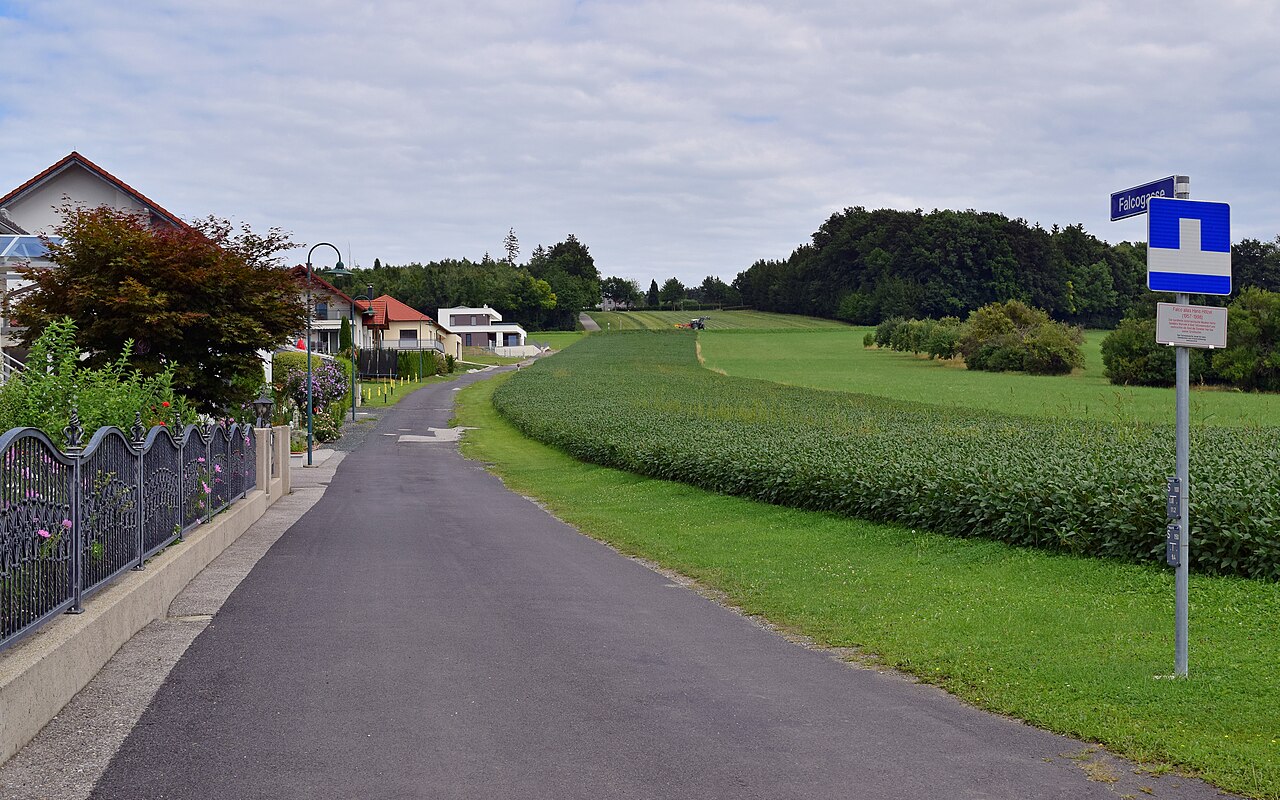
He then moved into Spinning Wheel, a Drahdiwaberl side project, where he made the pivotal shift from bassist to vocalist and began forging his own musical identity. In May 1979 he recorded early demos in a studio; one of those sketches would not surface as a single until twenty-eight years after his death. His live performance of "Ganz Wien"—a track whose lyrics cheekily proclaimed that all of Vienna was on heroin—caught the attention of manager Markus Spiegel, who offered him a solo contract in 1981.
From "Der Kommissar" to "Rock Me Amadeus"
After his large ego made group collaboration untenable, Falco went solo in 1981, writing his own material with songwriter Robert Ponger. Manager Horst Bork passed on the intended debut single "Helden von heute" but championed the B-side, "Der Kommissar," a German-language track blending rap verses with a sung chorus. Falco was hesitant—rap was still rare in Western Europe—but Bork insisted.
The song became a number-one hit in Germany, France, Italy, Spain, and Japan, though it failed to crack the UK or US charts. After the Fire's English cover reached number five on the Billboard Hot 100, and Laura Branigan recorded her own version. The album Einzelhaft topped charts in Austria and the Netherlands. The follow-up, Junge Roemer (1984), reached number one in Austria but faltered abroad.
Responding to the setback, Falco began writing in English, parted with Ponger, and enlisted the Dutch production duo Rob and Ferdi Bolland. Their collaboration yielded "Rock Me Amadeus," inspired by the Oscar-winning film, which became a worldwide phenomenon in 1986. It hit number one in over a dozen countries, held the top of the Billboard Hot 100 for three weeks, and made Falco the only artist to top the US chart with a German-language song.
A Legacy Measured in Millions, Cut Short at Forty
According to his estate, Falco sold 20 million albums and 40 million singles over his career, a record that cements his status as the best-selling Austrian singer of all time. His catalog of international hits—spanning "Der Kommissar," "Rock Me Amadeus," "Vienna Calling," "Jeanny," "The Sound of Musik," and "Coming Home (Jeanny Part II, One Year Later)"—demonstrates a remarkable range across pop, rock, and electronic styles, all filtered through a distinctive Viennese sensibility. Yet his story ended abruptly on 6 February 1998, when he died in a traffic collision at the age of forty, thirteen days before his forty-first birthday.
The loss stunned fans across the globe and left a body of work that continues to resonate. Even after his death, his music found new audiences: "Out of the Dark" was released posthumously, and early studio sketches from 1979 surfaced as a single twenty-eight years later. For Austria, Falco remains a cultural touchstone—a working-class boy from Margareten who defied expectations, broke language barriers on the world's biggest charts, and left behind a legacy that no subsequent Austrian artist has matched in commercial reach.
More in Pop & Rock
Test yourself
Three questions drawn from this entry’s sources. Pick an answer to check it.
Answers checked against the source article
Sources
Compiled from Wikipedia and the sources listed below. Text from Wikipedia is available under CC BY-SA 4.0; this entry is adapted from it.
- Wikipedia: Falco (musician) (CC BY-SA 4.0).
- Word definitions: the Codexery glossary, each quoted from its Wikipedia article.
Spotted an error? Know more?
Reader corrections go straight into our review queue. Suggest an edit · How this site is sourced