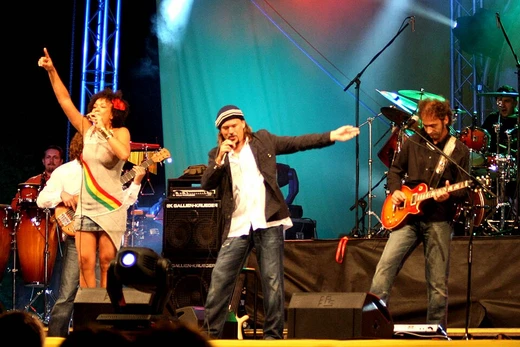
Sting (musician)
English musician, frontman of the Police, solo artist.

Gordon Matthew Thomas Sumner, born 2 October 1951 in Wallsend, Northumberland, is better known as Sting—an English musician, songwriter, and actor. He served as the lead singer, main songwriter, and bassist for the rock group the Police, active from 1977 to 1984, with brief reunions in 1986 and from 2007 to 2008. Starting his solo career in 1985, his music has drawn from rock, jazz, reggae, classical, new-age, and worldbeat. Across his work with the Police and as a solo artist, he has sold over 100 million records. His accolades include three Brit Awards (Best British Male Artist in 1994 and Outstanding Contribution to Music in 2002), a Golden Globe, an Emmy, four Academy Award nominations, and 17 Grammy Awards. The Police were inducted into the Rock and Roll Hall of Fame in 2003. Sting also has a star on the Hollywood Walk of Fame, an Ivor Novello Award for Lifetime Achievement, a CBE from Queen Elizabeth II, Kennedy Center Honors, and the Polar Music Prize. In May 2023, he became an Ivor Novello Fellow. Sting was the eldest of four children, born to hairdresser Audrey Cowell and milkman Ernest Matthew Sumner. Growing up near Wallsend’s shipyards left a strong impression; as a child, seeing the Queen Mother wave from a Rolls-Royce inspired him to escape the shipyards for a more glamorous life. He helped his father deliver milk and, by age ten, became obsessed with an old Spanish guitar left by a friend of his father who had emigrated. He attended St Cuthbert’s Grammar School in Newcastle upon Tyne, where he visited nightclubs like Club A'Gogo to see bands such as Cream and Manfred Mann, which shaped his musical tastes. He learned bass by speeding up records to 78 rpm to hear the bass lines more clearly. After leaving school in 1969, he briefly studied at the University of Warwick before dropping out. He worked as a bus conductor, building labourer, and tax officer, then attended Northern Counties College of Education (now Northumbria University), qualifying as a teacher in 1973. He taught at St Paul’s First School in Cramlington for two years. During evenings, weekends, and breaks from college and teaching, he performed jazz with groups like the Phoenix Jazzmen, Newcastle Big Band, and Last Exit. His nickname came from the Phoenix Jazzmen’s bandleader, Gordon Solomon, who said Sumner’s black-and-yellow striped jumper made him look like a wasp. In a 1985 documentary, a journalist called him Gordon, and he replied, “My children call me Sting, my mother calls me Sting, who is this Gordon character?” In 2011, he told *Time*, “I was never called Gordon. You could shout 'Gordon' in the street and I would just move out of your way.” Still, he never legally changed his name to Sting. In January 1977, Sting joined Stewart Copeland and Henry Padovani (soon replaced by Andy Summers) to form the Police, becoming lead singer, bassist, and primary songwriter. Between 1978 and 1983, the band released five UK number-one albums, won six Grammys, and two Brit Awards (Best British Group and Outstanding Contribution to Music). Their early sound was punk-inspired but shifted to reggae rock and minimalist pop. Their final album, *Synchronicity*, was nominated for five Grammys including Album of the Year in 1983, and featured their biggest hit, “Every Breath You Take,” written by Sting. Sting later said he decided to leave the Police during a concert at Shea Stadium in New York City on 18 August 1983, feeling that playing that venue was like reaching “Everest.” The group never formally broke up but agreed to focus on solo projects after *Synchronicity*. For years, band members—especially Sting—ruled out a reunion, but they temporarily reformed in 2007 for a reunion tour. Four of their five studio albums appear on *Rolling Stone*’s 500 Greatest Albums of All Time, and two of Sting’s songs, “Every Breath You Take” and “Roxanne,” are on the magazine’s 500 Greatest Songs of All Time. Both songs also appear on the Rock and Roll Hall of Fame’s 500 Songs that Shaped Rock and Roll. The Police were inducted into the Rock and Roll Hall of Fame in 2003 and are included in *Rolling Stone* and VH1’s lists of the 100 Greatest Artists of All Time. In 1978, Sting collaborated with members of Hawkwind and Gong as the Radio Actors on the single “Nuclear Waste.” In September 1981, he made his first live solo appearances at the fourth Amnesty International benefit, The Secret Policeman’s Other Ball, performing solo versions of “Roxanne” and “Message in a Bottle” and leading an all-star band on Bob Dylan’s “I Shall Be Released.” In 1982, he released the solo single “Spread a Little Happiness,” a reinterpretation of a 1920s song from the musical *Mr. Cinders*, which became a UK Top 20 hit.
- field
- Musician, songwriter, actor
- nationality
- English
- known_for
- Frontman, principal songwriter and bassist for the Police; solo career blending
Verified Timeline
Quick Facts
- Honorific Suffix
- country=GBR · size=100% · CBE
- Birth Name
- Gordon Matthew Thomas Sumner
- Birth Date
- df=y · 1951 · 10 · 2
- Birth Place
- Wallsend, Northumberland, England
- Education
- Northern Counties College of Education
- Occupation
- Musician / singer / songwriter / activist / actor
- Years Active
- 1969–present
- Awards
- Full list
- Spouse
- Frances Tomelty · 1976 · 1984 · end=divorced / Trudie Styler · 1992
- Children
- 6, including Joe, Mickey and Eliot
- Website
- sting.com
Facts from the source article.
Lore & Background
Sting grew up near Wallsend's shipyards, which made an impression on him. As a child, he was inspired to leave the shipyards and seek a more glamorous life by the Queen Mother waving at him from a Rolls-Royce. He helped his father deliver milk and by ten was 'obsessed' with an old Spanish guitar left by an emigrating friend of his father. He attended St Cuthbert's Grammar School in Newcastle upon Tyne. After leaving school in 1969, he enrolled at the University of Warwick in Coventry, but left after a term. After working as a bus conductor, building labourer, and tax officer, he attended the Northern Counties College of Education (now Northumbria University) from 1971 to 1974 and qualified as a teacher. He taught at St Paul's First School in Cramlington for two years. Sting performed jazz in the evenings, at weekends, and during breaks from college and teaching, playing with the Phoenix Jazzmen, Newcastle Big Band and Last Exit. He gained his nickname during his time with the Phoenix Jazzmen, when bandleader Gordon Solomon remarked that Sumner's habitual black-and-yellow striped jumper made him look like a wasp. In the 1985 documentary Bring On the Night a journalist called him Gordon, to which he replied, 'My children call me Sting, my mother calls me Sting, who is this Gordon character?' In 2011, he told Time 'I was never called Gordon. You could shout "Gordon" in the street and I would just move out of your way'. Despite this, he chose not to legally change his name to 'Sting'. In January 1977, Sting joined Stewart Copeland and Henry Padovani (soon replaced by Andy Summers) to form the Police, becoming the band's lead singer, bass player, and primary songwriter. Their final album, Synchronicity, included their most successful song, 'Every Breath You Take', written by Sting. According to Sting, appearing in the documentary Last Play at Shea, he decided to leave the Police while onstage during a concert of 18 August 1983 at Shea Stadium in New York City because he felt that playing that venue was '[Mount] Everest'. Sting's first solo album, 1985's The Dream of the Blue Turtles, featured jazz musicians including Kenny Kirkland, Darryl Jones, Omar Hakim and Branford Marsalis. It included the hit singles 'If You Love Somebody Set Them Free', 'Fortress Around Your Heart', 'Love Is the Seventh Wave' and 'Russians'. He released ...Nothing Like the Sun in 1987, including singles 'We'll Be Together', 'Fragile', 'Englishman in New York' and 'Be Still My Beating Heart', dedicated to his mother, who had recently died. The album won Best British Album at the 1988 Brit Awards.
Reader's Guide
Sting's significance lies in his dual career as frontman of the Police and as a solo artist who integrated diverse musical styles. He has received three Brit Awards, including Best British Male Artist in 1994 and Outstanding Contribution to Music in 2002; a Golden Globe; an Emmy; and four Academy Award nominations. As a solo musician and as a member of the Police, Sting has received 17 Grammy Awards. He was inducted into the Rock and Roll Hall of Fame as a member of the Police in 2003. Sting has received a star on the Hollywood Walk of Fame; the Ivor Novello Award for Lifetime Achievement from the British Academy of Songwriters, Composers and Authors; a CBE from Queen Elizabeth II for services to music; Kennedy Center Honors; and the Polar Music Prize. In May 2023, he was made an Ivor Novello Fellow. His work has influenced popular music across genres, and his longevity in the industry underscores his lasting impact.
Did You Know?
- Sting's nickname came from bandleader Gordon Solomon, who said his black-and-yellow striped jumper made him look like a wasp.
- He decided to leave the Police while onstage at Shea Stadium on 18 August 1983, because he felt playing that venue was 'Everest'.
- Sting learned to play bass by speeding the playing of records to 78 rpm so he 'could hear the bass lines more clearly'.
- He was a teacher at St Paul's First School in Cramlington for two years before his music career took off.
- Sting's album ...Nothing Like the Sun took its title from William Shakespeare's Sonnet 130.
Frequently Asked Questions
What genres does Sting's solo music blend?
His solo recordings weave together rock, jazz, reggae, classical, new-age, and worldbeat elements. This eclectic approach has let him collaborate with artists from vastly different musical traditions over the decades.
What is Sting's real name and where is he from?
His birth name is Gordon Matthew Thomas Sumner, and he is English. He has performed under the name Sting since the late 1970s and is widely recognized by that moniker in both music and acting.
More in Pop & Rock Solo Artists 1-22
Spotted an error? Know more?
This is a living reference — every entry is fact-audited, and reader corrections feed straight into our audit queue. Suggest an edit · See this site's audit record