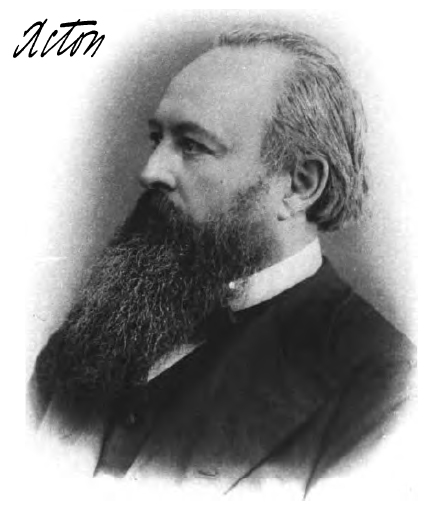
John Dalberg-Acton, 1st Baron Acton
English historian and advocate for individual liberty.

Oxenhillshaw · Public domain
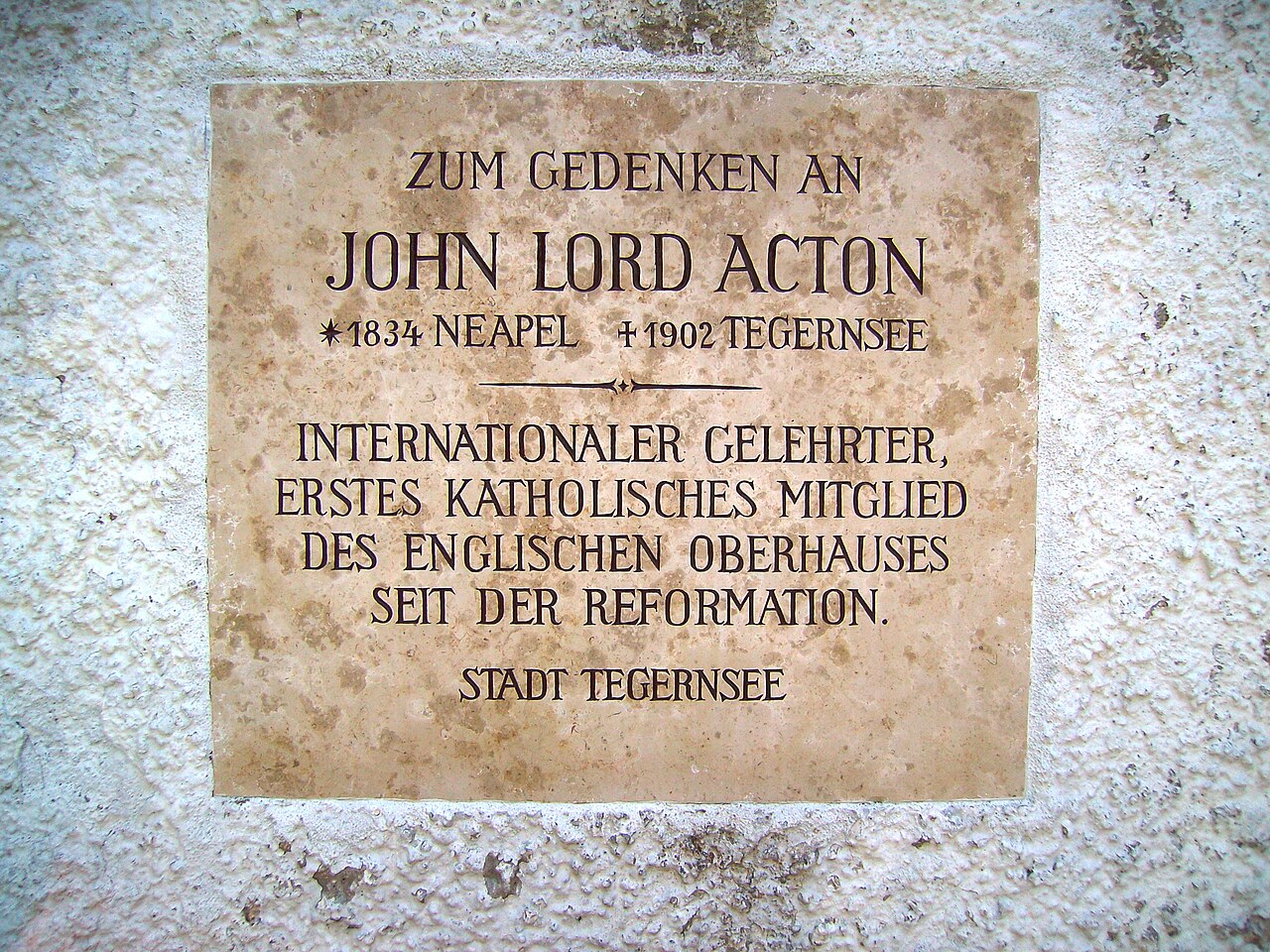
John Emerich Edward Dalberg-Acton, 1st Baron Acton, 13th Marquess of Groppoli (10 January 1834 – 19 June 1902), commonly called Lord Acton, was an English historian, Liberal politician, and writer who was Catholic. He strongly championed individual liberty and is most remembered for a warning he gave about concentrated authority. In an 1887 letter to an Anglican bishop, he wrote that power tends to corrupt and absolute power corrupts absolutely, reflecting his view that unchecked power endangers human freedom. His writings consistently stressed the need to limit government and institutional power in order to protect individual rights and personal liberty.
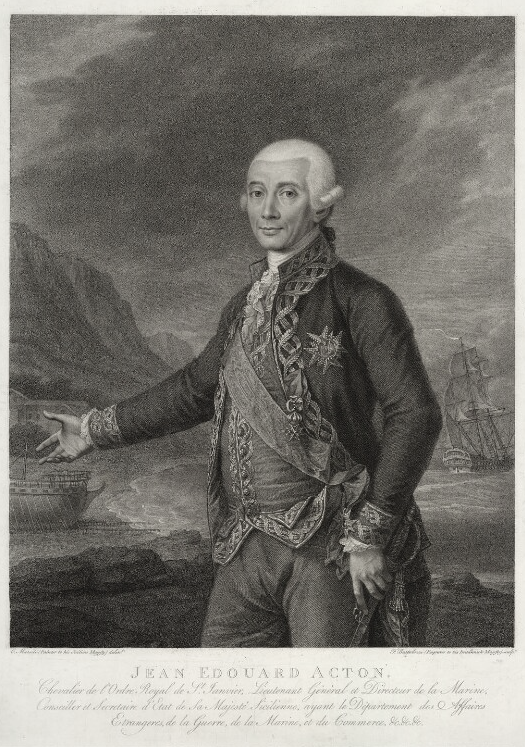
Acton was the only son of Sir Ferdinand Dalberg-Acton, 7th Baronet, and the grandson of Sir John Acton, 6th Baronet, a Neapolitan admiral and prime minister who inherited the baronetcy and Shropshire estates from another branch of the family in 1791. From 1837 to 1869, Acton was known as Sir John Dalberg-Acton, 8th Baronet. His grandfather belonged to a younger line that had moved to France and Italy but became the family patriarch after the elder line died out. Acton’s father, called Richard, married Marie Louise Pelline, the only daughter of Emmerich Joseph, 1st Duc de Dalberg, a naturalised French noble of old German descent who served Napoleon and represented Louis XVIII at the 1814 Congress of Vienna. After Richard Acton died in 1837, she married the 2nd Earl Granville in 1840. Marie Louise Pelline de Dalberg was heiress of Herrnsheim in Germany. She gave birth to John Dalberg-Acton in Naples. His father died in Paris when he was three.
Raised Roman Catholic, Acton was educated at Oscott College under future-Cardinal Nicholas Wiseman until 1848. He then studied privately in Edinburgh. Because he was Catholic, Cambridge University refused him entry, so he went to Munich and studied at the Ludwig-Maximilians-Universität München, living in the home of Johann Joseph Ignaz von Döllinger, a theologian and forerunner of the Old Catholic Church, with whom he formed a lifelong friendship. Döllinger gave him a deep love of historical research and a strong sense of its role as a critical tool for studying sociopolitical liberty. Acton mastered several major foreign languages and early on began collecting a magnificent historical library, which he planned to use for writing a "History of Liberty." Politically, he was always a committed Liberal.
During his wide travels, Acton spent much time in Europe’s main intellectual centres, reading the correspondence of historical figures. His friends included Montalembert, Tocqueville, Fustel de Coulanges, Bluntschli, von Sybel, and Ranke. In 1855, he was made deputy lieutenant of Shropshire. The next year, he joined Lord Granville’s mission to Moscow as the British representative at the coronation of Tsar Alexander II.
In 1859, Acton settled in England at his country house, Aldenham, in Shropshire. That same year he was elected to the House of Commons for the Irish borough of Carlow and became a devoted admirer and follower of Prime Minister William Ewart Gladstone. Acton was not an active MP, and his parliamentary career ended after the 1865 general election, when he headed the Liberal ballot for Bridgnorth near his Shropshire home. He nearly defeated Conservative leader Henry Whitmore, but Whitmore successfully petitioned for a scrutiny of the ballots and kept his seat. After the Reform Act 1867, Acton again contested Bridgnorth in 1868, now reduced to a single seat, but lost.
Acton had a strong interest in the United States, seeing its federal structure as an ideal protector of individual liberties. During the American Civil War, his sympathies were entirely with the Confederacy because of its defence of states’ rights against a centralised government he believed would become tyrannical. His notes to Gladstone on the subject helped sway many in the British government toward sympathising with the South. After the South surrendered, he wrote to Robert E. Lee that he mourned the stake lost at Richmond more deeply than he rejoiced over what was saved at Waterloo, adding that he believed Lee was fighting battles for liberty, progress, and civilisation. This stance was shared by most English Catholics at the time, both liberal and Ultramontane. The Ultramontane *Tablet* denounced Abraham Lincoln as a dangerous radical, and John Henry Newman, when asked, stated that slavery was not intrinsically evil and should be assessed case by case.
In 1869, Queen Victoria made Acton a peer as Baron Acton, of Aldenham in Shropshire, largely through Gladstone’s intervention. The two were close friends and frequent correspondents. Gladstone particularly wanted to raise Acton’s standing as he went to Rome to oppose the Pope’s plan to confirm Papal Infallibility at the Vatican Council. Both Acton and Gladstone opposed this scheme, and it was thought that a British peerage would strengthen Acton’s position in Rome. Matthew Arnold remarked that Gladstone influenced everyone around him except Acton, who instead influenced Gladstone. Acton was made a Knight Commander of the Royal Victorian Order (KCVO) in the 1897 Birthday Honours. He also strongly supported Irish Home Rule.
In 1859, Acton became editor of the Roman Catholic monthly *The Rambler*, following John Henry (later Cardinal) Newman’s retirement.
- field
- History, politics, writing
- nationality
- English
- known_for
- Observation that 'Power tends to corrupt, and absolute power corrupts absolutely
Verified Timeline
Lore & Background
In politics, Acton was always an ardent Liberal. He took a great interest in the United States, considering its federal structure an ideal guarantor of individual liberties. During the American Civil War, his sympathies lay entirely with the Confederacy, for their defence of States' Rights against a centralised government that he believed would inevitably turn tyrannical. After the South's surrender, he wrote to Robert E. Lee that 'I mourn for the stake which was lost at Richmond more deeply than I rejoice over that which was saved at Waterloo,' adding that he 'deemed that you were fighting battles for our liberty, our progress, and our civilization.' Acton's stance on the Confederacy was shared by most English Catholics at the time, both liberal and Ultramontane. The editors of the Ultramontane Tablet denounced Abraham Lincoln as a dangerous radical, and John Henry Newman stated that slavery was not 'intrinsically evil' and that the issue had to be assessed on a case-by-case basis.
Reader's Guide
Acton's most famous pronouncement came in an April 1887 letter to scholar and ecclesiastic Mandell Creighton: 'Power tends to corrupt, and absolute power corrupts absolutely. Great men are almost always bad men, even when they exercise influence and not authority, still more when you superadd the tendency or the certainty of corruption by authority.' This principle has become a foundational concept in political philosophy and historical analysis, underscoring the necessity of checks on authority. His work as a historian and editor, particularly through The Rambler (which he edited from 1859) and Home and Foreign Review (which he merged into in 1862), reflected a commitment to critical historical inquiry that often brought him into conflict with ultramontane church hierarchy. In the March 1862 Rambler, Acton wrote: 'The Celts are not among the progressive, initiative races... The Persians, the Greeks, the Romans, and the Teutons are the only makers of history.' He also wrote: 'Subjection to a people of a higher capacity for government is of itself no misfortune; and it is to most countries the condition of their political advancement.' Acton's legacy is that of a thinker who consistently prioritized individual liberty and the limitation of concentrated power, influencing later debates on governance, rights, and the moral responsibilities of those in authority.
Did You Know?
- Acton was denied entry to the University of Cambridge because he was a Catholic, and instead studied at the Ludwig-Maximilians-Universität München (LMU) in Munich.
- He was raised to the peerage as Baron Acton in 1869, primarily through the intercession of Prime Minister William Ewart Gladstone.
- In 1870, Acton traveled to Rome to oppose the promulgation of papal infallibility at the First Vatican Council, ultimately unsuccessfully.
- Acton was appointed a Knight Commander of the Royal Victorian Order (KCVO) in the 1897 Birthday Honours.
- He wrote to Robert E. Lee after the Confederacy's surrender that he mourned 'for the stake which was lost at Richmond more deeply than I rejoice over that which was saved at Waterloo.'
Gallery
Frequently Asked Questions
What was Lord Acton's core political belief?
He argued that governments and institutions should be kept in check so that individual rights and personal freedom remain paramount. His writings consistently warned against concentrating too much authority in any single body.
What fields did Lord Acton work in?
He published in history, political commentary, and general literature. He also served as a Liberal politician in England during his lifetime.
More in Political Theorists And Social Scientists 1-24
Spotted an error? Know more?
This is a living reference — every entry is fact-audited, and reader corrections feed straight into our audit queue. Suggest an edit · See this site's audit record