
Eleanor Roosevelt
First Lady of the World and human rights champion
Anna Eleanor Roosevelt was born on October 11, 1884, in Manhattan to socialites Anna Rebecca Hall and Elliott Roosevelt. From early childhood she preferred to be called Eleanor. Through her father, she was a niece of President Theodore Roosevelt. Her mother nicknamed her “Granny” due to her serious demeanor and was emotionally distant, ashamed of what she considered her daughter’s plainness. Roosevelt had two younger brothers, Elliott Jr. and Hall, as well as a half-brother from her father’s affair with a servant. The family belonged to New York’s wealthy high society. When she was two, she survived a ship collision at sea, an event that left her with a lifelong fear of ships and the ocean. Her mother died of diphtheria when Eleanor was eight, and her younger brother Elliott Jr. died of the same disease the following year. Her father, an alcoholic confined to a sanitarium, died after a seizure following a fall from a window during delirium tremens. These early losses made her prone to depression throughout her life. Before his death, her father asked her to act as a mother to her surviving brother Hall, a duty she fulfilled for the rest of his life. At fifteen, she attended Allenswood Boarding Academy in London, where headmistress Marie Souvestre deeply influenced her. Returning to the United States, she married her fifth cousin once removed, Franklin Delano Roosevelt, in 1905. Between 1906 and 1916 she gave birth to six children, one of whom died in infancy. The marriage became complicated after she discovered her husband’s affair with her social secretary, Lucy Mercer, in 1918. With mediation from her mother-in-law Sara, the affair was officially ended. Thereafter, both partners pursued independent agendas. Eleanor joined the Women’s Trade Union League and became active in the New York state Democratic Party. After Franklin was stricken with a paralytic illness in 1921, she helped persuade him to remain in politics. Following his election as governor of New York in 1928, and throughout his subsequent political career, she made regular public appearances on his behalf. As first lady from 1933 to 1945, she redefined the role through her travels, public engagement, and advocacy. She was the first presidential spouse to hold regular press conferences, write a daily newspaper column, write a monthly magazine column, host a weekly radio show, and speak at a nati
- died
- November 7, 1962
- field
- Political figure, diplomat, activist
- nationality
- American
- known_for
- Longest-serving first lady; UN delegate; chair of the UN Commission on Human Rig
Lore & Background
Roosevelt was a member of the prominent and wealthy Roosevelt and Livingston families and a niece of President Theodore Roosevelt. She had an unhappy childhood, having suffered the deaths of both parents and one of her brothers at a young age. At 15, she attended Allenswood Boarding Academy in London and was deeply influenced by its founder and director Marie Souvestre. Returning to the U.S., she married her fifth cousin once removed, Franklin Delano Roosevelt, in 1905. Between 1906 and 1916 she gave birth to six children, one of whom died in infancy. The Roosevelts' marriage became complicated after Eleanor discovered her husband's affair with her social secretary, Lucy Mercer, in 1918. Due to mediation by her mother-in-law, Sara, the liaison was ended officially. After that, both partners started to keep independent agendas, and Eleanor joined the Women's Trade Union League and became active in the New York state Democratic Party. Roosevelt helped persuade her husband to stay in politics after he was stricken with a paralytic illness in 1921. Following Franklin's election as governor of New York in 1928, and throughout the remainder of Franklin's political career, Roosevelt regularly made public appearances on his behalf; and as first lady, while her husband served as president, she greatly influenced the present scope and future of the role. Roosevelt was, in her time, one of the world's most widely admired and powerful women. Nevertheless, in her early years in the White House she was controversial for her outspokenness, particularly with respect to her promotion of civil rights for African Americans. She was the first presidential spouse to hold regular press conferences, write a daily newspaper column, write a monthly magazine column, host a weekly radio show, and speak at a national party convention. On a few occasions, she publicly disagreed with her husband's policies. She launched an experimental community at Arthurdale, West Virginia, for the families of unemployed miners, later widely regarded as a failure. She advocated for expanded roles for women in the workplace, the civil rights of African Americans and Asian Americans, and the rights of World War II refugees. Following her husband's death in 1945, Roosevelt pressed the United States to join and support the United Nations and became its first delegate to the committee on Human Rights. She se
Reader's Guide
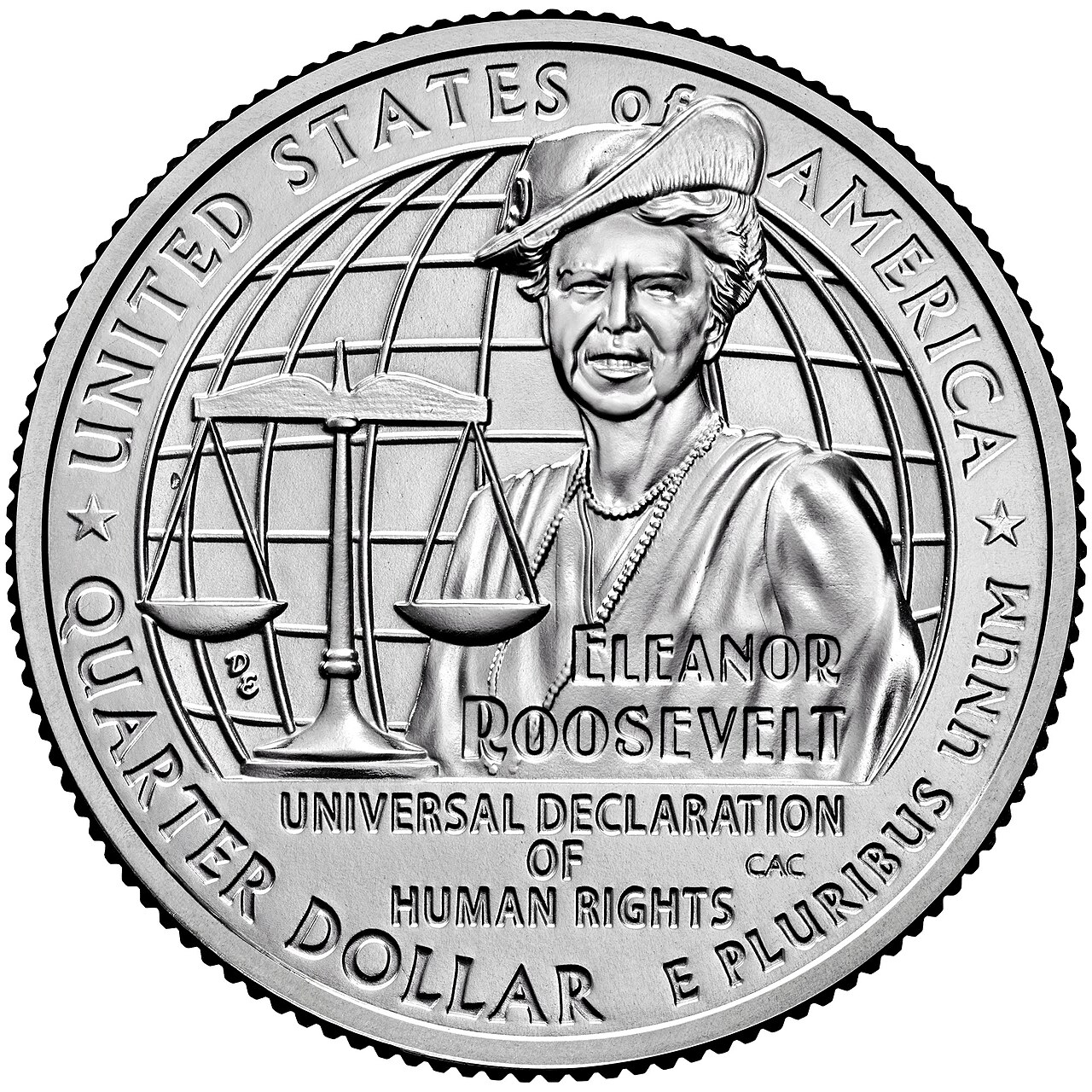
As first lady, Eleanor Roosevelt fundamentally reshaped the role through constant travel, public speaking, and advocacy. She was the first presidential spouse to hold regular press conferences, write a daily newspaper column, host a weekly radio show, and address a national party convention. Her outspokenness, especially on civil rights for African Americans, made her a controversial figure early in her husband’s administration, and she occasionally publicly disagreed with his policies. She championed expanded workplace roles for women, the rights of African Americans and Asian Americans, and protections for World War II refugees. One of her initiatives, a community for unemployed miners’ families in West Virginia, was widely seen as a failure. After Franklin Roosevelt’s death, she became a U.S. delegate to the United Nations, serving as the first chair of its Commission on Human Rights. She led the drafting of the Universal Declaration of Human Rights and received a standing ovation from the assembly upon its adoption in 1948. President Harry Truman called her the “First Lady of the World” for these achievements. She later chaired President Kennedy’s Commission on the Status of Women until her death. By then, she was considered one of the most esteemed women globally, and historians consistently rank her as the greatest American first lady.
Did You Know?
- She was the first presidential spouse to hold regular press conferences, write a daily newspaper column, write a monthly magazine column, host a weekly radio show, and speak at a national party convention.
- She launched an experimental community at Arthurdale, West Virginia, for the families of unemployed miners, later widely regarded as a failure.
- She served as the first chair of the UN Commission on Human Rights and oversaw the drafting of the Universal Declaration of Human Rights.
- President Harry S. Truman called her the 'First Lady of the World' in tribute to her human rights achievements.
Origins and Vision at the Creek's Edge
Franklin Roosevelt nudged his wife toward a bold experiment on a stretch of land beside Fallkill Creek in Hyde Park, New York. What began as a shared project with friends Nancy Cook and Marion Dickerman grew into a living laboratory for social reform. Eleanor envisioned a place where local farming families could earn a living through handcraft traditions, and so Val-Kill Industries took shape within a large two-story stuccoed building. The name itself, loosely meaning waterfall-stream, echoed the Dutch linguistic heritage of the region's earliest European settlers. The property sat roughly two miles east of the family's main estate, Springwood, and a few hundred feet from New York State Route 9G, where a Dutchess County bus line ran toward Tivoli. More than a retreat, Val-Kill was a working space where Eleanor could test ideas about seasonal employment for rural workers and women, turning a quiet creek-side parcel into a nexus of economic opportunity and political conversation.
A Home, a Gathering Place, a Life of Her Own
After Franklin's death in 1945, Nancy Cook and Marion Dickerman sold their shares in the property and relocated to Connecticut, leaving Eleanor with full ownership of Val-Kill. The larger stuccoed building, which had housed the Industries workshop, became her primary residence and the only home she ever personally owned. Stone Cottage, the smaller structure that had been the friends' dwelling, remained adjacent to the creek. In this relaxed creek-side setting, Eleanor entertained a wide circle: family members, close friends, political allies, and even world leaders who passed through Hyde Park. She also used the grounds to host workshops for the Encampment for Citizenship, a program that brought civic education to broader audiences. The 181-acre property, with its buildings and historic features, became the physical embodiment of her later life. It was here, away from the formal pressures of Washington, that she most fully inhabited the role of independent public figure rather than the wife of a sitting president.
Threat and Triumph of Preservation
Eleanor died in 1962, and within a few years the larger house at Val-Kill was subdivided into four rental units. By 1970, a private company had purchased the land with plans to develop it commercially. The prospect of construction rolling up Route 9G galvanized a public preservation campaign that grew rapidly in intensity. Advocates pushed for federal recognition, arguing that the site deserved protection as a national memorial to a woman whose life shaped the country. Their efforts culminated in May 1977, when an Act of Congress formally designated the property the Eleanor Roosevelt National Historic Site. The congressional language made clear the purpose: the site existed to educate, inspire, and serve generations yet to come by preserving the story of a woman who left an indelible mark on American history. The 181-acre parcel, its buildings, and its historic features were thus removed from the private market and placed under the stewardship of the National Park Service, ensuring that Val-Kill would remain a public trust rather than a developer's blueprint.
A Living Legacy Under Shared Stewardship
Since its designation, Val-Kill has remained an active site of education and interpretation. In 1984, the Eleanor Roosevelt Center at Val-Kill struck a partnership agreement with the National Park Service and made Stone Cottage its headquarters. A new facility opened on the property in 2008, expanding the Center's capacity. Meanwhile, the Save America's Treasures program named Val-Kill Cottage an official project in 1998, spawning the Honoring Eleanor Roosevelt initiative. That volunteer-driven effort has raised nearly one million dollars toward restoration and has also funded the documentary Eleanor Roosevelt: Close to Home. The site's profile grew further when it received a 75,000-dollar grant and was selected as one of twelve locations featured in Restore America: A Salute to Preservation, a collaboration involving Save America's Treasures, the National Trust, and HGTV. Today the National Park Service manages the historic site in coordination with the adjacent Home of Franklin D. Roosevelt and the nearby Vanderbilt Mansion, while continuing to partner with both Save America's Treasures and the Eleanor Roosevelt Center to keep Val-Kill vibrant and accessible.
Gallery
Frequently Asked Questions
Who is Eleanor Roosevelt?
Anna Eleanor Roosevelt (1884–1962) was an American political figure, diplomat, and activist who redefined the role of First Lady and later became a leading voice in international human rights. She is widely regarded as one of the most influential women in U.S. political history.
What was Eleanor Roosevelt's role as First Lady?
She served as the longest-serving First Lady in American history, holding the position across Franklin D. Roosevelt's four terms from 1933 to 1945. Instead of limiting herself to social duties, she used the platform for extensive travel, public speaking, and direct advocacy on housing, labor, and civil-rights issues.
What did Eleanor Roosevelt do at the United Nations?
After her husband's death in 1945, she was appointed a U.S. delegate to the UN General Assembly and went on to chair the UN Commission on Human Rights. She took a leading role in drafting the text of the Universal Declaration of Human Rights and in securing broad international backing for it.
How does Eleanor Roosevelt's story end?
Eleanor Roosevelt died on November 7, 1962, at the age of 78. Her legacy persists through the human-rights framework she helped build and the precedent she set for women in public political life.
Why is Eleanor Roosevelt important?
She transformed the First Lady position from a largely ceremonial role into one of active policy engagement and public advocacy. Her central contribution to the Universal Declaration of Human Rights cemented her place as a defining figure in the post-war establishment of global human-rights standards.
More in Political Leaders & Revolutionaries 1-24
Spotted an error? Know more?
This is a living reference — every entry is fact-audited, and reader corrections feed straight into our audit queue. Suggest an edit · See this site's audit record