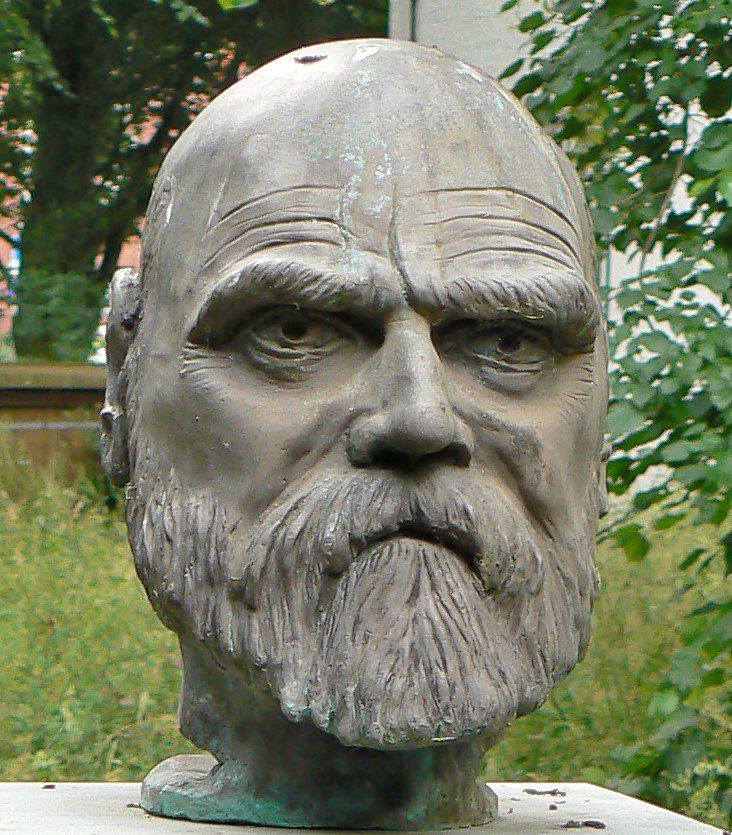
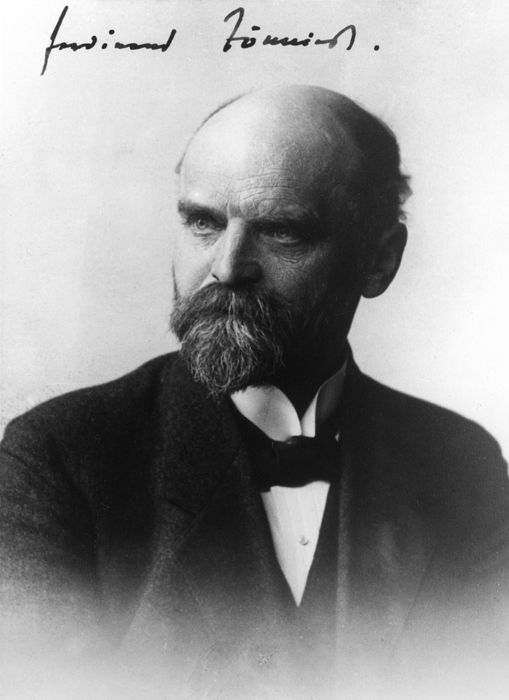
Ferdinand Tönnies
German sociologist who distinguished Gemeinschaft from Gesellschaft.
Last updated

Marseille77 · CC BY-SA 4.0
Ferdinand Tönnies (26 July 1855 – 8 April 1936) was a German sociologist, economist, and philosopher. He is best known for distinguishing between two types of social groups, Gemeinschaft and Gesellschaft (community and society). He co-founded the German Sociological Association together with Max Weber and Georg Simmel and served as its president from 1909 to 1933, when he was ousted for criticizing the Nazis.
Background
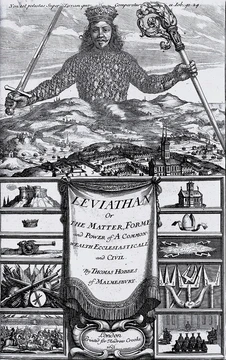
Tönnies was born on 26 July 1855 on a farm in Oldenswort, North Frisia, then under Danish rule, into a wealthy farming family. He earned a doctorate in philology at the University of Tübingen in 1877. After postdoctoral work in Berlin, he traveled to London to study Thomas Hobbes. He became a Privatdozent in philosophy at the University of Kiel in 1909, a post he held until 1913.
Because he sympathized with the Hamburg dockers' strike of 1896, the conservative Prussian government considered him a social democrat, and he was not called to a professorial chair until 1913. He returned to Kiel as a professor emeritus in 1921 and taught sociology until 1933, when the Nazis ousted him. He died in Kiel in 1936.
The Gemeinschaft–Gesellschaft Typology
Tönnies's most enduring intellectual contribution is his division of social groupings into two ideal types. Gemeinschaft, often rendered as community, describes collectives bound by genuine mutual attachment and a felt sense of togetherness; membership is itself the goal, and individuals function as means toward sustaining that bond. Gesellschaft, or society, captures associations held together because they instrumentally serve members' separate aims. In Gemeinschaft, order is preserved through implicit norms—morals, conformism, social exclusion—whereas Gesellschaft depends on explicit mechanisms such as written statutes, police, courts, and prisons.
He rooted the distinction in two modes of human will: the essential will (Wesenwille), in which a person submerges into the group as an underlying, almost subconscious drive, and the arbitrary will (Kürwille), in which one treats the group as a tool for personal, future-oriented ends. His illustrative cases ranged from pre-modern rural families and neighborhoods to joint-stock companies and modern states. In Einteilung der Soziologie he further sorted the discipline into pure-theoretical, applied, and empirical branches.
A Career Blocked by Politics
Tönnies's route to a full professorship was unusually protracted and shaped by political suspicion. After earning a doctorate in philology at Tübingen in 1877 and completing postdoctoral work in Berlin, he traveled to London to study Thomas Hobbes. He secured a Privatdozent post at Kiel only after submitting his landmark Gemeinschaft und Gesellschaft as his habilitation thesis in 1881, yet held that junior position for a mere three years. The conservative Prussian government, interpreting his sympathy for the 1896 Hamburg dockers' strike as evidence of social-democratic leanings, refused to elevate him to a full chair until 1913.
He returned to Kiel as professor emeritus in 1921, teaching sociology until the Nazis forced him out in 1933 because of earlier publications criticizing the regime and his public endorsement of the Social Democratic Party. He simultaneously lost the presidency of the German Sociological Association, a post he had occupied since 1909. He remained in Kiel and died in isolation in his home three years later.
Founding Classical German Sociology
Tönnies is widely regarded as the first proper German sociologist and, together with Max Weber and Georg Simmel, one of the founding fathers of the classical German tradition. He co-founded the German Sociological Association alongside Weber, Simmel, and numerous other scholars, and served as its president from 1909 to 1933. His published output exceeded nine hundred works spanning sociology, philosophy, and economics. Beyond the famous Gemeinschaft-Gesellschaft framework, he contributed to the study of social change, public opinion, customs, technology, crime, and suicide.
He coined the metaphysical term Voluntarism and devised his own technique of statistical association, reflecting a deep interest in research methodology. After his 1887 masterwork, he turned his attention to morals, folkways, and public opinion, applying his core concepts to concrete facets of social life. Despite this extraordinary breadth, Tönnies has not attracted the same sustained scholarly attention as Weber or Simmel, whose work has experienced a notable resurgence in recent decades.
Rural Origins and Intellectual Formation
Tönnies was born on 26 July 1855 aboard the Haubarg De Reap in Oldenswort on the Eiderstedt Peninsula, in the Duchy of Schleswig then under Danish rule. He came from a prosperous North Frisian farming family; his father August Ferdinand was a successful farmer and cattle rancher of Frisian descent, while his mother Ida Frederica hailed from a lineage of Lutheran ministers in East Holstein. As the only sociologist of his generation to originate from the countryside, this rural grounding likely sharpened his sensitivity to organic community life. The family had seven children, and young Ferdinand received the baptismal name Ferdinand Julius.
After his father retired in 1864, the household relocated to Husum on the North Sea coast. He graduated from high school in 1872, enrolled at the University of Strasbourg, and then traveled extensively, studying at Jena, Bonn, Leipzig, Berlin, and Tübingen. His 1877 doctorate in philology carried a Latin thesis on the ancient Siwa Oasis, though by then his interests had shifted decisively toward political philosophy and social questions, heavily shaped by Hobbes.
Did You Know?
- He used gender polarity in his theory, linking Gemeinschaft with the feminine and Gesellschaft with the masculine.
- He proposed two solutions to revitalize family life, including family unions and groups of unrelated families.
More in Political And Social Theorists
Sources
Compiled from Wikipedia and the sources listed below. Text from Wikipedia is available under CC BY-SA 4.0; this entry is adapted from it.
- Wikipedia: Ferdinand Tönnies (CC BY-SA 4.0).
Spotted an error? Know more?
Reader corrections go straight into our review queue. Suggest an edit · How this site is sourced