If—
A poem of Victorian stoicism, inspired by Leander Starr Jameson.

Rudyard Kipling’s poem “If—” first appeared in 1910 within the “Brother Square-Toes” chapter of his collection *Rewards and Fairies*, a volume that blended short stories with verse. In his posthumously published autobiography *Something of Myself* (1937), Kipling explained that the poem’s inspiration came from the character of Leander Starr Jameson, the leader of the failed Jameson Raid against the South African Republic. That mercenary coup attempt, which aimed to overthrow the Boer government of Paul Kruger, worsened political tensions between Britain and the Boers and helped precipitate the Second Boer War (1899–1902). The poem is written as paternal advice to Kipling’s son, John, and is considered a literary embodiment of Victorian-era values, particularly stoicism and the “stiff upper lip” self-discipline that British popular culture later elevated into a national virtue. Its cultural status in Britain is reflected in numerous parodies and its enduring popularity. Kipling himself, in his final year, noted wryly how the poem had spread: schools required students to copy it as punishment, it was printed on cards for offices and bedrooms, and it was translated into twenty-seven languages. In 1931, Elizabeth Lincoln Otis published “An ‘If’ for Girls” in response. T. S. Eliot included the poem in his 1941 collection *A Choice of Kipling’s Verse*. The poem has been physically installed in various locations: in India, a framed copy hung in officer cadet cabins at the National Defence Academy and the Indian Naval Academy; in Britain, the first verse is set in granite setts into the promenade at Westward Ho! in Devon; and the lines “If you can meet with Triumph and Disaster / and treat those two impostors just the same” appear on the players’ entrance wall at Wimbledon’s Centre Court and at the West Side Tennis Club in Forest Hills, New York. The Indian writer Khushwant Singh called it “the essence of the message of *The Gita* in English.” Charles McGrath recalled reciting it daily after the Pledge of Allegiance in school. Pablo Neruda, however, dismissed it as “pedestrian and sanctimonious poetry.” In a 1996 BBC poll, “If—” was voted the UK’s favourite poem, receiving twice as many votes as the runner-up. Boxer Muhammad Ali carried it in his wallet as a guiding principle throughout his life. Philosopher Olivier Rey, in 2006, interpreted the poem as an example o
- field
- Poetry
- nationality
- English
- known_for
- "If—"
Lore & Background
As an evocation of Victorian-era stoicism, the "stiff upper lip" self-discipline that popular culture rendered into a British national virtue and character trait, "If—" remains a cultural touchstone. The British cultural-artifact status of the poem is evidenced by the parodies of the poem, and by its popularity among Britons. Kipling himself in the last year of his life took wry note of the poem's ubiquity, remarking on its spread through schools, cards, translations, and anthologies.
The poem was written by the English poet Rudyard Kipling as a tribute to Leander Starr Jameson, leader of the failed Jameson Raid against the South African Republic. It first appeared in the "Brother Square Toes" chapter of Kipling's 1910 collection *Rewards and Fairies*, a mix of poetry and short-story fiction. Kipling later stated in his autobiography that Jameson's character inspired the work. The poem takes the form of paternal advice addressed to the poet's son, John. Its reception has been wide and varied. In a 1996 BBC nationwide poll, it was voted the United Kingdom's favourite poem, receiving twice the votes of the runner-up. The boxer Muhammad Ali carried a copy in his wallet throughout his life. In India, framed copies were placed in officer cadet cabins at the National Defence Academy and the Indian Naval Academy. In Britain, the first verse is set into the pavement of the promenade in Westward Ho!, Devon. Lines from the second stanza, about meeting Triumph and Disaster as impostors, are inscribed on the players' entrance to Wimbledon's Centre Court and also appear at the West Side Tennis Club in Forest Hills, New York. T. S. Eliot included the poem in his 1941 collection *A Choice of Kipling's Verse*. The Indian writer Khushwant Singh considered it the essence of the message of the *Gita* in English. However, the Nobel laureate Pablo Neruda dismissed it as pedestrian and sanctimonious, while the French philosopher Olivier Rey saw it as an example of paternal tyranny imposing impossible conditions. Elizabeth Lincoln Otis wrote an "An 'If' for Girls" in response in 1931.
Reader's Guide
"If—" holds significance as a cultural touchstone of Victorian-era stoicism and the "stiff upper lip" self-discipline that popular culture rendered into a British national virtue. Its legacy is evidenced by its widespread use: in India, a framed copy was affixed to the wall before the study desk in the cabins of officer cadets at the National Defence Academy at Pune and the Indian Naval Academy at Ezhimala. In Britain, the first verse is set in granite setts into the pavement of the promenade in Westward Ho! in Devon. Lines from the poem appear on the wall of the players' entrance to the Centre Court at Wimbledon and at the West Side Tennis Club in Forest Hills, New York City. The boxer Muhammad Ali carried the poem in his wallet throughout his life as a guiding principle. The poem has also drawn critical perspectives: the French philosopher Olivier Rey saw it as an example of paternal tyranny, imposing impossible conditions on a son. Pablo Neruda referred to it as "that pedestrian and sanctimonious poetry."
Did You Know?
- The poem was not written specifically for Kipling's son, John; it was inspired by Leander Starr Jameson, as Kipling stated in his autobiography.
- Kipling said in his autobiography that the poem was inspired by the character of Leander Starr Jameson, leader of the failed Jameson Raid.
Roots in Oral Tradition and the Bardic Art
The earliest epics emerged in societies that had not yet developed writing, meaning these vast narrative poems were first shaped and preserved entirely through the spoken word. Bards in these preliterate cultures employed intricate rhetorical and metrical patterns that allowed them to memorize the received tradition while also improvising additions during live performances. This oral method of transmission was not merely a primitive precursor to written literature; it was a sophisticated system of cultural communication that spread alongside written scriptures. In the early twentieth century, scholars Milman Parry and Albert Lord studied living oral epic traditions in the Balkans and identified what they called the paratactic model. Their research revealed that oral epics are typically built from short, self-contained episodes of roughly equal weight, a structure that makes memorization practical because the poet recalls each segment in sequence and stitches them together during performance. Parry and Lord further argued that the Homeric poems—the foundational texts of Western literature—were most likely transcribed from such oral performances, meaning that dictation from a bard's recitation was the probable bridge between the spoken and the written word.
A Global Canon Spanning Millennia and Cultures
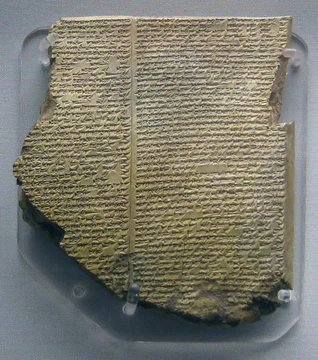
The epic genre has produced works across virtually every major literary tradition, stretching from the ancient Sumerian Epic of Gilgamesh—recorded between roughly 2500 and 1300 BCE during the Neo-Sumerian Empire—to modern compositions like Derek Walcott's Omeros and Mircea Cărtărescu's The Levant. The Mahabharata, composed in ancient India between the third century BCE and the third century CE, stands as the longest written epic from antiquity, containing approximately 100,000 ślokas and over 200,000 verse lines alongside extended prose passages. At roughly 1.8 million words, it dwarfs the Persian Shahnameh by about a factor of two, exceeds the Rāmāyaṇa by a factor of four, and is approximately ten times the combined length of Homer's Iliad and Odyssey. Other celebrated examples span the Sumerian, Sanskrit, Tamil, Persian, Greek, Latin, Old English, Italian, Finnish, German, French, Spanish, Portuguese, Armenian, Old East Slavic, Mongolian, Kyrgyz, and Malian traditions, while John Milton's Paradise Lost and Adam Mickiewicz's Pan Tadeusz anchor the European canon. William Carlos Williams's Paterson, published in five volumes between 1946 and 1958, drew partial inspiration from Ezra Pound's The Cantos, demonstrating that the epic impulse continues to generate new works well into the modern era.
Poetic Framework: Conventions and Structural Rules
Aristotle, in his treatise Poetics, positioned epic poetry as one of the principal forms of verse, setting it apart from lyric poetry and from dramatic forms such as tragedy and comedy. He noted that epic shares with tragedy its imitation of elevated characters, yet differs in key respects: it employs a single meter, it is narrative in form, and its action is unconstrained by the temporal limits that tragedy observes. Aristotle also observed that every element of an epic can be found within a tragedy, but not vice versa, suggesting tragedy is a more concentrated subset of epic. Centuries later, scholars Harmon and Holman codified ten defining characteristics of the genre. These include an opening in medias res, a setting spanning nations or the cosmos, an invocation to a muse, an explicit statement of theme, the use of epithets, extended catalogues, lengthy formal speeches, divine intervention in human affairs, and heroes who embody the values of their people. The term itself descends from the Greek epos—meaning word, story, or poem—and in its earliest usage encompassed all dactylic hexameter verse, from Hesiod's wisdom poetry to the Delphic oracle's pronouncements, before later tradition narrowed it to the heroic narrative.
Legacy, Influence, and the Epic Adjective
The influence of the epic tradition extends far beyond the page. Homer's Iliad and Odyssey, Virgil's Aeneid, and the anonymous Old English Beowulf have collectively shaped Western literature and culture to such a degree that nearly all subsequent Western epic—from Virgil to Dante's Divine Comedy—presents itself as a conscious continuation of the Homeric tradition. The genre has also given us the adjective "epic," a word now applied to any endeavor of grand scale or sweeping ambition, and it has spawned derivative works across other artistic mediums, including what are commonly called epic films, which seek to evoke or emulate the characteristics of the ancient narrative poems. Later writers such as Virgil, Apollonius of Rhodes, Dante, Camões, and Milton adopted and adapted Homer's style and subject matter while deploying techniques available only to those who work in written form, creating a continuous chain of influence stretching from the oral bards of antiquity to the literary giants of the modern era. In this way, the epic is not merely a genre but a living cultural force whose conventions and structural principles continue to inform how storytellers across disciplines conceive of scale, heroism, and the shaping of the mortal world.
More in Poetry Collections And Epic Poems 1-22
Spotted an error? Know more?
This is a living reference — every entry is fact-audited, and reader corrections feed straight into our audit queue. Suggest an edit · See this site's audit record