Howl (poem)
Poem by Allen Ginsberg, central to the Beat Generation.

Allen Ginsberg wrote "Howl" (also called "Howl for Carl Solomon") between 1954 and 1955, and it appeared in his 1956 collection *Howl and Other Poems*. The poem is dedicated to Carl Solomon. Ginsberg started working on it in the autumn of 1954. He first read it aloud at the Six Gallery in San Francisco in October 1955. Lawrence Ferlinghetti, a poet who ran City Lights Books, attended that reading and later published the work in 1956. When the book came out, Ferlinghetti and the bookstore's manager, Shigeyoshi Murao, were arrested and charged with distributing obscene material. On October 3, 1957, Judge Clayton W. Horn decided the poem was not obscene. Though it sparked fierce debate and was long kept out of academic study, "Howl" eventually became recognized as a major piece of twentieth-century American literature. It is also strongly linked to the Beat Generation writers.
The poem's composition began with a frightening peyote vision Ginsberg had on the evening of October 17, 1954. He was at his girlfriend Sheila Williams's apartment in San Francisco's Nob Hill district when the Sir Francis Drake Hotel, seen through the fog, looked like a monstrous, child-eating face. Notes from that nightmare became the basis for Part II. Ginsberg then worked on the poem in a rented apartment at 1010 Montgomery Street in North Beach, San Francisco, during late 1954 and 1955. He originally called it "Strophes." Some drafts were written at the Caffe Mediterraneum in Berkeley, where he moved into a small cottage near the University of California campus on September 1, 1955. Several influences shaped the poem. His therapist, Dr. Philip Hicks, had urged him to quit a dull market-research job, focus on poetry, and accept his homosexuality. Around this time, Ginsberg was experimenting with a technique called parataxis—a syntactic disruption of meaning—which he used in "Dream Record, 1955," a poem about Joan Vollmer's death. That technique became central to "Howl." He showed "Dream Record, 1955" to Kenneth Rexroth, who found it too stiff and academic and told Ginsberg to free his voice and write from the heart. Ginsberg followed that advice, aiming to write without restrictions. He was influenced by William Carlos Williams's imagist approach and Jack Kerouac's emphasis on spontaneity. He began "Howl" in the stepped triadic form borrowed from Williams, but as he typed, his voice shifted, and his own style—long lines based on breath and a fixed base—emerged. The lines from that first burst later appeared in Parts I and III. These parts are known for their tumbling, hallucinatory quality, for telling stories of Ginsberg's friends and contemporaries, and for openly discussing sexuality, especially homosexuality, which later led to the obscenity trial. Although the poem mentions many people (Neal Cassady, Jack Kerouac, William S. Burroughs, Peter Orlovsky, Lucien Carr, Herbert Huncke), its emotional core was sympathy for Carl Solomon, whom Ginsberg met in a mental institution. Ginsberg later said his sympathy for Solomon was tied to guilt and concern over his own mother's schizophrenia—she had been lobotomized—a subject he wasn't ready to address directly.
When *Howl and Other Poems* was published in 1956, Ginsberg's dedication noted that "several phrases and the title of Howl" came from Kerouac. Ann Charters, in her 1973 biography of Kerouac, wrote that Ginsberg mailed a draft to Kerouac in the summer of 1955, and Kerouac replied enthusiastically, "I received your Howl." In 2008, Peter Orlovsky offered another possible origin: he told the co-directors of the film *Howl* that a short moonlit walk, during which Orlovsky sang Hank Williams's "Howlin' at the Moon," might have inspired the title. Orlovsky said he never asked Ginsberg about it, but noted that poets often pick up on things and use them in their work.
Part I of "Howl" was first performed at the Six Gallery reading on October 7, 1955. Ginsberg hadn't planned to perform it. The reading was organized by Wally Hedrick, a painter and co-founder of the Six Gallery, an avant-garde co-op art space. Hedrick asked Ginsberg in mid-1955 to set up a poetry reading there. Ginsberg initially refused, but after writing a rough draft of "Howl," he changed his mind. He invited the other readers—Gary Snyder, Philip Lamantia, Philip Whalen, and Michael McClure—and designed the invitation. Kenneth Rexroth acted as master of ceremonies. "Howl" was the second-to-last reading, before Snyder's "A Berry Feast," and most attendees considered it the evening's highlight. Many saw it as the start of a new movement, and the reputations of Ginsberg and the Six Gallery readers spread across San Francisco. Michael McClure later wrote that Ginsberg read on to...
- Author
- Allen Ginsberg
- Collection
- Howl and Other Poems
- Dedicatee
- Carl Solomon
- Literary movement
- Beat Generation
Lore & Background
Ginsberg began work on "Howl" in autumn of 1954. According to Ginsberg's bibliographer and archivist Bill Morgan, the poem was inspired by a terrifying peyote vision on the evening of October 17, 1954 in the Nob Hill apartment of Ginsberg's girlfriend Sheila Williams, when the façade of the Sir Francis Drake Hotel in the San Francisco fog seemed as the monstrous face of a child-eating demon. Ginsberg's notes on the nightmarish vision became the basis for Part II of the poem. Upon the book's release, Ferlinghetti and the City Lights Bookstore manager, Shigeyoshi Murao, were charged with disseminating obscene literature, and both were arrested. On October 3, 1957, Judge Clayton W. Horn ruled that the poem was not obscene.
Reader's Guide
"Howl" is a landmark poem of twentieth-century American literature, closely tied to the Beat Generation. Its frank discussion of sexuality, particularly homosexuality, provoked an obscenity trial that tested the boundaries of free expression. The poem's long line based on breath and its tumbling, hallucinatory style emerged from Ginsberg's experimentation with parataxis and his response to advice from Kenneth Rexroth and influences from William Carlos Williams and Jack Kerouac. The poem's emotional core is Ginsberg's sympathy for Carl Solomon, whom he met in a mental institution, and his own mother's schizophrenia. Despite initial controversy and exclusion from the academic canon, "Howl" has gradually been recognized as a great work, and its publication and subsequent obscenity trial remain significant in the history of American literature and censorship.
Did You Know?
- The poem was originally referred to by Ginsberg as "Strophes".
- Part II of the poem was inspired by a terrifying peyote vision of the Sir Francis Drake Hotel appearing as a child-eating demon.
- Ginsberg's therapist Dr. Philip Hicks encouraged him to quit his market-research job and pursue poetry full-time, and to accept his own homosexuality.
The Dawn of Epic: Mesopotamian and Greek Foundations
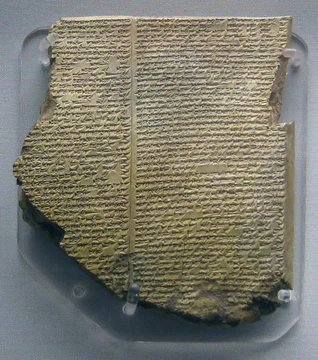
The earliest known epic poems emerge from the religious and mythological landscapes of ancient Mesopotamia, predating the eighth century BC. Works such as the Epic of Gilgamesh, the tales of Lugalbanda, the stories of Enmerkar, Atrahasis, and the Enuma Elish all belong to the Mesopotamian religious tradition, while the Descent of Inanna into the Underworld and the Legend of Keret, rooted in Ugaritic religion, extend this tradition across the ancient Near East. By the eighth through sixth centuries BC, Greek mythology had produced its own towering epics: the Iliad and Odyssey, both ascribed to Homer, alongside Hesiod's Works and Days, Theogony, and Shield of Heracles. The so-called Epic Cycle and Theban Cycle, composed by multiple anonymous poets, expanded these narratives, though only fragments of most survive. Additional poems attributed to Hesiod and Homer during antiquity—such as the Catalogue of Women, Titanomachy, and Capture of Oechalia—further illustrate how densely layered the ancient Greek epic tradition was, even when entire works have been lost to time.
The Indian Epic Tradition: A Continuous Thread
India contributed some of the longest and most enduring epic poems in the world. The Mahabharata, ascribed to Veda Vyasa, and the Ramayana, attributed to Valmiki, both date to the fifth and fourth centuries BC and are rooted in Indian religious tradition. The tradition continued to evolve: the second century saw Buddhacarita by Aśvaghoṣa, while the fourth century produced Kālidāsa's Kumārasambhava and Raghuvaṃśa. In the seventh century, Sanskrit courtly epics like Bhaṭṭikāvya drew on the Ramayana and Pāṇini's grammar, and Bharavi's Kiratarjuniya and Magha's Shishupala Vadha each retold episodes from the Mahabharata. The eighth through tenth centuries brought the Bhagavata Purana, a Sanskrit work drawing on earlier sources, while Kannada poets Adikavi Pampa and Ranna composed Vikramarjuna Vijaya, Ādi purāṇa, Ajitha Purana, and Gadaayuddha. By the eleventh century, Nannayya's Andhra Mahabharatam carried the tradition into Telugu, demonstrating how Indian epic poetry spanned languages, centuries, and religious frameworks.
The Roman and Latin Epic Legacy
Roman and Latin poetry built extensively upon Greek mythological and historical material, producing a rich body of epic verse from the second century BC through the fourth century AD. Ennius's Annales, composed in the second century BC, offered a Roman historical epic but survives only in fragments. The first century BC brought Lucretius's De rerum natura, a work of natural philosophy, and Virgil's Georgics, a didactic poem, alongside the Aeneid, rooted in Roman mythology. The first century AD saw Ovid's Metamorphoses, Lucan's unfinished Pharsalia on Roman history, Valerius Flaccus's incomplete Argonautica, Silius Italicus's Punica, and Statius's Thebaid and incomplete Achilleid. The third and fourth centuries continued the tradition with Quintus of Smyrna's Posthomerica, Triphiodorus's Sack of Troy, and Claudian's De raptu Proserpinae and Gigantomachy, both incomplete. Even in the eleventh century, the Carmen Campidoctoris emerged as the first poem about El Cid, showing how the Latin epic form persisted across a full millennium.
The Medieval Mosaic: Epic Poetry Across Cultures
The North Germanic Poetic Edda preserved oral traditions without a single identifiable author. Persian literature saw Ferdowsi's Shahnameh, which narrates Persian legend and history from prehistoric eras through the collapse of the Sassanid Empire, alongside Garshaspname and Borzu Nama. Arabic tradition contributed the Taghribat Bani Hilal, while Byzantine Greek produced Digenis Akritas and the Song of Armouris. The Tibetan Epic of King Gesar, the Turkic Alpamysh, and the Armenian Daredevils of Sassoun further illustrate the global reach of the form. In South Asia, Tamil epics like Cilappatikāram, Manimekalai, Neelakesi, and Cīvaka Cintāmaṇi, along with the Pali Mahavamsa, enriched the medieval landscape. Christian epics, including the Vision of Dorotheus, Gospel Epics by Juvencus and Sedulius, and Prudentius's Psychomachia, added a religious allegorical dimension to the tradition.
More in Poetry Collections And Epic Poems 1-22
Spotted an error? Know more?
This is a living reference — every entry is fact-audited, and reader corrections feed straight into our audit queue. Suggest an edit · See this site's audit record