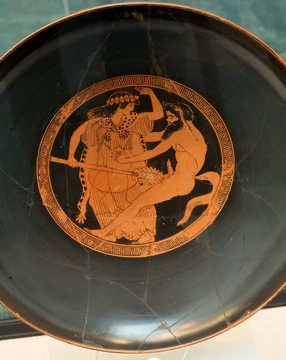
Women of Trachis

Women of Trachis (also known as *The Trachiniae*) is an Athenian tragedy written by Sophocles, likely performed sometime between 450 and 425 BC. Critics and scholars have long disagreed on its exact date, and the play is often regarded as less polished than Sophocles’ other surviving works.
The plot opens with Deianeira, Heracles’ wife, recalling her difficult early life and the challenges of her marriage. Before Heracles, the river god Achelous had courted her, but with Zeus’s help, Heracles defeated him and took her as his wife. Now, Heracles is frequently absent, and she has not heard from him in fifteen months. Worried about prophecies that he will die if he stays where he is, she sends their son Hyllus to find him. Soon after, a messenger arrives saying Heracles has won a battle and is making offerings at Cape Cenaeum before returning to Trachis, though his homecoming has been delayed by crowds eager to hear of his victories.
Heracles’ herald, Lichas, then arrives with a group of captives. He falsely tells Deianeira that Heracles attacked the city of Oechalia because its king, Eurytus, had tried to enslave him. In truth, Heracles destroyed the city to obtain Iole, Eurytus’s daughter, after the king refused to let him take her as a secret lover. Deianeira learns the truth from another messenger and confronts Lichas, who confirms it.
Distraught over her husband’s infatuation with a younger woman, Deianeira decides to use a love charm. Years earlier, the centaur Nessus had tried to assault her while carrying her across the River Evenus. Heracles shot Nessus with an arrow, and as he died, Nessus told Deianeira that his blood—mixed with the Hydra’s poison from the arrow—would prevent Heracles from loving anyone more than her, if she followed his instructions. Now, she dyes a robe with the blood and sends it to Heracles via Lichas, insisting no one else wear it and that it be kept in darkness until he puts it on.
After sending the gift, Deianeira grows uneasy. She tests leftover material in sunlight, and it reacts like boiling acid. Realizing Nessus tricked her—the “charm” was actually poison meant to kill Heracles—she is horrified. Hyllus returns and reports that his father, poisoned by the robe, is dying in agony. In his pain and rage, Heracles killed Lichas by smashing his skull. Overcome with shame and her son’s harsh accusations, Deianeira takes her own life. Hyllus later learns she acted without malice. Heracles, carried home in torment, initially believes his wife tried to murder him, but Hyllus explains the truth. Heracles then understands that a prophecy has been fulfilled: he would be killed by someone already dead—Nessus.
In unbearable pain, Heracles begs to be killed, lamenting that his weakness makes him like a woman. He forces Hyllus to promise two things: to take him to Zeus’s highest peak and burn him alive on a pillar, and to marry Iole. Heracles is then carried offstage to his death.
The play’s date is unknown, with scholars like T.F. Hoey arguing for an early date around 450 BC. Evidence for an early date includes the play’s less developed dramatic form, which suggests a younger Sophocles. The plot also resembles a story in Bacchylides XVI, but differs significantly from earlier versions; Hoey and others think Sophocles’ version likely influenced Bacchylides, not the reverse. Further evidence comes from the character of Deianeira, who is softer and more feminine than earlier portrayals—unlike Clytemnestra in Aeschylus’s *Oresteia* (produced in 458 BC), who deliberately kills her husband. Some scholars believe Sophocles’ Deianeira was meant as a commentary on Aeschylus’s Clytemnestra, which would place *Women of Trachis* reasonably close to that date.
- type
- Athenian tragedy
- author
- Sophocles
- genre
- Tragedy
- original_language
- Ancient Greek
- setting
- Trachis
Quick Facts
- Writer
- Sophocles
- Chorus
- Women of Trachis
- Characters
- Deianeira / Nurse / Hyllus / Messenger / Lichas / Heracles / Old man
- Mute
- Iole
- Setting
- At Trachis, before the house of Heracles
- Premiere Place
- Athens
- Original Language
- Ancient Greek
- Genre
- Athenian tragedy
Facts from the source article.
Lore & Background
The story begins with Deianeira, the wife of Heracles, relating her early life and difficulties in married life. Heracles was not her first suitor; the river god Achelous first wooed her, but with Zeus's intervention, Heracles defeated Achelous and took her as a wife. Now distraught over her husband's neglect, she sends their son Hyllus to find him, concerned about prophecies foretelling that Heracles will die if he stays where he is. A messenger arrives with word that Heracles, victorious in battle, is making offerings before coming home. Lichas, a herald, arrives with captives and lies about why Heracles laid siege to the city of Oechalia. Deianeira learns the truth: Heracles besieged the city to obtain Iole, daughter of King Eurytus, as a secret lover.
Reader's Guide
Women of Trachis is significant for its exploration of unintended consequences and the fulfillment of prophecy. Deianeira, unable to cope with her husband's infatuation with Iole, uses a love charm given by the centaur Nessus—his blood mixed with the poison of the Lernaean Hydra. The charm proves to be a poison that brings death to Heracles. The play examines themes of knowledge and responsibility, and its characterization of Deianeira as softer and more feminine than earlier versions has been seen as a commentary on Aeschylus' Clytemnestra. The dating of the play remains disputed, with scholars arguing for early (c. 430s), or late (c.
Did You Know?
- Deianeira's character in Women of Trachis is softer and more feminine than in earlier versions, possibly as a commentary on Aeschylus' Clytemnestra.
- The centaur Nessus gave Deianeira his blood mixed with Hydra poison, claiming it would be a love charm, but it actually killed Heracles.
- Heracles' prophecy that he would be killed by someone already dead was fulfilled by Nessus, who was already dead when Heracles died.
Frequently Asked Questions
What is Women of Trachis?
It is an Athenian tragedy composed by Sophocles in Ancient Greek, set in the town of Trachis. The drama focuses on Deianira, Heracles' wife, and the catastrophic events that unfold in their household.
What is the plot of Women of Trachis?
Deianira, convinced she must win back Heracles' affection, is manipulated into giving him a garment soaked in a deadly poison. Heracles perishes in agonizing pain, and the play closes with the aftermath for those who loved him.
Why do critics often regard Women of Trachis as less polished than Sophocles' other tragedies?
Many scholars feel the dramatic structure and character development are somewhat uneven compared to masterpieces like Oedipus Rex or Antigone. Its uncertain composition date and a sense of rougher dramatic architecture have led to the view that it may be an earlier, less refined work in his output.
Why is Women of Trachis significant in the history of Greek drama?
It is one of the few surviving tragedies that places a woman's domestic grief and agency at the center of the action. The play also preserves a vivid dramatic rendering of Heracles' death, a scene that went on to become a major subject in later Greek art and literature.
More in Plays & Drama 1-18
Spotted an error? Know more?
This is a living reference — every entry is fact-audited, and reader corrections feed straight into our audit queue. Suggest an edit · See this site's audit record