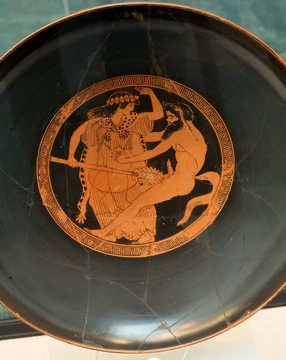
Henry IV, Part 2
A history play about Prince Hal's kingship and Falstaff's rejection.

Miami U. Libraries - Digital Collections · No restrictions
Henry IV, Part 2 is a history play by William Shakespeare, written between 1596 and 1599. It is the third installment in a tetralogy, coming after Richard II and Henry IV, Part 1, and before Henry V. Rather than a direct continuation of the historical story, the play is often seen as an expansion of elements from Henry IV, Part 1, giving more attention to the popular character Falstaff and adding new comic figures to his circle, such as Ancient Pistol, Doll Tearsheet, and Justice Robert Shallow. Several scenes mirror those in Part 1.
The plot picks up where Henry IV, Part 1 ends, centering on Prince Hal’s path to becoming king and his eventual rejection of Falstaff. Unlike the first part, Hal and Falstaff’s stories run almost entirely separately—they meet only twice, and briefly. Much of the play has an elegiac mood, focusing on Falstaff’s aging and his nearness to death, which mirrors the declining health of the king.
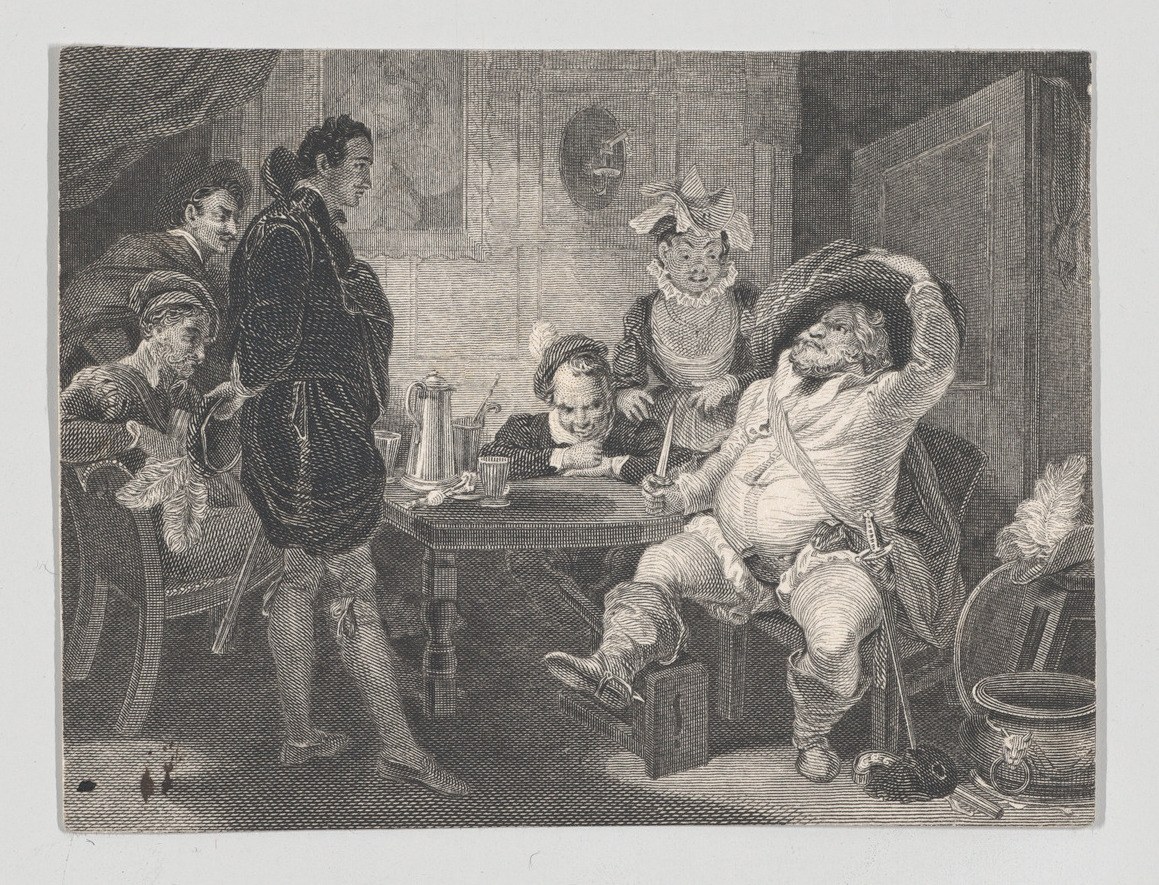
Falstaff continues drinking and committing petty crimes in London’s underworld. He first appears with a young page, assigned to him as a joke by Prince Hal. Falstaff asks about a doctor’s analysis of his urine, and the page cryptically says the urine is healthier than the patient. Falstaff delivers one of his most famous lines: “I am not only witty in myself, but the cause that wit is in other men.” He plans to dress the page in ragged clothes, complains about being broke (“consumption of the purse”), and vows to find a wife in the local brothels. The Lord Chief Justice seeks him out; Falstaff feigns deafness, then pretends to mistake him for someone else. When questioned about a robbery, Falstaff shifts the topic to the king’s illness, claims to be much younger than the Chief Justice, and asks for a loan of one thousand pounds for a military expedition, which is refused.
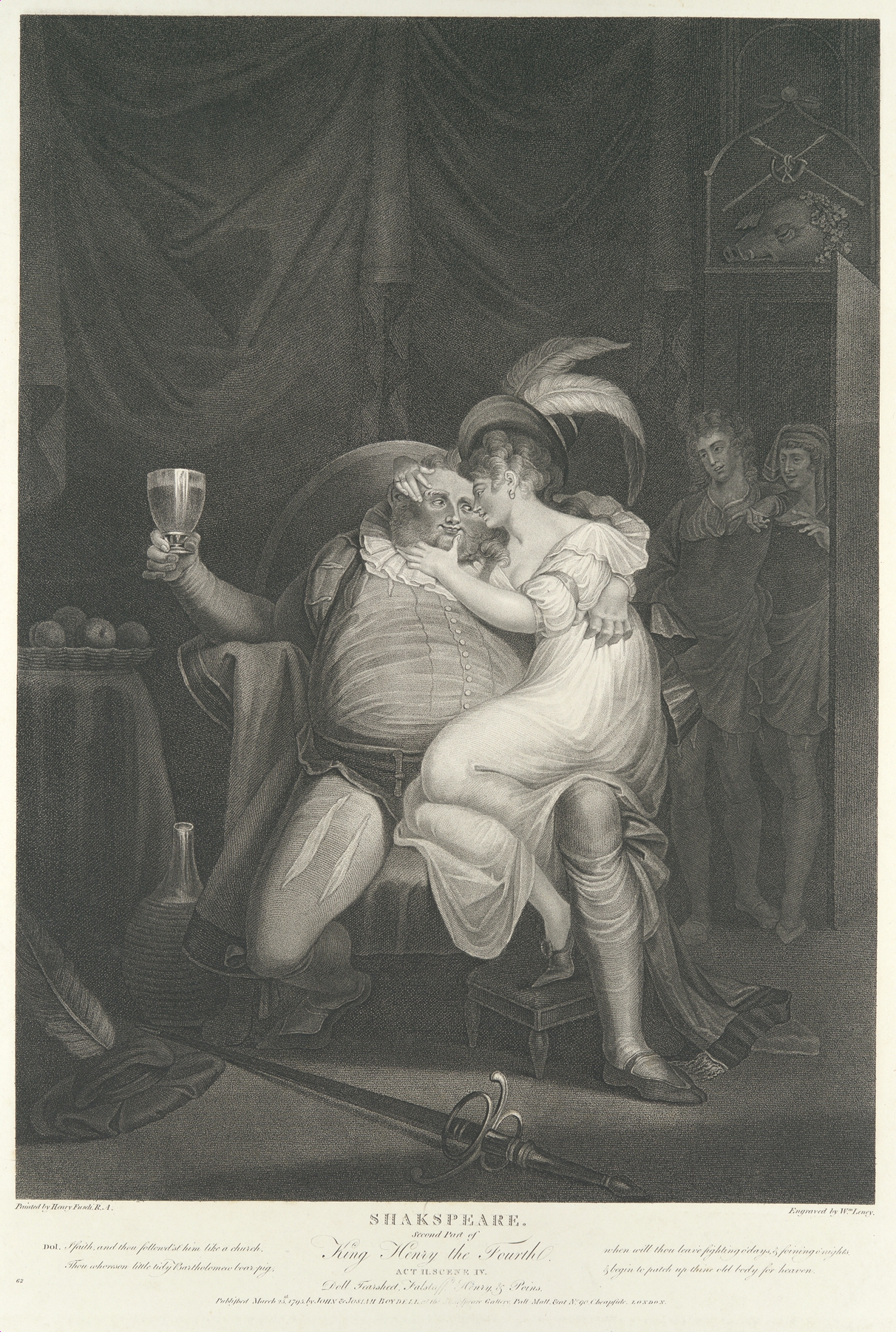
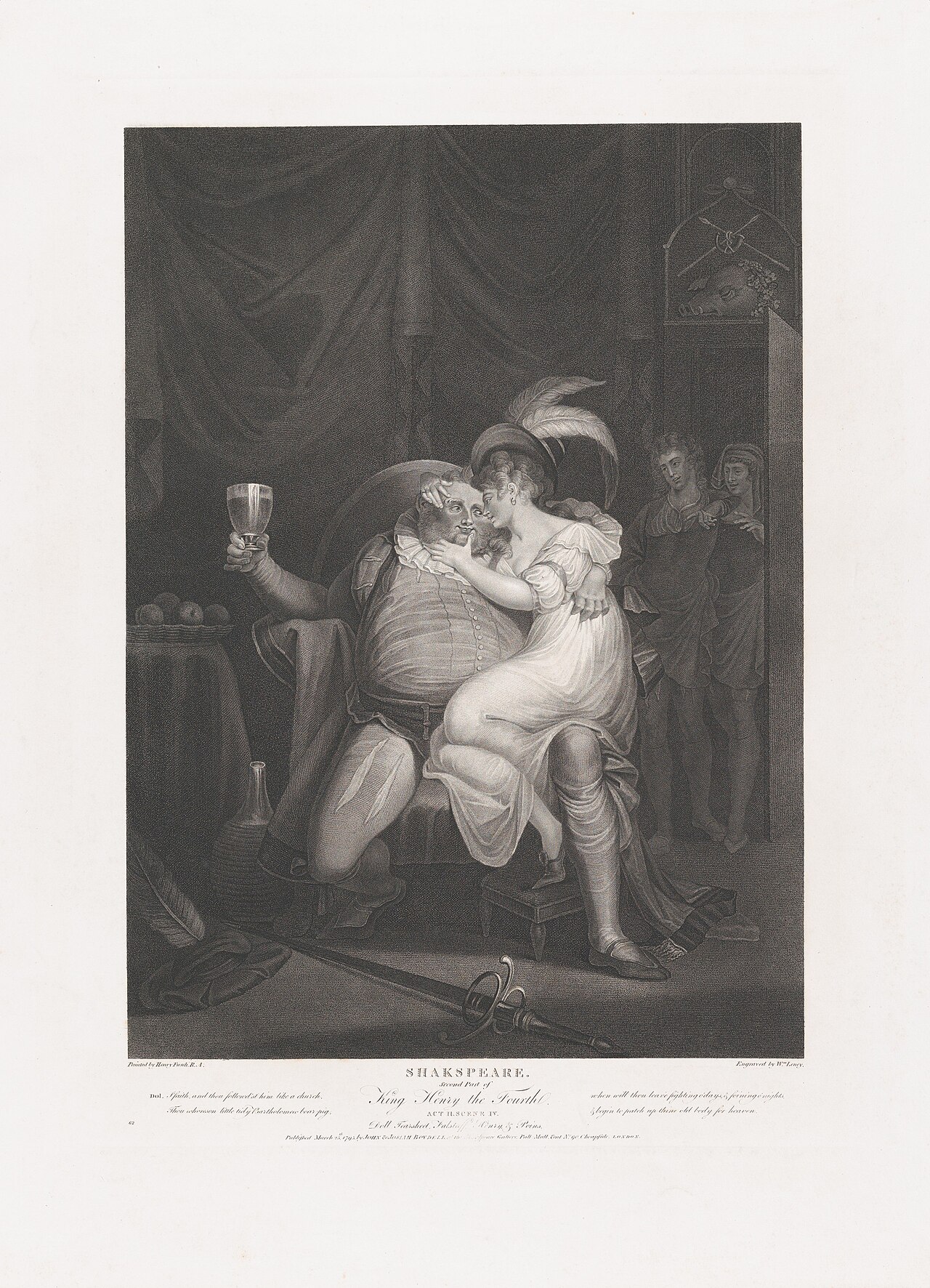
Falstaff has a relationship with the prostitute Doll Tearsheet, who fights with his ensign, Ancient Pistol. After Falstaff throws Pistol out, Doll asks about the Prince. Falstaff makes derogatory remarks about Hal, not realizing Hal is nearby disguised as a musician. Hal overhears, and Falstaff tries to talk his way out of it, but Hal is unconvinced. When news of a second rebellion arrives, Falstaff rejoins the army and goes to the countryside to recruit soldiers. There he meets an old school friend, Justice Shallow, and they reminisce about their youth. Shallow presents potential recruits—Mouldy, Bullcalf, Feeble, Shadow, and Wart, a motley group of rustics. Falstaff and his cronies take bribes from Mouldy and Bullcalf to exempt them from service.
In the other storyline, Hal still associates with London lowlife and seems unfit for kingship. King Henry IV is again disappointed in him, despite court reassurances. Another rebellion rises against the king, but it is defeated not by battle but through the deceitful political maneuvers of Hal’s brother, Prince John. The king then falls ill and appears to die. Hal, seeing this, believes he is king and leaves with the crown. When King Henry awakens, he is devastated, thinking Hal only cares about becoming king. Hal convinces him otherwise, and the old king dies contentedly after advising his son to neutralize internal threats by waging war abroad: “Be it thy course to busy giddy minds / With foreign quarrels.”
The two storylines converge in the final scene. Falstaff learns from Pistol that Hal is now king and travels to London expecting great rewards. But Hal rejects him, saying he has changed and can no longer associate with such people. The London lowlifes, who anticipated a thieves’ paradise under Hal, are instead purged and imprisoned by the authorities.
The play ends with an epilogue thanking the audience and promising a continuation in a forthcoming play “with Sir John in it, and make you merry with fair Katharine of France; where, for all I know, Falstaff shall die of a sweat.” Although Falstaff does die “of a sweat” in Henry V, it happens offstage in London at the start of that play, described by another character; he never appears on stage. The Merry Wives of Windsor includes Sir John, but cannot be the play referred to, since the epilogue clearly describes Henry V’s story and his wooing of Katherine of France. In Henry V, Falstaff’s role as a cowardly soldier is taken by Ancient Pistol, his braggart sidekick from Henry IV, Part 2 and Merry Wives. The epilogue also assures the audience that Falstaff is not based on the anti-Catholic rebel Sir John Oldcastle, because “Oldcastle died martyr, and this is not the man.” Falstaff was originally named Oldcastle, following Shakespeare’s main model, an earlier play called The Famous Victories of Henry V. Shakespeare changed the name after complaints from Oldcastle’s descendants. While modern critics agree the name was originally Oldcastle in Part 1, it is disputed whether Part 2 initially kept that name or always used “Falstaff.” According to René Weis, metrical analyses of the verse passages containing Falstaff’s name have been inconclusive.
- Playwright
- William Shakespeare
- Genre
- History play
- Part of
- Tetralogy (Richard II, Henry IV Part 1, Henry IV Part 2, Henry V)
Lore & Background
The play picks up where Henry IV, Part 1 left off, but Hal and Falstaff meet only twice and very briefly. Falstaff continues drinking and petty crime in London, accompanied by new characters including Ancient Pistol, Doll Tearsheet, and Justice Shallow. He feigns deafness to avoid the Lord Chief Justice, asks for a loan of one thousand pounds, and later accepts bribes from potential recruits not to be conscripted. In the other storyline, King Henry IV is disappointed in Hal, but after the king's death Hal convinces him of his loyalty and receives advice to wage war abroad. In the final scene, Hal rejects Falstaff, saying he has changed and can no longer associate with such people.
Reader's Guide
Henry IV, Part 2 is generally seen as a less successful play than Part 1, with a structure in which Falstaff and Hal barely meet, sometimes criticized as undramatic. Some critics believe Shakespeare never intended a sequel and was hampered by a lack of historical material, making comic scenes seem like filler. However, the scenes with Falstaff and Justice Shallow are admired for their touching elegiac comedy, and Falstaff's rejection can be extremely powerful onstage. The critic Harold Bloom has suggested the two parts of Henry IV along with the Hostess' elegy for Sir John in Henry V may be Shakespeare's greatest achievement. It was less popular than Part 1, and this was the only quarto edition. The epilogue promises a forthcoming play with Sir John in it, though Falstaff dies offstage in Henry V.
Did You Know?
- The play is the third part of a tetralogy, preceded by Richard II and Henry IV, Part 1 and succeeded by Henry V.
- Falstaff was originally named Oldcastle, but Shakespeare changed the name after complaints from Oldcastle's descendants.
- The epilogue assures the audience that Falstaff is not based on the anti-Catholic rebel Sir John Oldcastle.
Production & Filming
The two-part adaptation was filmed simultaneously over a three-month span from January through March 2012. The production team made use of several distinct locations across England and Wales. Ealing Studios in London served as the base where the Boar's Head Tavern set was constructed. Court scenes depicting Henry IV's presence at the Palace of Westminster were captured at Gloucester Cathedral. In Wales, Caerphilly Castle doubled for two separate narrative purposes: it stood in for Warkworth Castle and also hosted the scenes involving the meeting with Glendower. The climactic Battle of Shrewsbury was shot in a field near Rickmansworth, and the crew encountered an unexpected winter snowfall during filming. Although the historical engagement took place in July, director Richard Eyre welcomed the conditions, explaining that English grass tends to soften the visual impact of battle, while the snow converted the landscape into a stark, monochromatic world.
Cast & Creative Team
The creative leadership behind both episodes was concentrated in a small group: Sam Mendes served as producer, while Richard Eyre handled both the direction and the adaptation of Shakespeare's text. The principal cast featured Jeremy Irons in the role of King Henry IV, Simon Russell Beale as the beloved companion Falstaff, and Tom Hiddleston as the young Prince Hal. A significant portion of the cast and crew worked across both parts, reinforcing the sense of a continuous narrative that flows directly from one episode to the next. The most notable recognition came for Simon Russell Beale, whose performance as Falstaff was awarded the 2013 British Academy Television Award for Supporting Actor, cementing his portrayal as a standout achievement in the series.
Shakespearean Context & Adaptation
Within the broader architecture of Shakespeare's Henriad, the two Henry IV plays occupy the second and third positions in a tetralogy that traces the successive reigns of Richard II, Henry IV, and Henry V. The Hollow Crown's first series adapted this second set of plays as its second and third episodes, placing them after the Richard II installment and before the Henry V conclusion. The adaptation treats the two parts as a unified narrative arc, with the plot flowing directly from Part 1 into Part 2 without a significant break. This structural choice mirrors the original plays' interdependence, where the political intrigue and personal relationships established in the first part carry forward and evolve in the second, creating a seamless dramatic progression across both episodes.
Broadcast & Release
The two episodes found their audience on BBC Two in the summer of 2012. Part 1 was scheduled for Saturday, 7 July 2012, but the broadcast was delayed by a full hour to accommodate live coverage of the 2012 Wimbledon Championships. To make up for the late start, the episode was repeated the following Sunday, 8 July, on BBC4. Part 2 aired exactly one week later on Saturday, 14 July 2012, maintaining the weekly Saturday schedule. The placement during the Wimbledon period meant that the first episode's premiere was somewhat overshadowed by the sporting event, though the repeat on BBC4 gave viewers a second opportunity to watch at a more conventional time.
Gallery
Frequently Asked Questions
What is Henry IV, Part 2 about?
The play tracks Prince Hal's final steps toward the throne, capped by his public rejection of his old companion Falstaff. A smaller rebellion led by the Earl of Worcester and Hotspur's widow also unfolds, which the young prince must suppress before his father's death.
How does Henry IV, Part 2 end?
King Henry IV dies, and the newly crowned Henry V turns on Falstaff with the famous words, 'I know thee not, old man.' The final scene leaves Falstaff alone, meditating on his own aging and approaching death, giving the play a deeply elegiac close.
Where does Henry IV, Part 2 sit in Shakespeare's history cycle?
It is the third installment of the four-play Henriad tetralogy, following Richard II and Henry IV, Part 1 and leading directly into Henry V. The tetralogy together traces the rise of Henry V from a wayward prince to a celebrated king.
Why is Falstaff's final scene so important to the play?
It is the last appearance of one of English drama's most beloved comic figures, and Shakespeare strips away his usual wit to force him to confront mortality. The scene shifts the play's tone from comedy to elegy and marks the definitive farewell to the character.
More in Plays & Drama 1-18
Spotted an error? Know more?
This is a living reference — every entry is fact-audited, and reader corrections feed straight into our audit queue. Suggest an edit · See this site's audit record