They Always Run
A space western action-platformer with a three-armed bounty hunter.

U.S. Marine Corps photo by Lance Cpl. Jennifer Le · Public domain
They Always Run is a science-fiction and Western themed action-platformer developed by Alawar and released for Windows by PID Games in 2021, with console ports following in 2022. Described by its developer as a 'story-driven action scroller,' the game features a three-armed bounty hunter protagonist and received average reviews upon release, noted for its detailed visual presentation and combat mechanics.
Quick Facts
- Title
- They Always Run
- Developer
- Alawar
- Publisher
- PID Games (console)
- Platform
- Windows, PlayStation 4, Xbox One, Switch
- Released
- WindowsWW · October 20, 2021 · PS4, XOne, Switch WW · May 19, 2022
- Genre
- Platform
- Modes
- Single-player
Facts from the source article.
Lore & Background
They Always Run was created by Russian developer Alawar, with a team of between 10 and 13 staff who had worked on previous titles including Distrust and I Am Not A Monster: First Contact. The game originated from a studio contest where staff proposed and bid on pitches, with designer Artemy Naimushin's winning proposal for 'a game about a space hunter.' Producer and lead artist Stepan Komarov stated the team aimed for a unique visual style based on 'classical art education,' adopting a labor-intensive frame-by-frame animation approach inspired by cartoon animation. The space western tone was inspired by television series including Firefly and Cowboy Bebop, seeking to capture 'the feeling of a space adventure with a team on a ship.' The game was announced on April 12, 2021, and showcased at the E3 PC Gaming Show.
Reader's Guide
They Always Run received average reviews according to Metacritic, with The Verge citing it as one of the best titles from the 2021 E3 PC Gaming Show. Critics praised the game's visual presentation and animation, with NME noting the 'convincing detail' and use of parallax layering and dynamic lighting, while Rock Paper Shotgun highlighted 'painterly detail' and 'incredibly satisfying' player animations. PC Gamer commended the 'stylish' animation and 'love for detail' in backgrounds, and Vandal described the 'unusual' and 'comic' appearance as 'magnificent.' Combat and gameplay received generally positive but mixed responses: NME found combat 'immediately endearing' with a 'casual looseness to its hit-boxes,' while PC Gamer enjoyed its 'relative simplicity' but found the third arm's controls 'awkward and noodly.' Vandal faulted the controls for 'lack of fluidity' and a 'crude and unrewarding' skill progression system. The narrative and writing were generally well-received, with Rock Paper Shotgun commending 'brilliant pacing' and 'endearing' dialogue, and NME highlighting the writing as 'genuinely pretty funny,' though Vandal expressed the writing was not particularly good but provided structure.
Did You Know?
- The game was derived from designer Artemy Naimushin's winning proposal in a studio contest for 'a game about a space hunter.'
- The third arm's special directional attack can break enemy shields or holds and shoot weapons, but its use is limited to charges built from parrying.
- Players can attempt to capture bounties alive at greater difficulty or kill the target for a reduced bounty.
- The game's space western tone was inspired by television series Firefly and Cowboy Bebop.
Origins & Pioneers
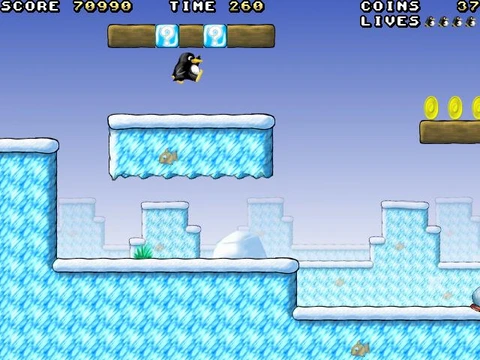
The platformer genre traces its roots to the early 1980s arcade era. Space Panic (1980), an Universal release, is sometimes credited as the first platformer, offering walkable platforms and ladders but notably omitting any jumping mechanic. Nichibutsu's Crazy Climber, also from 1980, presented another precursor by having the player scale vertically scrolling skyscrapers. The true breakthrough arrived with Nintendo's Donkey Kong (1981), the first title to let players leap over obstacles and gaps. It introduced Mario and set the template for what were initially dubbed "climbing games." A wave of imitators followed swiftly: Miner 2049er and Kangaroo in 1982, Sega's Congo Bongo in 1983 adding an isometric third dimension, and Pitfall! in 1982, which stretched play across a series of non-scrolling screens. Donkey Kong was ported to numerous consoles and computers, most notably as the system-selling pack-in for ColecoVision, a move that helped cement Nintendo as a major international force in the industry.
Core Mechanics & Level Design
At its heart, a platformer demands that a player guide a character across uneven terrain and suspended platforms to reach a goal, all while fending off enemies and dodging hazards. Presentation is typically a side-view two-dimensional layout, though three-dimensional variants place the camera behind the character or in an isometric perspective. Gameplay is intensely dynamic, testing reflexes, timing, and controller dexterity. The standard movement toolkit includes walking, running, jumping, attacking, and climbing, with jumping serving as the genre's defining verb—though exceptions like Popeye and BurgerTime, both from 1982, prove the rule. Jump trajectories vary: in Donkey Kong the arc is fixed, while other titles allow mid-air adjustment. Falling often means damage or death, and environmental killers such as lava pits and bottomless chasms add constant tension. Power-ups and collectibles grant new abilities, levels escalate in difficulty, and boss encounters punctuate the progression toward the final goal.
Naming & Cultural Identity
For years after Donkey Kong's 1981 release, the genre lacked a settled name. Shigeru Miyamoto himself described it during development as a "running/jumping/climbing game" and later preferred the term "athletic game" for titles like Super Mario Bros. Journalists and writers filled the vacuum with their own labels: Computer and Video Games magazine called them "Donkey Kong-type" or "Kong-style" games. Steve Bloom's 1982 book Video Invaders and magazines like Electronic Games and TV Gamer adopted "climbing games," with Bloom defining them as titles where the player ascends from bottom to top while avoiding or destroying foes. A December 1982 Creative Computing review coined "ladder game" for the Apple II title Beer Run, and Video Games Player magazine awarded Coleco's Donkey Kong port "Ladder Game of the Year" in 1983. By the late 1980s, "character action games" appeared for titles built around named protagonists. The term "platform game" finally took hold by 1989, popularized through British press usage.
Legacy & Market Evolution
Nintendo's Super Mario Bros. (1985) and the sprawling Super Mario series that followed became the genre's defining touchstones, introducing horizontally scrolling levels and a named protagonist—Mario—who went on to become Nintendo's global mascot. The platformer's commercial peak arrived in 1998, when the genre accounted for fifteen percent of video game sales. By 2006, that share had plummeted to just two percent, reflecting a broader industry shift away from traditional level-based action. Yet the genre adapted rather than vanished. A modern variant, the endless runner, gained particular traction on mobile platforms, where the character perpetually advances forward and the player's sole task is dodging or jumping over obstacles to avoid falling. This streamlined format preserved the core reflex-testing loop while stripping away complex level design, ensuring that the fundamental joy of leaping across gaps endures in a new era of gaming.
Gallery






Frequently Asked Questions
What is They Always Run?
They Always Run is a science-fiction and Western-themed action-platformer developed by Alawar and published by PID Games. It was released on Windows in October 2021, with PlayStation 4, Xbox One, and Nintendo Switch ports arriving in May 2022.
Who is the main character in They Always Run?
The player controls a three-armed bounty hunter who serves as the protagonist throughout the game's narrative.
What genre and style does They Always Run blend?
The game fuses space-western aesthetics with action-platforming gameplay, and Alawar itself describes the experience as a 'story-driven action scroller.'
How big was the development team behind They Always Run?
Alawar staffed the project with a small team of roughly 10 to 13 developers.
How did critics and players receive They Always Run?
The title earned generally average reviews at launch, with critics specifically singling out its detailed visual presentation and its combat mechanics as standouts.
More in Platform Games, Further Titles 1-24
Spotted an error? Know more?
Reader corrections go straight into our review queue. Suggest an edit · How this site is sourced