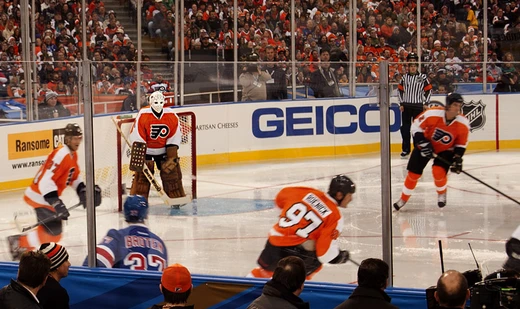
Rick MacLeish
First Flyer to score 50 goals in a season; two-time Stanley Cup champion.
Last updated
Richard George MacLeish (January 3, 1950 – May 30, 2016) was a Canadian professional ice hockey forward who spent 14 seasons in the NHL, suiting up for the Philadelphia Flyers, Hartford Whalers, Pittsburgh Penguins, and Detroit Red Wings. He played 12 of those seasons in Philadelphia, where he helped the Flyers capture back-to-back Stanley Cups in 1974 and 1975. MacLeish’s 53 playoff goals with the Flyers remain a franchise record, tied with Bill Barber.
MacLeish grew up playing minor hockey in Cannington, Ontario, and took part in the 1962 Quebec International Pee-Wee Hockey Tournament with his youth team. He played junior hockey for the Peterborough Petes from 1967 to 1970 before being selected fourth overall by the Boston Bruins in the 1970 NHL Amateur Draft.
After starting his pro career with the Oklahoma City Blazers, he was moved in a three-team trade that sent him, Bruce Gamble, Dan Schock, and a first-round pick to the Flyers; Bernie Parent and a second-round pick to the Toronto Maple Leafs; and Mike Walton to Boston. MacLeish finished the 1970–71 season with Philadelphia, notching two goals and four assists in 26 games, plus a goal in four playoff contests. His production dropped sharply the next season—just one goal—and he split time between the Flyers and their AHL affiliate, the Richmond Robins.
The 1972–73 season marked a breakout. That year, as the Flyers earned the nickname “the Broad Street Bullies,” MacLeish became the first player in franchise history to score 50 goals in a season, adding 50 assists for 100 points. He finished fourth in league scoring, one point behind Bobby Orr.
In the playoffs, the Flyers won their first-ever series against the Minnesota North Stars before facing the heavily favored Montreal Canadiens in the semifinals. MacLeish scored the overtime winner in Game 1 after intercepting a pass from Frank Mahovlich, who lost the puck in a notorious puddle of water on the ice. Philadelphia pushed Montreal to overtime again in Game 2 but lost 4–3, eventually dropping the series 4–1.
In the 1973–74 regular season, MacLeish’s numbers dipped to 32 goals and 45 assists, but he exploded in the playoffs, leading all scorers with 13 goals and 9 assists as the Flyers won their first Stanley Cup. He scored the only goal in the decisive Game 6 and narrowly missed the Conn Smythe Trophy, which went to teammate Bernie Parent.
Lore & Background
MacLeish played minor ice hockey in Cannington, Ontario, and went to the 1962 Quebec International Pee-Wee Hockey Tournament with his youth team. He played junior hockey with the Peterborough Petes from 1967 to 1970. The Boston Bruins selected him fourth overall in the 1970 NHL Amateur Draft. After spending the first half of his first professional season with the Oklahoma City Blazers, MacLeish was involved in a three-way deal which sent him; Bruce Gamble, Dan Schock, and a 1st round pick to the Philadelphia Flyers, Bernie Parent and a 2nd round pick to the Toronto Maple Leafs, and Mike Walton to Boston.
MacLeish spent the rest of the 1970–71 season with the Flyers, scoring two goals and four assists in 26 games. He also added a goal in four playoff games. In the 1971–72 season his output dropped to a single goal, and he split the year between the Flyers and their AHL affiliate the Richmond Robins.
The 1972–73 season, during which the Flyers earned the nickname 'the Broad Street Bullies,' proved to be a breakout year for MacLeish as he became the first member of the Flyers to ever score 50 goals in a single campaign. He added 50 assists that year, for 100 points, finishing fourth in league scoring, a single point behind Bobby Orr.
In the playoffs, the Flyers won their first playoff series against the Minnesota North Stars and faced the Montreal Canadiens in the semi-final round. MacLeish and the Flyers stunned the Canadiens winning the opening game in Montreal when MacLeish intercepted an errant Frank Mahovlich pass (Mahovlich lost the puck in a legendary 'puddle of water' on the ice) and scored in overtime. The Flyers pushed the Canadiens into overtime in game two as well, but lost that game 4–3 and lost the series four games to one.
In the 1973–74 season, MacLeish's regular season scoring dropped to 32 goals and 45 assists. In the playoffs, he led all scorers with 13 goals and 9 assists as the Flyers claimed their first Stanley Cup. He scored the only goal in the series' sixth and final game, and narrowly missed out on winning the Conn Smythe Trophy to his teammate, Bernie Parent.
After another successful regular season in 1974–75 (38 goals, 41 assists), MacLeish again led his team in playoff scoring as they won a second consecutive championship. This championship marked the last time the trophy was raised by a team consisting solely of Canadian-born players. MacLeish's 1975–76 season was marred by injury; he played only 51 games, managing 22 goals and 23 assists, and was unable to play in the playoffs, which saw the Flyers swept in four games by the Montreal Canadiens.
Reader's Guide
MacLeish's playing style was shaped by years of river skating, which gave him smooth, long striding speed. He depended on a whipping and accurate wrist shot for the majority of his goals and was the Flyers' first pure goal-scoring 'sniper.' In 2016, sportswriter Bill Fleischman recalled, 'Forty-two years later, I can still see him gliding across the opponent's blue line with the puck, often swerving left, leaning as if he might tumble to the ice and flicking a wrist shot past the goalie. It seemed as if MacLeish was on cruise control.' After the 1980–81 season, the Flyers traded MacLeish, Blake Wesley, and Don Gillen to the Hartford Whalers for Fred Arthur and Ray Allison. During the 1981–82 season, the Whalers traded MacLeish to the Pittsburgh Penguins for Russ Anderson.
Pittsburgh released MacLeish during the 1982–83 season, and he played briefly in Switzerland. He rejoined the Flyers as a free agent for the 1983–84 season, and was traded during the season to the Detroit Red Wings for future considerations. He retired at the end of that season. In retirement, MacLeish enjoyed owning racehorses.
Later life
In the early 2000s, he suffered a heart attack during a Flyers Alumni game and had cardiac bypass surgery the next day. He also suffered from diabetes. On May 11, 2016, his daughter announced he had been battling multiple medical problems for the last six weeks in a Philadelphia hospital. MacLeish died in that hospital on May 30, 2016, at age 66 of meningitis, as well as kidney and liver failure.
Tribute
He was survived by his wife, Charlene, and two daughters, Brianna and Danielle. Philadelphia Flyers team president Paul Holmgren issued a statement: 'With the passing of Rick MacLeish, the Flyers have lost one of their legends. A good father, grandfather, teammate and friend, Rick will be missed by all who were fortunate to come and know him over the years. His happy and friendly demeanor was front and center everywhere Rick went.'
Career statistics and honours
Career statistics
| Regular Season | Playoffs | |||||||||||
|---|---|---|---|---|---|---|---|---|---|---|---|---|
| Season | Team | League | GP | G | A | Pts | PIM | GP | G | A | Pts | PIM |
| 1966–67 | London Nationals | OHA-Jr. | 2 | 0 | 0 | 0 | 0 | — | — | — | — | — |
| 1966–67 | Peterborough Petes | OHA-Jr. | 8 | 0 | 0 | 0 | 0 | — | — | — | — | — |
| 1967–68 | Peterborough Petes | OHA-Jr. | 54 | 24 | 25 | 49 | 16 | 5 | 2 | 1 | 3 | 0 |
| 1968–69 | Peterborough Petes | OHA-Jr. | 54 | 50 | 42 | 92 | 29 | 10 | 7 | 14 | 21 | 8 |
| 1969–70 | Peterborough Petes | OHA-Jr. | 54 | 45 | 56 | 101 | 135 | 6 | 4 | 4 | 8 | 10 |
| 1970–71 | Oklahoma City Blazers | CHL | 46 | 13 | 15 | 28 | 93 | — | — | — | — | — |
| 1970–71 | Philadelphia Flyers | NHL | 26 | 2 | 4 | 6 | 19 | 4 | 1 | 0 | 1 | 0 |
| 1971–72 | Richmond Robins | AHL | 42 | 24 | 11 | 35 | 33 | — | — | — | — | — |
| 1971–72 | Philadelphia Flyers | NHL | 17 | 1 | 2 | 3 | 9 | — | — | — | — | — |
| 1972–73 | Philadelphia Flyers | NHL | 78 | 50 | 50 | 100 | 69 | 10 | 3 | 4 | 7 | 2 |
| 1973–74 | Philadelphia Flyers | NHL | 78 | 32 | 45 | 77 | 42 | 17 | 13 | 9 | 22 | 20 |
| 1974–75 | Philadelphia Flyers | NHL | 80 | 38 | 41 | 79 | 50 | 17 | 11 | 9 | 20 | 8 |
| 1975–76 | Philadelphia Flyers | NHL | 51 | 22 | 23 | 45 | 16 | — | — | — | — | — |
| 1976–77 | Philadelphia Flyers | NHL | 79 | 49 | 48 | 97 | 42 | 10 | 4 | 9 | 13 | 2 |
| 1977–78 | Philadelphia Flyers | NHL | 76 | 31 | 39 | 70 | 33 | 12 | 7 | 9 | 16 | 4 |
| 1978–79 | Philadelphia Flyers | NHL | 71 | 26 | 32 | 58 | 47 | 7 | 0 | 1 | 1 | 0 |
| 1979–80 | Philadelphia Flyers | NHL | 78 | 31 | 35 | 66 | 28 | 19 | 9 | 6 | 15 | 2 |
| 1980–81 | Philadelphia Flyers | NHL | 78 | 38 | 36 | 74 | 25 | 12 | 5 | 5 | 10 | 0 |
| 1981–82 | Hartford Whalers | NHL | 34 | 6 | 16 | 22 | 16 | — | — | — | — | — |
| 1981–82 | Pittsburgh Penguins | NHL | 40 | 13 | 12 | 25 | 28 | 5 | 1 | 1 | 2 | 0 |
| 1982–83 | Pittsburgh Penguins | NHL | 6 | 0 | 5 | 5 | 2 | — | — | — | — | — |
| 1982–83 | EHC Kloten | NDA | 1 | 0 | 0 | 0 | 0 | — | — | — | — | — |
| 1983–84 | Philadelphia Flyers | NHL | 29 | 8 | 14 | 22 | 4 | — | — | — | — | — |
| 1983–84 | Detroit Red Wings | NHL | 25 | 2 | 8 | 10 | 4 | 1 | 0 | 0 | 0 | 0 |
| NHL totals | 846 | 349 | 410 | 759 | 434 | 114 | 54 | 53 | 107 | 38 | ||
Tables copied from the source article, totals included as the source gives them: Wikipedia: Rick MacLeish (CC BY-SA 4.0). Wide tables scroll sideways.
Frequently Asked Questions
Who is Rick MacLeish?
Rick MacLeish was a Canadian forward who played 14 NHL seasons, spending 12 of them with the Philadelphia Flyers. He is best remembered as a two-time Stanley Cup champion and one of the franchise's most prolific playoff scorers.
What was Rick MacLeish's role on the Flyers?
MacLeish served as a top-line forward and primary goal-scorer for Philadelphia. In the 1972–73 season he became the first Flyer ever to reach 50 goals in a single regular season.
How many Stanley Cups did Rick MacLeish win?
He captured back-to-back titles in 1974 and 1975, both with the Philadelphia Flyers. Those consecutive championships remain the highlight of his 14-year NHL career.
What franchise record does Rick MacLeish hold?
His 53 playoff goals scored while wearing the Flyers' sweater are a franchise record, a mark he shares with Bill Barber. No other Flyer has surpassed that total in postseason play.
When did Rick MacLeish die?
MacLeish passed away on May 30, 2016, at the age of 66. He had been born on January 3, 1950, in Cannington, Ontario.
More in Philadelphia Flyers Players
Test yourself
Three questions drawn from this entry’s sources. Pick an answer to check it.
Answers checked against the source article
Sources
Compiled from Wikipedia and the sources listed below. Text from Wikipedia is available under CC BY-SA 4.0; this entry is adapted from it.
- Wikipedia: Rick MacLeish (CC BY-SA 4.0).
- Statistics, medals and awards: the tables of the source article.
- Word definitions: the Codexery glossary, each quoted from its Wikipedia article.
Spotted an error? Know more?
Reader corrections go straight into our review queue. Suggest an edit · How this site is sourced