Juan Álvarez
Last updated

via Wikipedia: Juan Álvarez · see source
Juan Nepomuceno Álvarez Hurtado de Luna, generally known as Juan Álvarez, was a general and long-time caudillo in southern Mexico who served as president for two months in 1855 after the liberals ousted Antonio López de Santa Anna. His presidency kicked off the pivotal era of La Reforma. A liberal reformer, republican, and federalist, he rose to power in the Tierra Caliente by protecting indigenous peasants' lands. Historian Peter Guardino called him "most important as a champion of the incorporation of Mexico's peasant masses into the polity" through universal male suffrage and municipal autonomy.
Early life
Juan Álvarez was born in Santa Maria de la Concepcion Atoyac on 27 January 1790 to Antonio Álvarez and Rafaela Hurtado. He was educated in Mexico City under Ignacio Aviles, whom he later entrusted with his first son's education. When the Mexican War of Independence began in 1810, he joined José María Morelos's forces on 17 November as part of the second battalion of the Guadalupe Regiment and was promoted to sergeant the next month. Within a year he became a colonel.
Morelos sent him on a dangerous mission to Zacatula, and he later served in Morelos's personal escort. On 11 January he participated in the rout of Spanish General Francisco Paris. He led a company to accept the surrender of the Fort of San Diego, but the Spanish commander allowed his forces to approach before firing; most of Álvarez's men died, and Álvarez was wounded in both legs. Soldier Diego Eugenio Salas carried him to safety despite his own injuries.
During the fighting he lost his home and wealth of thirty-five pesos and lived off the land, earning the nom du guerre Gallego. In 1821 he joined Agustín de Iturbide's Trigarantine Army and led a siege of Acapulco with three hundred men, taking the port on 15 October. After independence, his request to retire was denied, and he was tasked with commanding the Acapulco fortress.
Centralist Republic of Mexico
During the Pastry War of 1838, Álvarez offered his services to the government. He took part in the 1841 revolt against Anastasio Bustamante, and the triumphant Santa Anna promoted him to division general. He suppressed Indian uprisings in the mountains of Chilapa and the Tierra Caliente, which often took on ethnic conflict characteristics. In the Mexican-American War, he chose not to fight despite commanding a notable army.
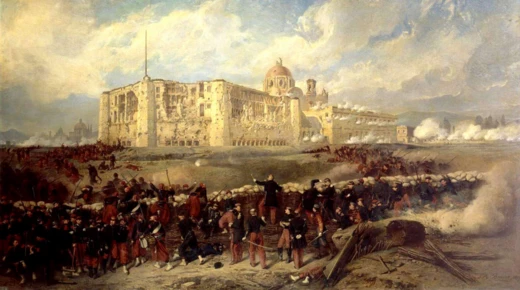
At the Battle of Molino del Rey in September 1847, Santa Anna ordered him to lead a cavalry force of 3,000–4,000 men to attack the U.S. flank, but Álvarez's cavalry never launched a decisive charge. Some later narratives criticized him, claiming he argued the terrain was unsuitable and held back. He contributed to establishing the State of Guerrero and became its first governor. He fought against the Plan of Jalisco, which overthrew President Mariano Arista and paved the way for Santa Anna's return in 1853.
Plan of Ayutla
Juan Álvarez rose up against Santa Anna’s dictatorship on February 20, 1854. Two weeks later, Colonel Florencio Villareal issued a revolutionary program in Ayutla, Guerrero. It opened with a list of complaints about the dictatorship, followed by nine articles. Santa Anna and his officers were removed from power in the name of the people.
Once most of the nation accepted the plan, the revolutionary leader would call an assembly of state and territory representatives to pick an interim government. That interim president would have enough power to run the country and protect its sovereignty. States that backed the plan would set up new governments, and the republic’s unity was declared unbreakable. The interim president would also convene a congress.
Trade and military matters were to be handled properly. Conscription and passport laws were canceled. Anyone opposing the plan was seen as a threat to national independence. Nicolás Bravo, Tomas Moreno, and Juan Álvarez were put in charge of the movement.
The plan was approved in Acapulco with a few changes, including one that allowed adjustments based on the national will, and Álvarez became the leader. Santa Anna fought back harshly, seizing revolutionaries’ property, burning enemy towns, and executing captured commanders. He personally attacked Acapulco but failed to take it and retreated to Mexico City. The rebellion kept growing, and by August 1855 Santa Anna stepped down.
His successor, Martín Carrera, tried to be a compromise figure and started enacting parts of the Ayutla Plan, but Álvarez and the other leaders distrusted him as a leftover from the old regime. After a month of failed talks, Carrera quit, and Mexico City garrison commander Rómulo Díaz de la Vega took over, backing the Plan of Ayutla and waiting for Álvarez to arrive.
Presidency
Álvarez formed a cabinet with Ignacio Comonfort as Minister of War, Melchor Ocampo as Minister of Relations, Guillermo Prieto as Minister of the Treasury, Benito Juárez as Minister of Justice and Ecclesiastical Affairs, and Miguel Lerdo de Tejada as Minister of Development. His first measure was framing an organic statue as an interim constitution. He needed to strengthen federal powers and alleviate the financial crisis. He decreed that a vacancy in the executive would be filled by the council of state.
On 15 October he granted amnesty to military deserters. On 16 October he called for a congress to assemble at Dolores Hidalgo in February 1856 to organize the nation under a republican, democratic, representative form, based on the Bases of Tacubaya of 1841. The cabinet debated dissolving the military; Ocampo and Juárez favored it, Comonfort opposed it. Clashes led to Ocampo's resignation on 7 December, replaced by Miguel Maria Arrioja.
Constitutional disorder spread as local governments assumed virtual sovereignty. The federal government forbade military governors from interfering in treasury matters or seizing custom house funds. Álvarez, governing from Cuernavaca, moved himself and his troops to Mexico City. The alleged brutality of his troops, known as 'pintos', caused distrust and rumors that he would be overthrown in favor of Comonfort.
Frequently Asked Questions
When and where was Juan Álvarez born?
Juan Álvarez was born on 27 January 1790 in Atoyac, New Spain.
When did Juan Álvarez die?
Juan Álvarez died on 21 August 1867 in La Providencia, Guerrero.
More in People of the Second French Intervention in Mexico
Sources
Compiled from Wikipedia and the sources listed below. Text from Wikipedia is available under CC BY-SA 4.0; this entry is adapted from it.
- Wikipedia: Juan Álvarez (CC BY-SA 4.0).
Spotted an error? Know more?
Reader corrections go straight into our review queue. Suggest an edit · How this site is sourced