Jules Brunet
Last updated

via Wikipedia: Jules Brunet · see source
Jules Brunet was a French military officer who served the Tokugawa shogunate during the Boshin War in Japan. Originally sent as a horse artillery instructor with the French military mission of 1867, he refused to leave after the shōgun's defeat and played a leading role in the separatist Republic of Ezo. His actions later inspired the character played by Tom Cruise in the 2003 film The Last Samurai. After the rebellion's defeat, he returned to France, fought in the Franco-Prussian War, and eventually reached the rank of general of division.
Early life and career
Brunet was born in Belfort, in the region of Bourgogne-Franche-Comté, to Jean-Michel Brunet, a veterinary doctor in the army, and Louise-Adine Rocher. He began his military education in 1855 at Saint-Cyr, then entered the École Polytechnique, graduating 68th of 120. After joining the horse artillery, he finished at the school of artillery of Metz, graduating fourth in his course in 1861.
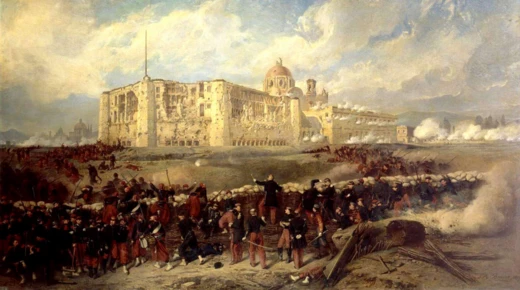
Shortly afterward, he served as a sub-lieutenant in the horse artillery regiment of the Imperial Guard during the French invasion of Mexico. He distinguished himself at the Siege of Puebla in 1863, for which Napoleon III awarded him the Cross of the Légion d'honneur. Promoted to captain in 1867, he also created quickly-drawn croquis that French newspapers published to illustrate the war.
Mission to Japan
In 1866, the French government decided to send military advisors to Japan to modernize the Shogun's army. Brunet, recommended by government official Émilien de Nieuwerkerke for his performance in artillery school and in Mexico, was a main choice for the artillery corps. At 28, he was one of the youngest officers selected. The fifteen-member mission, led by Captain Charles Chanoine, departed aboard the Péluse in November 1866 and arrived in Japan in January 1867.
Brunet trained the Shogun's troops for about a year and was promoted to captain in August 1867. After the Shogun was overthrown in the Boshin War in 1868, the mission was ordered to leave Japan in late September. Chanoine arranged departure on two ships sailing on 15 and 28 October, but Brunet chose to stay and assist the Ōuetsu Reppan Dōmei (the Northern Alliance) against the Imperial faction. He resigned from the French army on 4 October 1868, writing to Minister of War Adolphe Niel that he renounced the rank of captain.
In a letter to Napoleon III, he explained that the daimyos of the North had offered him the role of being the soul of a reaction, and that with one thousand Japanese officers and non-commissioned officers he could direct the 50,000 men of the Confederation.
Boshin War
Brunet took an active role in the Boshin War. He and Cazeneuve were present at the Battle of Toba–Fushimi in January 1868, before the mission was recalled. When Edo fell, they escaped to Sendai and then to Hokkaidō, where they captured the port city of Hakodate on 26 October 1868. By year's end, Enomoto and his allies proclaimed the independent Republic of Ezo, and Brunet became its de facto Minister of Foreign Affairs.
He handled negotiations with foreign powers and drafted French-language announcements. He helped organize the Ezo army under hybrid Franco-Japanese leadership, with Otori Keisuke as commander-in-chief and Brunet as second-in-command. Each of four brigades was commanded by a French officer. The final stand was the Battle of Hakodate in June 1869, where 3,000 Ezo forces were defeated by 7,000 Imperial troops.
In his memoirs, Brunet praised Shinsengumi vice-commander Hijikata Toshizō, saying that if he had been in Europe he would have been a general.
Return to France and later career
Brunet and other French advisers were evacuated from Hokkaidō by the French corvette Coëtlogon, commanded by Abel-Nicolas Bergasse du Petit-Thouars. In Yokohama they were arrested by the new French plenipotentiary Maxime d'Outrey, then taken to Saigon by the Dupleix before returning to France. The new Japanese government requested punishment, but his actions had popular support in France and the request was denied. He received a light sentence of six months' suspension and rejoined the French army in February 1870 with slight loss in seniority.
During the Franco-Prussian War he distinguished himself at Spicheren, Mars-la-Tour, and Gravelotte, and was taken prisoner at the Siege of Metz. After the war he played a key role in the Versailles Army's suppression of the Paris Commune. Promoted to chef d'escadron in 1879, he served as military attaché to Rome. As colonel he commanded the 11th Artillery Regiment from 1887 to 1891.
Promoted to brigade general in December 1891, he commanded the 48th Infantry Brigade and later the 19th Artillery Brigade. In 1898, Chanoine, now Minister of War, made him chef de cabinet and promoted him to general of division. He retired into the army reserve in January 1903 and died in Fontenay-sous-Bois on 13 August 1911 after a long illness.
Frequently Asked Questions
When and where was Jules Brunet born?
Jules Brunet was born on 2 January 1838 in Belfort, France.
When did Jules Brunet die?
Jules Brunet died on 12 August 1911 in Fontenay-sous-Bois, France.
More in People of the Second French Intervention in Mexico
Test yourself
Three questions drawn from this entry’s sources. Pick an answer to check it.
Answers checked against the source article
Sources
Compiled from Wikipedia and the sources listed below. Text from Wikipedia is available under CC BY-SA 4.0; this entry is adapted from it.
- Wikipedia: Jules Brunet (CC BY-SA 4.0).
Spotted an error? Know more?
Reader corrections go straight into our review queue. Suggest an edit · How this site is sourced