Ignacio Comonfort
Last updated

via Wikipedia: Ignacio Comonfort · see source
Ignacio Gregorio Comonfort de los Ríos (12 March 1812 – 13 November 1863) was a Mexican politician and soldier who served as president during La Reforma. He played a leading role in the liberal movement that overthrew the dictatorship of Santa Anna and later assumed the presidency when Juan Álvarez stepped down. His tenure saw the drafting of the Constitution of 1857, but his attempt to compromise with conservatives by nullifying that constitution led to his resignation and exile.
Plan of Ayutla
Comonfort's liberal sympathies and military office placed him at the center of the Plan of Ayutla, a revolutionary program formulated by Colonel Florencio Villareal on 1 March 1854. The plan condemned Santa Anna's dictatorship, military conscription, and the Gadsden Purchase, and called for a new president and representative assembly.
Comonfort ratified the plan at Acapulco with amendments allowing changes according to the national will, and Juan Álvarez was chosen as head of the movement. During the revolution, Comonfort undertook a mission abroad to obtain war materiel, later established his base in Michoacán, and prepared to march on Guadalajara. He entered Guadalajara on 22 August 1855 and published a circular to that effect, and by September he had secured the recognition of Álvarez's leadership from independent revolutionary leaders Antonio de Haro y Tamariz and Manuel Doblado.
Role in Alvarez administration
President Álvarez appointed Comonfort as Minister of War, serving alongside Melchor Ocampo (Relations), Guillermo Prieto (Treasury), Benito Juárez (Justice and Ecclesiastical Affairs), and Miguel Lerdo de Tejada (Development). On 16 October, a call was made for a congress to assemble at Dolores Hidalgo in February 1856 to organize the nation under a republican, democratic, and representative form, based on the Bases of Tacubaya of 1841. Álvarez stepped down before that date, leaving Comonfort to preside over the congress.
Within the cabinet, divisions emerged: Ocampo and Juárez favored dissolving the military and rebuilding it, while Comonfort preferred reforming the military class without destroying it. Comonfort was publicly seen as more moderate than his fellow ministers. Álvarez moved himself and his troops to Mexico City, but the filth and brutality of his 'pintos' troops caused disgust and rumors that Álvarez would be overthrown in favor of Comonfort. The cabinet represented a new generation of liberals who intended to pass unprecedented reforms, beginning with the Juárez Law of 22 November 1855, which stripped ecclesiastical courts of their right to judge civil cases involving clergy.
Opponents accused government deputies of hypocrisy for maintaining their own immunity while claiming to support equality before the law.
Presidency
Two days after assuming the presidency, Comonfort appointed his cabinet: Luis de la Rosa (Relations), Ezequiel Montes (Justice and Ecclesiastical Affairs), Manuel Siliceo (Development), José María Lafragua (Interior Relations), Manuel Payno (Treasury), and Jose Yanez (War and Marine). The ministers outlined a program to avoid territorial dismemberment, avoid civil war, use force only as a last resort, convoke a constitutional congress, and publish an organic statute as a provisional constitution.
The government dismantled remnants of Santa Anna's dictatorship: on 9 January 1856, a decree held Santa Anna, his ministers, and governors responsible for illegal acts, and their estates were seized. The ministry promised legislation on personal rights, the press, police, the national guard, and a moderate approach to ecclesiastical affairs. Economic measures included opening ports to commerce, facilities for commerce, manufacturing, mining, and education, and allowing foreigners to own real estate under certain conditions.
A revolt flared at San Luis Potosí on 10 December 1856, when over 1,000 men of Rosas Landa's brigades revolted under Manuel Maria Calvo. Hostile movements occurred in Michoacán and Tlaxcala, Tomás Mejía led troops around San Juan de los Llanos, and Indians of Chapala revolted with instigation from Guadalajara.
Exile, return and death
After generals Rangel and Pardo convinced him that holding the capital was hopeless, Comonfort decided to slip away from the city on the morning of January 22. Conservative General Parra let him pass, and he made for the liberal stronghold of Veracruz. On February 7, he boarded the steamer Tennessee and sailed for Europe with his family. By 1861, he was living in Texas and asked Santiago Vidaurri to help him get permission to come back to Mexico.
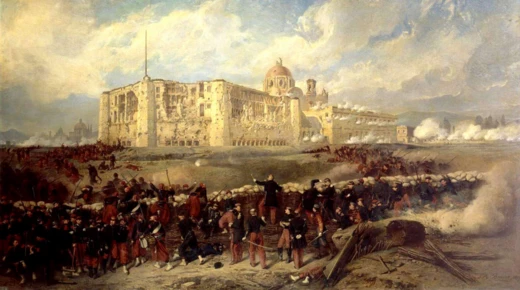
Vidaurri let him settle in Monterrey. The government first wanted him arrested but later accepted his help when the French Intervention started. Comonfort had to lead newly drafted troops who were no match for the French, and he lost the Battle of San Lorenzo on May 8, 1863, then fell back to Mexico City. He went along when the national government fled the capital on May 31, 1863, and was appointed Minister of War.
On November 13, while riding from San Luis Potosí to Guanajuato, he was ambushed and killed between Chamacuero and Celaya at the Soria Mill by a band led by Chief Gonzales Aguirre. His body was taken to San Miguel de Allende, and after the republic was restored in 1867, his ashes were moved to the San Fernando cemetery.
Did You Know?
- Comonfort was 20 years old in 1832 when he took part in the liberal revolt that overthrew President Anastasio Bustamante, and by the Siege of Mexico City he was already a cavalry captain.
- Comonfort was elected president of the third ayuntamiento in the capital and made prefect of western State of Mexico during the Mexican-American War.
- He was removed from his customs post in Acapulco during Santa Anna's last dictatorship in 1854.
Frequently Asked Questions
When and where was Ignacio Comonfort born?
Ignacio Comonfort was born on 12 March 1812 in Amozoc de Mota, Puebla, Viceroyalty of New Spain.
When did Ignacio Comonfort die?
Ignacio Comonfort died on 13 November 1863 in Chamacueros, Guanajuato, Mexico (now Municipio de Comonfort).
More in People of the Second French Intervention in Mexico
Sources
Compiled from Wikipedia and the sources listed below. Text from Wikipedia is available under CC BY-SA 4.0; this entry is adapted from it.
- Wikipedia: Ignacio Comonfort (CC BY-SA 4.0).
Spotted an error? Know more?
Reader corrections go straight into our review queue. Suggest an edit · How this site is sourced