Jesús González Ortega
Last updated

via Wikipedia: Jesús González Ortega · see source
Jesús González Ortega was a Mexican soldier and politician who served as governor of Zacatecas and was a notable ally of President Benito Juárez during the Reform War and the French intervention in Mexico. He is best known for defending the city of Puebla against the French army from March 16, 1863, to May 16, 1863. His later falling out with Juárez over the presidential succession led to his arrest and eventual retirement from public life.
Early life
Ortega was born in San Mateo, in Valparaíso, Zacatecas, and later moved to Guadalajara, Jalisco, where he began law studies that he could not complete for family reasons. As a young man he worked as a clerk at City Hall in San Juan Bautista of Teúl. From his youth he was a fervent supporter of the Liberal Party. As governor of Zacatecas in 1859, he issued severe decrees against priests agitating against the Constitution of 1857, prescribing the death penalty for acts such as denying sacraments to Catholics who had sworn fealty to the constitution; the penalty was also applied to laymen who served as witnesses for those retracting their oaths.
Military career
Although not a career soldier, González Ortega led President Juárez's army to victory at the decisive battle of Calpulalpan in 1860. He was appointed Minister of War in March 1861 but resigned due to differences with cabinet members, remaining in command of the division of Zacatecas. On August 8, 1861, he commanded at the Battle of San Felipe del Obraje. After the murders of Melchor Ocampo, Santos Degollado and Leandro Valle, he returned to Mexico City and was appointed president of the Supreme Court of the Nation, a position that made him successor to the president.
French intervention in Mexico
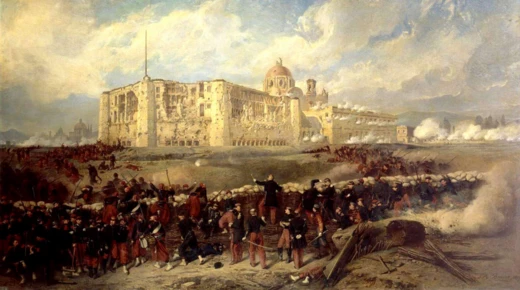
González Ortega arrived in Puebla a day after General Ignacio Zaragoza defended the city on May 5, 1862. However, his army was routed at the Battle of Cerro del Borrego and forced to retreat. He was then instructed to defend Puebla against the French under General Élie Frédéric Forey. The French besieged the city from March 16, 1863; after two months of heavy losses on both sides, with no weapons or ammunition left and his strength sharply reduced, Ortega ordered his army to surrender on May 16, 1863, and later disperse, giving up the capital.
In 1864, Ortega claimed the presidency, arguing that Juárez' term had expired and that the constitution required the presidency to pass to him as president of the Supreme Court. It was pointed out that the clause did not take effect until the following year, and Ortega left for the United States. When Juárez' term expired in 1865, Ortega's claim was declared forfeited because he had been out of the country. Ortega defended himself, publishing a letter from December 1864 granting him permission to leave his post indefinitely as long as he continued to aid the war effort; he claimed he had done so, that Juárez' government had ignored his request to recruit volunteers, and that he was entangled in a US lawsuit.
He also argued that a conspiracy had placed him in critical positions without sufficient forces. Most liberals supported Juárez, though Ortega gained support from General José María Patoni and Guillermo Prieto. As the Second Mexican Empire collapsed in 1866, the departing French urged Maximilian to abdicate and considered forming a new republican government friendly to France and led by González Ortega.
Did You Know?
- Ortega claimed the presidency in 1864–1865 based on his position as president of the Supreme Court, but most liberals supported Juárez.
- His supporter General José María Patoni was kidnapped and murdered in 1868 by General Benigno Canto, who alleged he acted on orders from Minister of War Ignacio Mejía.
Frequently Asked Questions
When and where was Jesús González Ortega born?
Jesús González Ortega was born on 20 January 1822 in Valparaíso, Zacatecas, Mexican Empire.
When did Jesús González Ortega die?
Jesús González Ortega died on 18 February 1881 in Saltillo, Coahuila, Mexico.
More in People of the Second French Intervention in Mexico
Sources
Compiled from Wikipedia and the sources listed below. Text from Wikipedia is available under CC BY-SA 4.0; this entry is adapted from it.
- Wikipedia: Jesús González Ortega (CC BY-SA 4.0).
Spotted an error? Know more?
Reader corrections go straight into our review queue. Suggest an edit · How this site is sourced