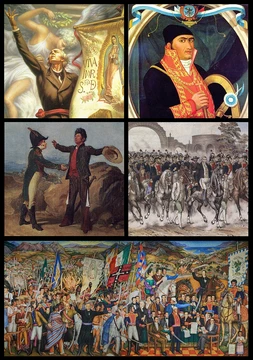
José Figueroa
Mexican governor who unified Alta California and oversaw mission secularization.
Last updated
José María Figueroa (1792 – 29 September 1835) was a Mexican politician and military officer who served as governor of Alta California from 1833 until his death. A veteran of the Mexican War of Independence, he helped formalize the alliance between Vicente Guerrero and Agustín de Iturbide that ended the war. He also authored the Manifiesto a la República Mexicana (1835), the first book-length work printed in California.
Early life and Mexican War of Independence
Figueroa was born in 1792 in Jonacatepec, in what is now Morelos, Mexico. He was of short stature and dark complexion, came from a family of predominantly indigenous ancestry, and openly expressed pride in his heritage. In 1811 he joined the insurgent forces of José María Morelos, serving directly under Mariano Matamoros. He participated in the Capture of Oaxaca and the Battle of La Chincúa.
After the executions of Matamoros and Morelos in 1815, Vicente Guerrero became the leading insurgent commander. From 1815 to 1821, Figueroa served as treasurer of the insurgent forces while remaining an active combatant; he earned high praise for his role in the Battle of El Tamo. In early 1821, as royalist commander Agustín de Iturbide began conspiring with Guerrero, Figueroa acted as Guerrero's emissary, arranging the meeting at Acatempan and facilitating the Plan of Ayala. He marched into Mexico City as a brigadier general alongside Guerrero and Iturbide.
Alta California governorship
Figueroa was appointed governor of Alta California in 1832 and arrived in January 1833. The province had two rival acting governors: Agustín V. Zamorano in Monterey and José María de Echeandía in Southern California. Both deferred to Figueroa, unifying the government. He oversaw the initial secularization of the missions, including the expulsion of Spanish Franciscan officials.
His government issued many Mexican land grants for former mission lands, though these had originally been intended for Mission Indians. He also dealt with the Híjar-Padrés Colony in Los Angeles, which briefly rebelled. Many mission communities became secular pueblos, keeping their mission names; Figueroa considered renaming Mission Santa Cruz to Villa Figueroa, but the change was never implemented. In 1833, the Mexican Congress passed secularization legislation.
Acting president Valentín Gómez Farías appointed José María de Híjar and D. José María Padrés to lead 239 colonists to establish secular control. A horseman carried the news from Mexico City to Monterey in 40 days, arriving before the colonists' ships.
Illness, death and burial
Francisco García Diego y Moreno reported that Figueroa was greatly agitated by disturbances caused by the colonists. In 1835 Figueroa undertook a strenuous voyage from Monterey to San Francisco, then to San Diego, and back to Monterey in June, already ailing. He participated in the territorial assembly session on 25 August but on 27 August requested a leave of absence, appointing José Castro as interim governor. Confined to bed from 6 September, he resigned on 22 September, naming Castro his successor.
On 27 September he wrote his last will, asking that his body be preserved and buried at Mission Santa Barbara. Figueroa died in Monterey on 29 September 1835. His body was preserved, sent to Santa Barbara by ship, and buried in a crypt beneath Mission Santa Barbara. Rumors of poisoning circulated; Diego later reported symptoms of apoplexy and blood clots in the brain.
In 1912 the casket was opened, revealing a skeleton in a Mexican military uniform, consistent with Figueroa's small stature of no more than five feet two inches.
Legacy
Early 20th-century historian J. M. Guinn wrote that Figueroa is generally regarded as the best of the Mexican governors sent to California. Historian Kevin Starr described him as the most competent governor of California during the Mexican era. Landmarks named after him include Altar de Villa de Figueroa (now Altar, Sonora), Figueroa Mountain in the San Rafael Mountains, Figueroa Street and Figueroa Avenue in Los Angeles, and the Figueroa Street Tunnels.
Did You Know?
- He presented an ambitious colonization scheme known as the Commissioned on the Development of the Californias while serving as a constituent of the Congress of the State of Mexico.
- In 1826 he defeated Yaqui, Mayo and Opata rebels under Juan Banderas in a two-day battle at Pitic.
More in People of the Mexican War of Independence
Sources
Compiled from Wikipedia and the sources listed below. Text from Wikipedia is available under CC BY-SA 4.0; this entry is adapted from it.
- Wikipedia: José Figueroa (CC BY-SA 4.0).
Spotted an error? Know more?
Reader corrections go straight into our review queue. Suggest an edit · How this site is sourced