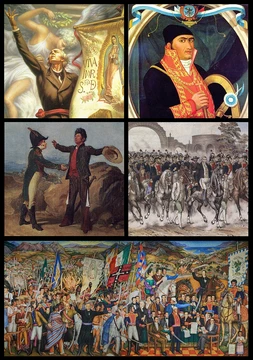
Vicente Guerrero
Mexican insurgent commander, president, and national hero.
Last updated
Vicente Ramón Guerrero Saldaña, a Mexican military leader and guerrilla commander, was a key figure in the War of Independence and became the country's second president in 1829. He is remembered as a consummator of independence and a founder of the First Mexican Republic.
Insurgent
Guerrero joined the early revolt against Spain in November 1810, enlisting in a division organized by José María Morelos to fight in southern Mexico. He gained military expertise at the Battle of Zitlala. At the Battle of Tixtla on 26 May 1811, Morelos sought Guerrero's advice on strategy because Guerrero was from Tixtla. After the battle, Morelos instructed Guerrero to speak to the indigenous people of Tixtla in Nahuatl, which Guerrero spoke from having grown up there, and to inform them of their freedom from the Spanish.
By November 1811, Guerrero and Morelos controlled the highlands of the Mesa Del Sur. Guerrero distinguished himself at the Battle of Izúcar in February 1812 and reached the rank of lieutenant colonel when Oaxaca was claimed by rebels in November 1812. In a 1815 speech in Tlapa, Guerrero argued for extending citizenship to indigenous people. After Morelos was captured and executed in December 1815, Guerrero pledged allegiance in March 1816 to the itinerant insurgent government, the Junta Subalterna Gubernativa Provisional, often called the Junta de Jaujilla.
Using guerrilla tactics learned with Morelos, he fought skirmishes at Piaxtla and Xonacatlán, where he ambushed royalist Captain Jose Vicente Robles's force of 150 troops, securing a victory.
1828 presidential election
Guerrero was a committed liberal and a member of the York Rite Masons, a group founded in Mexico after independence by U.S. diplomat Joel Roberts Poinsett. With no formal political parties, different Masonic lodges acted as political factions. The Yorkinos drew support from a wide cross-section of society, while the Scottish Rite Masons stood for conservative interests. Guerrero commanded a strong base among urban Yorkinos, who were rallied during the 1828 election and its aftermath.
That year, the first president, Guadalupe Victoria, completed his four-year term. The election was fiercely contested. Guerrero’s backers included federalist liberals and the radical wing of the York Rite. He campaigned for universal suffrage, arguing that political opportunity should not depend on race or wealth.
General Manuel Gómez Pedraza won the September election through an indirect vote by state legislatures, with Guerrero finishing second and Anastasio Bustamante third. Gómez Pedraza represented the Impartials, a coalition of Yorkinos uneasy with Guerrero’s radicalism and Scottish Rite Masons. Two weeks after the vote, Antonio López de Santa Anna launched a rebellion on Guerrero’s behalf. Santa Anna stepped down as governor of Veracruz, led 800 troops to seize the Perote fortress, and issued a plan demanding that Gómez Pedraza’s victory be overturned and Guerrero installed as president.
Fall and execution
Guerrero lost power after Vice President Anastasio Bustamante launched a rebellion on December 4, 1829. He went south to fight, but while he was away, the Mexico City garrison removed him from office on December 17. He then returned to the same southern region where he had once fought for independence. There, he faced intense warfare against his former comrade Nicolás Bravo.
Bravo held the highlands, including Tixtla, where Guerrero was born. Guerrero controlled the hot coastal areas of the Costa Grande and Tierra Caliente, where mixed-race communities had been active during the independence struggle. The fighting in the south went on through all of 1830. The conflict finally ended with what one historian called the most shocking event of the early republic: Guerrero was captured in Acapulco through betrayal.
An Italian ship captain, Francisco Picaluga, offered to trap Guerrero for 50,000 pesos. On January 14, 1831, Picaluga invited Guerrero aboard his ship for a meal. Guerrero and a few aides were seized. Picaluga sailed to Huatulco and handed him over to federal troops.
Guerrero was taken to Oaxaca and quickly tried by a court-martial. Conservatives and some state legislatures welcomed his capture, but the legislatures of Zacatecas and Jalisco tried to stop his execution.
The liberal press revealed the government’s payment to Picaluga. Despite appeals for mercy, Guerrero was shot by a firing squad in Cuilapam on February 14, 1831. His death ended the southern rebellion, but the politicians behind his execution never recovered their reputations.
Legacy
Vicente Guerrero is a celebrated Mexican national hero. The state of Guerrero bears his name, and several towns across the country are named after him, such as Vicente Guerrero in Durango, Vicente Guerrero in Baja California, and the Colonia Guerrero neighborhood in Mexico City. Following his death in 1831, his wife Guadalupe, his daughter Dolores, and his former supporters created a political group known as the Guerreroistas, who advocated for equal rights for all races.
Guerrero's grandson, Vicente Riva Palacio, was shaped by this family tradition and, in 1861, was given the chance to investigate the Spanish Inquisition in Mexico, uncovering over 38,000 documents detailing Spanish abuses. Riva Palacio credited his mother Dolores for his beliefs, linking them directly to Guerrero's ideals. In 1986, Senator Antonio Riva Palacio cited his own lineage to Guerrero as inspiration to carry forward Guerrero's mission of equality and equity for all Mexicans, regardless of race.
Historian Lorenzo de Zavala recorded that in 1817, Guerrero’s father urged him to surrender and accept a Spanish pardon. Guerrero replied, pointing to his father, that while he respected him, his country came first. These words, "La Patria es Primero," were inscribed in gold inside Mexico’s Chamber of Deputies in 2007, honoring Guerrero’s lasting impact on Mexican culture and government.
Did You Know?
- Guerrero's father's family included landowners, affluent farmers, traders, members of the Spanish militia, gunsmiths, and cannon manufacturers.
- Guerrero's ethnic origins have been a subject of debate, with some historians suggesting he was of mixed African heritage; no portraits of him were made during his lifetime.
Frequently Asked Questions
Where was Vicente Guerrero born?
Vicente Guerrero was born in Tixtla, Kingdom of Mexico, Viceroyalty of New Spain.
When did Vicente Guerrero die?
Vicente Guerrero died on 14 February 1831 in Cuilapan, Oaxaca, Mexico.
More in People of the Mexican War of Independence
Sources
Compiled from Wikipedia and the sources listed below. Text from Wikipedia is available under CC BY-SA 4.0; this entry is adapted from it.
- Wikipedia: Vicente Guerrero (CC BY-SA 4.0).
Spotted an error? Know more?
Reader corrections go straight into our review queue. Suggest an edit · How this site is sourced