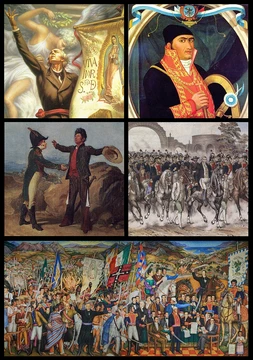
José María Morelos
Priest and insurgent leader who shaped Mexico's independence.
Last updated
José María Morelos was a Mexican Catholic priest, statesman, and military leader who led the Mexican War of Independence after the execution of Miguel Hidalgo y Costilla in 1811. He organized insurgent campaigns in southern and central New Spain, captured Acapulco, and convened the Congress of Anáhuac, which declared Mexico's independence in 1813. Captured and executed in 1815, he is considered a national hero in Mexico.
Early life
Morelos was born in Valladolid, a city later renamed Morelia, which served as the seat of a bishop and the colonial Intendency of Valladolid and was known as the 'Garden of the Viceroyalty of New Spain' for its prosperity. His baptismal register classified him as a Spaniard, though his paternal ancestry included Spaniards, Africans, and Mestizos, while his maternal family was fully Spanish. His father, José Manuel Morelos y Robles, was a carpenter from Zindurio, and his mother, Juana María Guadalupe Pérez Pavón, came from San Juan Bautista de Apaseo.
Through his paternal line, Morelos was related to Miguel Hidalgo y Costilla, both sharing a common ancestor, Diego Ruiz de Cortés, a descendant of Hernán Cortés. Before entering the priesthood, Morelos worked as a muleteer in the area where he later fought, gaining valuable knowledge of the terrain, and also labored on a ranch rented by his uncle for nearly ten years. He studied diligently, influenced by his maternal grandfather, a school teacher, and enrolled in the Colegio de San Nicolás Obispo in Valladolid in 1789, where Hidalgo was rector.
Ordained a secular cleric without connections to secure a benefice, he could pursue business activities to support himself.
Insurrection against the Spanish monarchy
Miguel Hidalgo y Costilla, former rector of the Colegio de San Nicolás Obispo, had been planning with others for New Spain's independence. On 16 September 1810, Hidalgo rang the church bells in Dolores, Guanajuato, and urged his congregation to take up arms with the Cry of Dolores, after the Conspiracy of Querétaro was discovered. Ignacio Allende, Juan Aldama, and Josefa Ortiz de Domínguez were among the initial supporters. The insurgency proclaimed Hidalgo captain general of Mexico in Celaya on 21 September.
Rebels captured the Alhóndiga de Granaditas in Guanajuato on 28 September, killing at least 400 Spaniards, including Intendant Juan Antonio Riaño. The bishop of Michoacán, Manuel Abad y Queipo, excommunicated the insurgents. Hidalgo's army marched to Valladolid, which was taken peacefully on 17 October 1810, after locals feared a repeat of the Guanajuato slaughter.
Legacy
José María Morelos is a revered national figure in Mexico, with the state of Morelos and the city of Morelia named in his honor. Since 1997, his portrait has been featured on the 50-peso banknote, and it previously appeared on 1-peso coins in the 1940s, 1970s, and 1980s. Many sites bear his name, including Estadio Morelos, Puerto Morelos, a Mexico City Metro station, and Ecatepec de Morelos, where he was executed. His remains rest at the Monument to Independence El Ángel in Mexico City.
Frequently Asked Questions
When and where was José María Morelos born?
José María Morelos was born on 30 September 1765 in Valladolid, Michoacán, New Spain.
When did José María Morelos die?
José María Morelos died on 22 December 1815 in San Cristóbal Ecatepec, State of México.
Where did José María Morelos study?
José María Morelos studied at Universidad Michoacana de San Nicolás de Hidalgo.
More in People of the Mexican War of Independence
Test yourself
Three questions drawn from this entry’s sources. Pick an answer to check it.
Answers checked against the source article
Sources
Compiled from Wikipedia and the sources listed below. Text from Wikipedia is available under CC BY-SA 4.0; this entry is adapted from it.
- Wikipedia: José María Morelos (CC BY-SA 4.0).
Spotted an error? Know more?
Reader corrections go straight into our review queue. Suggest an edit · How this site is sourced