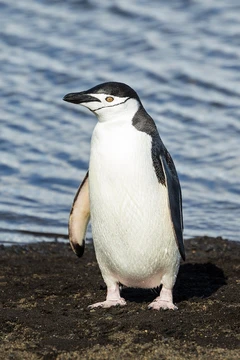
Humboldt penguin
A vulnerable penguin of South America's Pacific coast.
Last updated
The Humboldt penguin (Spheniscus humboldti) is a medium-sized penguin found along the Pacific coast of South America, from Peru to Chile. It is named after the explorer Alexander von Humboldt, as is the cold water current it inhabits. The species is listed as vulnerable by the IUCN, with a declining wild population of roughly 23,800 mature individuals.
Scientific classification
- KingdomAnimalia
- PhylumChordata
- ClassAves
- OrderSphenisciformes
- FamilySpheniscidae
- GenusSpheniscus
- SpeciesSpheniscus humboldti
Named by Meyen, 1834
Close relatives
Other species of Spheniscus with a Codexery entry.
- African penguin Spheniscus demersus
- Magellanic penguin Spheniscus magellanicus
- Galapagos penguin Spheniscus mendiculus
Sources: Wikipedia taxobox: Humboldt penguin (CC BY-SA 4.0) · order, family and genus agree with WoRMS AphiaID 293019 (CC BY 4.0)
Conservation status
Vulnerable (VU)
- LC
- NT
- VU▲ this species
- EN
- CR
- EW
- EX
Source: IUCN Red List assessment · GBIF copy of the Red List category
How big is it?
Largest length in the source, 0.7 m, next to a 1.8 m person.
Diagram: drawn by Codexery, schematic shapes to scale (not a likeness). Length: Wikipedia: Humboldt penguin
Where the humboldt penguin has been recorded
Each dot is a place where the species has been observed and reported (14,545 records, half-degree grid) — not a modelled range. 41 inland records left out (institution coordinates).
Map: drawn by Codexery. Data: GBIF occurrence search (records CC0 / CC BY) · Natural Earth basemap (public domain) · place coordinates: Wikipedia (CC BY-SA 4.0)
Description
Humboldt penguins are medium-sized, reaching 56–70 cm in length and weighing 2.9–6 kg. The sexes are monomorphic in plumage, but males are heavier and larger, with a longer bill and wider head. Among Spheniscus penguins, the Humboldt is the heaviest species: 123 females averaged 4.05 kg and 165 males averaged 4.7 kg. The head is black with a white border running from behind the eye, around the black ear-coverts and chin, meeting at the throat.
Upperparts are blackish-grey, underparts whitish, and a black breast-band extends down the flanks to the thigh. The bill has a fleshy-pink base. Juveniles have dark heads and lack the breast-band. The tongue bears spines used to hold prey.
Vocalizations serve distinct functions. The Yell is a warning call given when an individual approaches too closely, often followed by pecking or chasing; higher penguin density increases territorial behavior and Yell frequency. The Throb is a soft call between mates at the nest, used by incubating birds when their partner returns. The Haw is a short call by juveniles alone in water or by paired birds when one is on water and the other on land, with significant individual variation.
The Bray is a long call for attracting a mate and advertising territory, individually distinct in syllables per call, duration, inter-syllable intervals, and frequency; the bird points its head upward and flaps its flippers slowly. The Courtship Bray is given synchronously by pairs during pre-laying, with necks and heads pointed up and flippers out to the side. Chicks give a Peep when begging for food.
Ecology
The Humboldt penguin feeds mainly on pelagic schooling fish, with cephalopods and crustaceans varying by population. Northern colonies eat Atlantic saury and garfish, while southern populations consume anchovy, Araucanian herring, silver-side, pilchard, and squid. Diet shifts seasonally with fish availability. It is a visual hunter, leaving islands after sunrise; foraging rhythm depends on light intensity, with more time spent foraging during overnight trips.
Fish are seized from below via short, shallow dives. At Pan de Azúcar, foraging range is 2–92 km, with 90% within 35 km and 50% within 5 km; maximum dive depth is 54 m.
Failed breeders take longer trips with deeper dives and dive less often than breeding birds. During courtship, birds bow heads and exchange mutual glances with each eye alternately. In the ecstatic display, the bird extends its head vertically, collapses its chest, flaps its wings, and emits a loud braying call.
Mutual displaying involves the pair standing side by side repeating these actions. Nests are in loose colonies; most pairs lay two eggs of equal size four days apart, requiring 41 days of incubation. Breeding schedule adjusts to food abundance, occurring after moulting when food is plentiful and solar radiation reduced. Eggs are laid from March to December, with peaks in April and August–September; half of females have two clutches per year, mostly double broods.
Lost eggs are replaced within 1–4 months. Incubation shifts average 2.5 days, with no difference in provisioning between sexes.
Threats
The Humboldt current ecosystem is affected by El Niño, which depresses upwelling and increases sea surface temperature anomaly (SSTA). This causes massive juvenile mortality, nest desertion, and reproductive failure. Penguins migrate south following anchovy stocks and expend more time and energy foraging as SSTA rises. The total breeding population requires an estimated 1,400 tons of fish.
Dependence on commercially exploited schooling prey like anchovies makes them vulnerable to overfishing and entanglement in fishing nets. Humboldt penguins are extremely sensitive to human presence, with the greatest response distance reported for any penguin: passing at 150 m from an incubating bird provokes a reaction. They need up to half an hour to recover normal heart rates after human approach, though this decreases with repeated visits. Cumulative stress from frequent visits and delayed return of foraging partners leads to nest desertion and reduced breeding success.
Feral goats on Puñihuil islands browse nest vegetation and cause burrow collapse; connection of the island to the mainland allowed mammal movement. In central Chile, European rabbits and Norway rats graze vegetation; Norway rats and black rats predate eggs; feral cats and dogs consume chicks, fledglings, and adults.
Conservation
Legal protection was granted in 1977 by the Peruvian Government, and the species is listed in Appendix I of CITES, implemented under national law in both Peru and Chile. In August 2010, the Humboldt penguin was protected under the U.S. Endangered Species Act. Most penguins breed within protected areas. Peruvian legislation categorizes it as endangered, prohibiting hunting, possession, capture, transport, and export for commercial purposes.
Chile imposed a 30-year hunting ban in 1995 forbidding hunting, transport, possession, and commercialization. In 2017, a large mining project by Andes Iron in Chile was vetoed due to potential environmental impact on penguins, though later overturned.
As of August 2020, the IUCN lists it as Vulnerable with a declining population. Threats include climate change, overfishing of sardines and anchovy, bycatch, and predation by rats, feral cats, and dogs. Historical guano extraction reduced burrowing habitat.
Did You Know?
- In July 2002, a Humboldt penguin was caught in a fishing net off Prince of Wales Island in Alaska, the only record of a penguin in the wild in North America.
- The 1982–83 El Niño event caused a 65% decline in the Humboldt penguin population and failure of the 1982 hatchling class.
More in Penguins
Test yourself
Three questions drawn from this entry’s sources. Pick an answer to check it.
Answers checked against the source article
Sources
Compiled from Wikipedia and the sources listed below. Text from Wikipedia is available under CC BY-SA 4.0; this entry is adapted from it.
- Wikipedia: Humboldt penguin (CC BY-SA 4.0).
- Classification: the source article's taxobox; order, family and genus checked against WoRMS, the World Register of Marine Species (CC BY 4.0).
- Conservation status: IUCN Red List assessment.
- Occurrence records: GBIF (CC0 / CC BY). Basemap: Natural Earth (public domain).
- Word definitions: the Codexery glossary, each quoted from its Wikipedia article.
Spotted an error? Know more?
Reader corrections go straight into our review queue. Suggest an edit · How this site is sourced