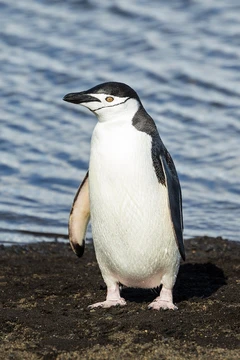
Eastern rockhopper penguin
A small crested penguin with pink bill margins and yellow crest feathers.
Last updated
The eastern rockhopper penguin, or tawaki kaipiki toka, is a small crested penguin with yellow crest feathers. Its bill has distinctive pink edges. Once grouped with the western rockhopper as the "southern rockhopper," it now breeds on islands in the southern Indian and Pacific Oceans.
Scientific classification
- KingdomAnimalia
- PhylumChordata
- ClassAves
- OrderSphenisciformes
- FamilySpheniscidae
- GenusEudyptes
- SpeciesEudyptes filholi
Named by Hutton, 1879
Close relatives
Other species of Eudyptes with a Codexery entry.
- Western rockhopper penguin Eudyptes chrysocome
- Erect-crested penguin Eudyptes sclateri
- Fiordland penguin Eudyptes pachyrhynchus
- Northern rockhopper penguin Eudyptes moseleyi
- Snares penguin Eudyptes robustus
- Macaroni penguin Eudyptes chrysolophus
- Royal penguin Eudyptes schlegeli
Sources: Wikipedia taxobox: Eastern rockhopper penguin (CC BY-SA 4.0) · order, family and genus agree with WoRMS AphiaID 1348499 (CC BY 4.0)
How big is it?
Largest length in the source, 0.55 m, next to a 1.8 m person.
Diagram: drawn by Codexery, schematic shapes to scale (not a likeness). Length: Wikipedia: Eastern rockhopper penguin
Where the eastern rockhopper penguin has been recorded
Each dot is a place where the species has been observed and reported (350 records, half-degree grid) — not a modelled range. 16 inland records left out (institution coordinates).
Map: drawn by Codexery. Data: GBIF occurrence search (records CC0 / CC BY) · Natural Earth basemap (public domain) · place coordinates: Wikipedia (CC BY-SA 4.0)
Quick Facts
- Genus
- Eudyptes
- Species
- filholi
Facts from the source article.
Description
The eastern rockhopper penguin has a black back and throat, a white belly, and pink feet. It measures 45–55 cm in length and weighs 2.2–4.3 kg. A thin yellow stripe runs from its lower forehead over its red eye and splits into crest feathers at the back of its head. The crest consists of long, thin, spiky yellow feathers on each side, joined by shorter black feathers.
Its bill is orange-brown with distinctive pink margins. Males are generally larger and have a thicker bill than females. Fledglings are bluish black all over without crest feathers. Juveniles are black-brown with a grey throat and small yellow crest feathers; adult plumage is attained at 2 years old.
Distribution and habitat
The eastern rockhopper penguin is found in the southern Indian and Pacific oceans from Prince Edward Islands to the Antipodes Islands. It breeds on Marion Islands, Macquarie Island, and subantarctic islands in New Zealand such as the Antipodes Islands and Campbell Island. It occupies a mainly marine pelagic habitat, returning to land only to breed and moult. During winter (April to October), it forages in the southern Indian Ocean, traveling 2000–4000 km from its breeding site and spending up to 6 months at sea.
It forages in cool waters below 4.5°C. It is a surface nester, building nests of small pebbles on slopes or rocky shores near the coastline, often in colonies of tens of thousands. Some colonies settle in grasslands, but soil erodes to rock over decades due to guano and trampling. It is rarely found more than 200 metres from the coast.
Behaviour
Eastern rockhopper penguins use calls for parent-chick recognition when returning with food. Their courtship song is a short, repeated, rhythmic ascending song with 5–30 syllables, the first being the longest. The contact call of chicks and adults is a very short, shrill bark.
Their diet includes fish, crustaceans, and cephalopods such as krill and squid, varying by life stage and location. During pre-moult, they mainly consume crustaceans; during breeding at Marion Islands, they rely heavily on euphausiids. Chicks at Campbell Islands were found to eat dwarf cod.
They depend on predictable food sources near the nest but can forage up to 120 km away if needed. They forage in cool, productive waters and select areas with eddy currents that support high prey aggregations. Predators include fur seals, sea lions, brown skuas, and northern giant petrels.
Threats and Conservation
The eastern rockhopper penguin is considered vulnerable due to rapid population declines, most evident in breeding regions. The decline is attributed to low food availability and reduced food quality driven by climate change. Changing sea surface and ocean temperatures affect prey distribution, forcing adults to forage farther from colonies and return with less food for chicks, reducing chick body mass.
Low food availability also increases mortality during the energy-demanding moulting period. Poor food quality and abundance in wintering regions raise adult mortality. Climate change has also increased storm intensity in breeding ranges, displacing prey and reducing foraging success.
Did You Know?
- The species was formally described in 1879 by Frederick Wollaston Hutton based on a specimen from Campbell Island.
- The specific epithet filholi honors French medical doctor and palaeontologist Henri Filhol.
- A molecular phylogenetic study published in 2021 led to its recognition as a separate species from the western rockhopper penguin.
More in Penguins
Sources
Compiled from Wikipedia and the sources listed below. Text from Wikipedia is available under CC BY-SA 4.0; this entry is adapted from it.
- Wikipedia: Eastern rockhopper penguin (CC BY-SA 4.0).
- Classification: the source article's taxobox; order, family and genus checked against WoRMS, the World Register of Marine Species (CC BY 4.0).
- Occurrence records: GBIF (CC0 / CC BY). Basemap: Natural Earth (public domain).
- Word definitions: the Codexery glossary, each quoted from its Wikipedia article.
Spotted an error? Know more?
Reader corrections go straight into our review queue. Suggest an edit · How this site is sourced