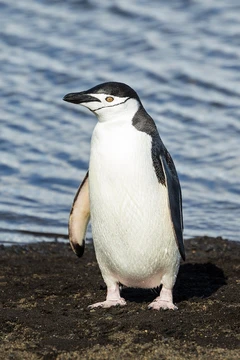
Erect-crested penguin
A crested penguin endemic to New Zealand's subantarctic islands.
Last updated
The erect-crested penguin, known scientifically as Eudyptes sclateri and in Māori as Tawaki nana hī, lives only in New Zealand waters. It breeds exclusively on the Bounty and Antipodes Islands.
Its plumage is black on top and white underneath, with a yellow stripe over the eye and a yellow crest. This bird spends winter at sea, and scientists know very little about its life cycle or nesting behavior. Its numbers likely fell in the late 1900s, and it is now classified as endangered.
Scientific classification
- KingdomAnimalia
- PhylumChordata
- ClassAves
- OrderSphenisciformes
- FamilySpheniscidae
- GenusEudyptes
- SpeciesEudyptes sclateri
Named by Buller, 1888
Close relatives
Other species of Eudyptes with a Codexery entry.
- Eastern rockhopper penguin Eudyptes filholi
- Fiordland penguin Eudyptes pachyrhynchus
- Northern rockhopper penguin Eudyptes moseleyi
- Snares penguin Eudyptes robustus
- Macaroni penguin Eudyptes chrysolophus
- Royal penguin Eudyptes schlegeli
- Western rockhopper penguin Eudyptes chrysocome
Sources: Wikipedia taxobox: Erect-crested penguin (CC BY-SA 4.0) · order, family and genus agree with WoRMS AphiaID 225987 (CC BY 4.0)
Conservation status
Endangered (EN)
- LC
- NT
- VU
- EN▲ this species
- CR
- EW
- EX
Source: IUCN Red List assessment · GBIF copy of the Red List category
How big is it?
Largest length in the source, 0.7 m, next to a 1.8 m person.
Diagram: drawn by Codexery, schematic shapes to scale (not a likeness). Length: Wikipedia: Erect-crested penguin
Where the erect-crested penguin has been recorded
Each dot is a place where the species has been observed and reported (848 records, half-degree grid) — not a modelled range. 25 inland records left out (institution coordinates).
Map: drawn by Codexery. Data: GBIF occurrence search (records CC0 / CC BY) · Natural Earth basemap (public domain) · place coordinates: Wikipedia (CC BY-SA 4.0)
Description
The erect-crested penguin is a black-and-white bird with a bright yellow stripe above each eye that sticks up as a short crest. It stands 50 to 70 centimeters tall and weighs between 2.5 and 6 kilograms. Males are a bit bigger than females and have a larger bill, as is typical for crested penguins. Its upper body ranges from bluish-black to jet black, with white underparts.
Averaging 6.38 kilograms for males and 5.4 kilograms for females, it is the largest crested penguin species and the fourth heaviest living penguin, nearly matching the gentoo penguin in weight. Very little is known about its biology; the only recent research, done on the Antipodes Islands, looked at mate choice.
Study is difficult due to logistical challenges and strict permits from New Zealand’s Department of Conservation. It likely eats small fish, krill, and squid, like other crested penguins. Its scientific name honors British zoologist Philip Lutley Sclater.
Distribution
The Erect-crested penguin nests on the Bounty and Antipodes Islands. Smaller groups were once recorded on Campbell Island and the Auckland Islands, and a single breeding pair was seen on New Zealand’s Otago Peninsula in the 1940s. These birds spend long stretches at sea before molting, from February to March, and throughout winter from March to August. They have been spotted as far off as the Falkland Islands and occasionally turn up in Argentina, Antarctica, and Australia.
Their colonies are large and built on rocky ground. On the Antipodes Islands, they nest alone or alongside Southern Rockhopper penguins; on the Bounty Islands, they share space with Salvin’s albatross. Breeding runs from September to late January, with two eggs per clutch. The first egg is 25 to 70 percent smaller than the second, and the larger egg gets more attention and priority during incubation.
Status
Since the 1940s, the erect-crested penguin has seen a steep drop in numbers. A late 1970s count on the Bounty and Antipodes Islands estimated 230,000 breeding pairs, but that figure's reliability is now doubted.
Strong evidence points to major population losses during the latter half of the 1900s, though the decline appears to have eased more recently. Today, roughly 150,000 mature individuals remain. The species is classified as endangered on the IUCN Red List and is also protected under the U.S. Endangered Species Act.
More in Penguins
Test yourself
Three questions drawn from this entry’s sources. Pick an answer to check it.
Answers checked against the source article
Sources
Compiled from Wikipedia and the sources listed below. Text from Wikipedia is available under CC BY-SA 4.0; this entry is adapted from it.
- Wikipedia: Erect-crested penguin (CC BY-SA 4.0).
- Classification: the source article's taxobox; order, family and genus checked against WoRMS, the World Register of Marine Species (CC BY 4.0).
- Conservation status: IUCN Red List assessment.
- Occurrence records: GBIF (CC0 / CC BY). Basemap: Natural Earth (public domain).
- Word definitions: the Codexery glossary, each quoted from its Wikipedia article.
Spotted an error? Know more?
Reader corrections go straight into our review queue. Suggest an edit · How this site is sourced