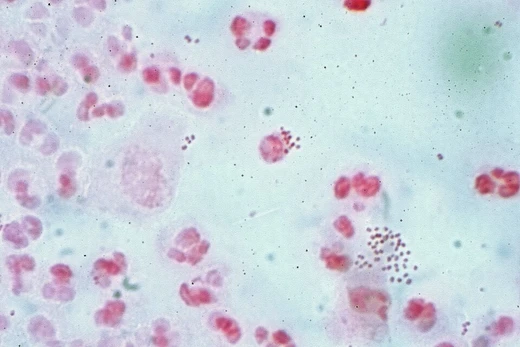
Bordetella pertussis
Causative agent of whooping cough, a reemerging human pathogen.
Last updated
Specialized surface proteins enable the bacterium to adhere to ciliated epithelial cells lining the respiratory tract.[1] B. pertussis has no known zoonotic reservoir, making humans its exclusive host.[2][3]
Scientific classification
- DomainBacteria
- KingdomPseudomonadati
- PhylumPseudomonadota
- ClassBetaproteobacteria
- OrderBurkholderiales
- FamilyAlcaligenaceae
- GenusBordetella
- SpeciesBordetella pertussis
Named by (Bergey et al. 1923) Moreno-López 1952
Sources: Wikipedia taxobox: Bordetella pertussis (CC BY-SA 4.0)
Quick Facts
- Species
- pertussis
- Type strain
- ATCC 9797
- CCUG 30873
- CIP 63.1
- DSM 5571
- LMG 14455
- NCTC 10739
Facts from the source article.
Key facts and history
Jules Bordet and Octave Gengou identified and isolated the causative agent in 1906.[4] B. pertussis is a strict aerobe that prefers a temperature range of 35 °C to 37 °C.[5] Following the 1578 epidemic, French physician Guillaume de Baillou provided the initial description of pertussis.[4] Nine species constitute the genus Bordetella, among them B. pertussis, B. parapertussis, and B. bronchiseptica.[6]
Amino acids, particularly glutamate, serve as the carbon source for B. pertussis, as it is unable to metabolize sugars.[7] Macrolide antibiotics, such as erythromycin, are employed to treat whooping cough.[8] A growing worry, especially in East Asia, is the development of macrolide resistance in B. pertussis.[9]
What the research sources say
The SERION ELISA classic Bordetella pertussis tests detect human antibodies for laboratory confirmation of whooping cough.[10] These ELISA tests can detect IgA and IgG antibodies for laboratory confirmation of whooping cough.[10] Genomic analysis of 343 B. pertussis strains collected over 100 years illustrates how vaccination has shaped its evolution.[11] The emergence and rapid global spread of B. pertussis in humans occurred within the last 500 years.[11]
Between 1985 and 1988, fewer than 100 children died from pertussis.[3]
References
- Wikipedia, "Bordetella pertussis" (CC BY-SA 4.0), which cites: "Pertussis; in Control of Communicable Diseases Manual.", American Public Health Association, 2008, p. 457; "Relevé épidémiologique hebdomadaire (Online) = Weekly epidemiological record.", Organisation mondiale de la sante, 1998 (we also read that source) en.wikipedia.org
- Wikipedia, "Bordetella pertussis" (CC BY-SA 4.0), which cites: "Epidemiology and Prevention of Vaccine-Preventable Diseases: The Pink Book", Centers for Disease Control and Prevention, Public Health Foundation, 2015 (original not read by us) en.wikipedia.org
- "15.3E: Whooping Cough", Biology LibreTexts, 2018-06-29. facts only, no text reused. bio.libretexts.org
- Wikipedia, "Bordetella pertussis" (CC BY-SA 4.0), which cites: "Origin and evolution of Bordetella pertussis", Sanger, 24 April 2014 (we also read that source) en.wikipedia.org
- Wikipedia, "Bordetella pertussis" (CC BY-SA 4.0), which cites: Hulbert, "Laboratory Maintenance of Bordetella pertussis", Current Protocols in Microbiology, November 2009, p. Unit 4B.1 (original not read by us) en.wikipedia.org
- Wikipedia, "Bordetella pertussis" (CC BY-SA 4.0), which cites: "Bordetella: molecular microbiology", Horizon Bioscience, 2007 (original not read by us) en.wikipedia.org
- Wikipedia, "Bordetella pertussis" (CC BY-SA 4.0), which cites: Belcher, "Pathogenicity and virulence of Bordetella pertussis and its adaptation to its strictly human host", Virulence, 2021-12-31, p. 2608–2632 (original not read by us) en.wikipedia.org
- Wikipedia, "Bordetella pertussis" (CC BY-SA 4.0), which cites: "Relevé épidémiologique hebdomadaire (Online) = Weekly epidemiological record.", Organisation mondiale de la sante, 1998; "Medical Microbiology", University of Texas Medical Branch at Galveston, 1996 (we also read that source) en.wikipedia.org
- Wikipedia, "Bordetella pertussis" (CC BY-SA 4.0), which cites: Mai, "Molecular epidemiology and increasing macrolide resistance of Bordetella pertussis isolates in Guangzhou, China", BMC Infectious Diseases, 2025-09-26; Mai, "Molecular epidemiology and increasing macrolide resistance of Bordetella pertussis isolates in Guangzhou, China", BMC Infectious Diseases, 2025-09-26; Mai, "Molecular epidemiology and increasing macrolide resistance of Bordetella pertussis isolates in Guangzhou, China", BMC Infectious Diseases, 2025-09-26 (original not read by us) en.wikipedia.org
- "ELISA classic – Bordetella pertussis SERION Diagnostics", www.serion-diagnostics.de. facts only, no text reused. serion-diagnostics.de
- "Origin and evolution of Bordetella pertussis", Sanger, 24 April 2014. facts only, no text reused. sanger.ac.uk
Each numbered sentence above was checked against the source it cites before publication. Sentences citing Wikipedia adapt text from the English Wikipedia article Bordetella pertussis (contributors), used under CC BY-SA 4.0; this entry is available under the same licence. Other sources were used for facts only; no text or images are copied from them.
More in Pathogenic Bacteria
Sources
Compiled from Wikipedia and the sources listed below. Text from Wikipedia is available under CC BY-SA 4.0; this entry is adapted from it.
- Wikipedia: Bordetella pertussis (CC BY-SA 4.0).
- Word definitions: the Codexery glossary, each quoted from its Wikipedia article.
Spotted an error? Know more?
Reader corrections go straight into our review queue. Suggest an edit · How this site is sourced