Quantum chromodynamics
Quantum field theory of the strong force binding quarks.
Last updated
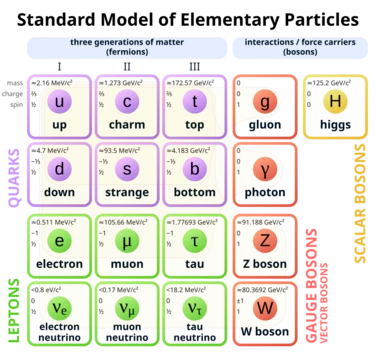
Quantum chromodynamics (QCD) is the theoretical framework in particle physics that describes the strong interaction, the force that binds quarks together inside hadrons such as protons, neutrons, and pions. It is a non-abelian gauge theory based on the symmetry group SU(3), with gluons as the force carriers and a property called color charge as the analog of electric charge. QCD is a cornerstone of the Standard Model of particle physics, supported by extensive experimental evidence.
History
The theory emerged from the need to explain the growing number of hadrons discovered in the 1950s and 1960s. After hadrons were classified by properties like charge, isospin, and strangeness, the eightfold way organized them into groups. This led Murray Gell-Mann and George Zweig to propose in 1963 that hadrons are composed of smaller particles called quarks.
A key puzzle arose: certain baryons, such as the Ω⁻ hyperon and the Δ⁺⁺, seemed to contain three identical quarks with parallel spins, violating the Pauli exclusion principle. This was resolved independently in 1964–65 by Oscar Greenberg, and by Moo-Young Han and Yoichiro Nambu, who proposed that quarks carry an additional SU(3) gauge degree of freedom, later named color charge. Han and Nambu also suggested that an octet of vector gauge bosons—the gluons—mediate the interaction between these color charges.
QCD exhibits three defining properties. Color confinement means that separating two color charges requires increasing energy until a new quark–antiquark pair is spontaneously produced, forming hadrons instead of isolating a single color charge. This phenomenon, though not analytically proven, is well established by lattice QCD calculations and decades of experiments. Asymptotic freedom, discovered in 1973 by David Gross and Frank Wilczek, and independently by David Politzer, describes how the strong interaction weakens as the energy scale increases (and length scale decreases).
This work earned them the 2004 Nobel Prize in Physics. Chiral symmetry breaking, elucidated by Yoichiro Nambu in 1960 (for which he received the 2008 Nobel Prize), explains how hadrons acquire masses far larger than their constituent quarks, while pseudoscalar mesons remain exceptionally light. Lattice simulations have confirmed Nambu’s predictions.
Quick Facts
- Field
- Theoretical physics
- Known for
- Strong interaction
- color confinement
- asymptotic freedom
- chiral symmetry breaking
- Symmetry group
- SU(3)
- Force carriers
- Gluons
Facts from the source article.
Lore & Background
The development of QCD emerged from the need to explain the growing number of hadrons discovered in the 1950s and 1960s. A problem arose: certain baryons, such as the Ω− and Δ++, seemed to require three identical quarks with parallel spins, violating the Pauli exclusion principle.
Boris Struminsky, advised by Nikolay Bogolyubov, suggested in a preprint that quarks must possess an additional quantum number. In 1964–65, Oscar W. Greenberg, and Moo-Young Han and Yoichiro Nambu independently proposed that quarks carry an additional SU(3) gauge degree of freedom, later named color charge. Han and Nambu also noted that quarks might interact via an octet of vector gauge bosons—the gluons.
Reader's Guide
Quantum chromodynamics is significant because it provides the fundamental theory of the strong nuclear force, one of the four known fundamental forces. Its three salient properties—color confinement, asymptotic freedom, and chiral symmetry breaking—explain why quarks are never found in isolation, why the force weakens at high energies, and why hadron masses are much larger than the sum of their constituent quark masses.
Chiral symmetry breaking, elucidated by Yoichiro Nambu (2008 Nobel Prize), explains the lightness of pseudoscalar mesons. Despite its successes, color confinement remains mathematically unproven, and proving it is one of the Clay Mathematics Institute's Millennium Prize Problems. QCD also predicts exotic phases of quark matter, including the quark–gluon plasma.
Did You Know?
- The word 'quark' was coined by Murray Gell-Mann, inspired by the phrase 'Three quarks for Muster Mark' from James Joyce's Finnegans Wake.
- The three kinds of color charge in QCD are loosely analogous to the three colors red, green, and blue, but are completely unrelated to everyday color.
More in Particle And Nuclear Physics
Sources
Compiled from Wikipedia and the sources listed below. Text from Wikipedia is available under CC BY-SA 4.0; this entry is adapted from it.
- Wikipedia: Quantum chromodynamics (CC BY-SA 4.0).
- Word definitions: the Codexery glossary, each quoted from its Wikipedia article.
Spotted an error? Know more?
Reader corrections go straight into our review queue. Suggest an edit · How this site is sourced