Proton
Proton: stable subatomic particle, building block of atomic nuclei.
Last updated
A proton is a stable subatomic particle carrying a positive electric charge of +1 e. Alongside neutrons, it is classified as a nucleon, with each having a mass of approximately one dalton. Protons are found in the nucleus of every atom, where their positive charge provides the electrostatic force that binds negatively charged electrons to the atom. The number of protons in a nucleus defines an element’s identity, known as its atomic number, which in turn determines the number of electrons and thus the element’s chemical properties.
Description
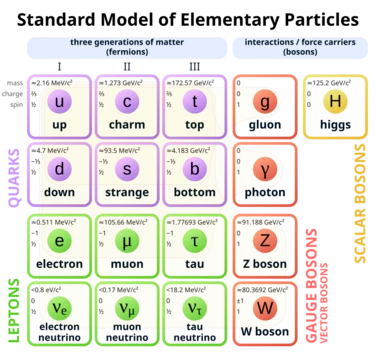
The name "proton" comes from the Greek word for "first," and was given by Ernest Rutherford in 1920 to the hydrogen nucleus. Rutherford had earlier discovered that this lightest nucleus could be knocked out of nitrogen atoms during collisions, suggesting that protons might be fundamental building blocks of heavier nuclei. Although once considered elementary, protons are now understood within the Standard Model as composite particles. They are baryons, a type of hadron, composed of three valence quarks: two up quarks (each with charge +e) and one down quark (charge −e).
These quarks are held together by the strong force, mediated by gluons. The rest masses of the quarks account for only about 1% of the proton’s mass; the remainder comes from quantum chromodynamics binding energy, including the kinetic energy of the quarks and the energy of the gluon fields. The proton’s positive charge distribution decays roughly exponentially, with a root mean square charge radius of about 0.8 fm, though two different measurement methods yield slightly different values.
History
Free protons, at sufficiently low temperatures and kinetic energies, will bind electrons in any matter they traverse. They are routinely used in accelerators for proton therapy and particle physics experiments, most notably the Large Hadron Collider. The concept of a hydrogen-like particle as a constituent of other atoms dates back to 1815, when William Prout proposed that all atoms are integer combinations of hydrogen atoms.
This idea, later called Prout’s hypothesis, was abandoned when more accurate atomic weights failed to show integer relationships, but it resurfaced a century later. In 1886, Eugen Goldstein discovered canal rays, and Wilhelm Wien later showed they had a charge opposite to electrons but a much higher mass-to-charge ratio. J. J.
Lore & Background
A proton is a stable subatomic particle carrying a positive electric charge of +1 elementary charge. Its mass is slightly less than that of a neutron and roughly 1836 times that of an electron. Protons and neutrons, each with a mass near one dalton, are collectively called nucleons.
One or more protons reside in the nucleus of every atom, providing the electrostatic central force that binds atomic electrons. The number of protons in a nucleus defines an element, known as its atomic number, which determines the element’s identity and chemical properties. The word “proton” is Greek for “first,” and the name was given to the hydrogen nucleus by Ernest Rutherford in 1920, following his discovery that hydrogen nuclei could be extracted from nitrogen atoms via collisions.
Though once considered elementary, protons are now understood in the Standard Model as composite particles—hadrons containing three valence quarks: two up quarks (each charge +⅔ e) and one down quark (charge −⅓ e). The rest masses of these quarks account for only about 1% of the proton’s mass; the remainder comes from quantum chromodynamics binding energy, including quark kinetic energy and gluon field energy. The proton’s charge radius is around 0.8 femtometers, though measurements yield slightly different values. At sufficiently low temperatures, free protons bind electrons in any matter they traverse.
Free protons are used in accelerators for proton therapy and particle physics experiments, notably the Large Hadron Collider. Protons are spin-½ fermions, classified as baryons, and are held together by the strong force mediated by gluons, with a positive charge distribution that decays approximately exponentially. The nucleus of ordinary hydrogen is a single proton; deuterium and tritium nuclei contain one proton bound to one or two neutrons, respectively, while all other atomic nuclei consist of two or more protons with various neutrons.
Reader's Guide
The proton is fundamental to the structure of matter. As the nucleus of the most common hydrogen isotope, and a constituent of all other atomic nuclei, the proton defines each element through its atomic number. Although originally considered elementary, the modern Standard Model shows protons are composite particles containing three valence quarks held together by gluons via the strong force.
The proton's stability is a key assumption in physics; while spontaneous decay has never been observed, some grand unified theories predict lifetimes between 10^31 and 10^36 years, with experimental lower bounds exceeding 10^34 years for certain decay modes. Free protons occur naturally in cosmic rays, plasmas, and thunderstorms, and are used in accelerators for proton therapy and particle physics experiments, such as the Large Hadron Collider. The proton's role in binding electrons and forming nuclei underpins chemistry and the structure of the universe.
Did You Know?
- Free protons make up 90% of cosmic rays, which propagate through the interstellar medium.
More in Particle And Nuclear Physics
Sources
Compiled from Wikipedia and the sources listed below. Text from Wikipedia is available under CC BY-SA 4.0; this entry is adapted from it.
- Wikipedia: Proton (CC BY-SA 4.0).
- Word definitions: the Codexery glossary, each quoted from its Wikipedia article.
Spotted an error? Know more?
Reader corrections go straight into our review queue. Suggest an edit · How this site is sourced