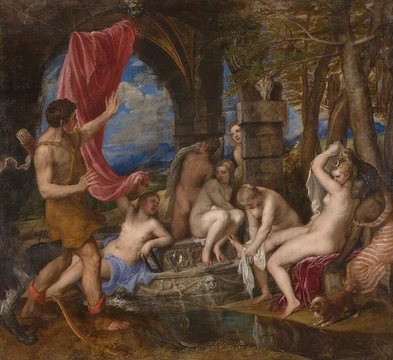
Diana and Callisto
Titian's mythological scene of Diana confronting Callisto.
Last updated
Diana and Callisto is a late Renaissance painting by Titian, completed between 1556 and 1559. It depicts the moment when the goddess Diana discovers her maid Callisto's pregnancy by Jupiter. The work was jointly purchased by the National Gallery and the Scottish National Gallery for £45 million in March 2012 and is displayed alternately between London and Edinburgh.
History
The painting belongs to a series of seven mythological canvases known as the "poesies", based on Ovid's Metamorphoses, created for Philip II of Spain after Maximilian II, Holy Roman Emperor declined Titian's offer to paint them. It remained in the Spanish royal collection until 1704, when King Philip V gave it to the French ambassador. Soon after, it was acquired by Philippe II, Duke of Orléans, nephew of Louis XIV and Regent of France during Louis XV's minority, for his renowned collection.
Following the French Revolution, the Orleans collection was sold in 1791 to a Brussels banker by Louis Philippe II, Duke of Orléans, two years before his execution. The painting was sent to London for sale in 1793 and purchased by a syndicate of three aristocrats led by Francis Egerton, 3rd Duke of Bridgewater, a canal and coal magnate. Bridgewater bought many paintings for himself, including both Diana and Callisto and Diana and Actaeon, along with works by Poussin, Raphael, and Rembrandt.
Gower displayed the collection publicly at Bridgewater House in London for over a century. At the outbreak of the Second World War in September 1939, the collection was moved from London to Scotland. Since 1945, both Titian paintings have resided at the National Gallery of Scotland in Edinburgh as part of the "Bridgewater loan" or "Sutherland Loan". Besides Hazlitt, the paintings inspired artists including J. M. W. Turner and Lucian Freud, who described the pair as "simply the most beautiful pictures in the world".
Did You Know?
- Titian employed an exceedingly wide palette including natural ultramarine, vermilion, malachite, verdigris, ochres, lead-tin-yellow, smalt, and carmine.
- There is a later version by Titian and his workshop in the Kunsthistorisches Museum in Vienna.
More in Paintings of Diana
Sources
Compiled from Wikipedia and the sources listed below. Text from Wikipedia is available under CC BY-SA 4.0; this entry is adapted from it.
- Wikipedia: Diana and Callisto (CC BY-SA 4.0).
Spotted an error? Know more?
Reader corrections go straight into our review queue. Suggest an edit · How this site is sourced