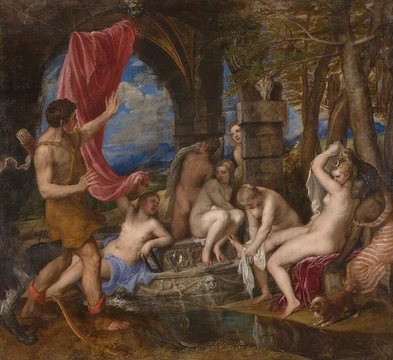
Diana and Her Companions
Vermeer's solemn depiction of Diana and her attendants.
Last updated
Diana and Her Companions is a painting by Johannes Vermeer, completed in the early to mid-1650s and housed at the Mauritshuis in The Hague. It may be the artist's earliest surviving work, though its exact year is uncertain. The painting is notable for its solemn mood, which is unusual for a depiction of the goddess Diana, and for the nymph washing the central figure's feet.
Description
The painting shows the goddess Diana with four companions. Diana wears a loose yellow dress with an animal-skin sash and a diadem bearing a crescent moon. She sits on a rock while a nymph washes her left foot. Behind Diana, another nymph sits with her partially bare back to the viewer, the most skin Vermeer ever depicted on a figure in his extant works.
A third nymph, at Diana's left, holds her own left foot with her right hand. A fourth stands in the rear, somewhat apart, facing the group and the viewer at an angle, her eyes cast down and fists in front of her. A dog sits in the lower left corner, its back to the viewer, facing the goddess and a thistle. All visible faces are in shadow, and none of the women look at each other, contributing to the solemn mood.
In 1999–2000, restoration revealed that a patch of blue sky in the upper right corner had been added in the 19th century; restorers covered it with foliage. The canvas had also been trimmed, with about 15 cm removed from the right side. Light falls from above and left, with short shadows to the viewer's right. The painting is signed on the lower left, on the rock between the thistle and the dog.
Attribution and relationship to other works
The painting has no visual precedent, according to Arthur K. Wheelock Jr. It notably avoids depicting popular mythological episodes such as Actaeon spying on Diana or the revelation of Callisto's pregnancy, and does not show Diana's temper or hunting attributes. The dog is gentle, not a fast hound. The work also does not use Diana as an allegorical portrait, a tradition seen in Jacob van Loo's Diana and Her Nymphs from around 1648, with which Vermeer's painting has often been compared.
The similarities to Rembrandt's style are close enough that the work was attributed to Rembrandt's student Nicolaes Maes when auctioned in 1876; Vermeer's signature had been altered to resemble Maes's. During restoration, the original signature of J. v.
Meer was faintly visible, though ascribed to Johannes van der Meet. Vermeer incorporated Rembrandt's techniques, such as thick impasto brushwork and shadowed faces. The painting is very similar in feeling to Rembrandt's Bathsheba (1654), which Vermeer likely saw firsthand.
Carel Fabritius, Rembrandt's former pupil in Delft from 1650 until his death in 1654, may have introduced Vermeer to Rembrandt's work.
Critical commentary
Wheelock describes the painting as having an overwhelming sense of solemnity more associated with Christian than mythological traditions. The foot-washing may combine Christian symbolism of purification with the chastity and purity invoked by Diana's modest dress and the white cloth and brass basin. The companion holding her own foot resembles the ancient Spinario statue, whose pose is nearly identical; the thorn is a Christian symbol of grief and suffering.
Foot washing also symbolizes humility and the nearness of death, and the dignity of the washing companion recalls Mary Magdalene washing Christ's feet. Selena Cant believes Vermeer's contemporaries would have associated the foot-washing with Jesus washing feet, and notes that the maidservant in her unusual brown-bronze bodice steals the scene. The painting has no obvious literary source, according to Wheelock. Ovid's Metamorphoses mentions that before discovering Callisto's pregnancy, Diana washed her feet and disrobed with her attendants.
Walter Liedtke suggests the nymph standing apart with clenched hands may be Callisto, contrasting with the foot-washing nymph's devotion, though Wheelock states the episode seems unrelated to the painting's mood.
Dating and position within Vermeer's life and work
The painting was created around the time Vermeer joined the painters' guild in Delft on December 29, 1653, at age 21, the same year he converted to Catholicism and married Catharina Bolnes. Liedtke speculates that the ideas of purity and fidelity symbolized in the painting were connected to Vermeer's marriage, possibly as a tribute to his new wife. With less assured brushwork and cautious arrangement, Diana is less mature in technique than Christ in the House of Martha and Mary, which may indicate the latter was painted afterward.
Did You Know?
- The painting was owned by Neville Davison Goldsmid of The Hague from 1866 to 1875, then by his widow Eliza Garey, before being sold at the Goldsmid sale on May 4, 1876, to Victor de Stuers for the Mauritshuis.
- The painting is in relatively poor condition, having been cleaned and restored on several occasions, with several areas differing significantly from the original work.
- About one ninth of the painting's width has been removed from the right side.
More in Paintings of Diana
Sources
Compiled from Wikipedia and the sources listed below. Text from Wikipedia is available under CC BY-SA 4.0; this entry is adapted from it.
- Wikipedia: Diana and Her Companions (CC BY-SA 4.0).
Spotted an error? Know more?
Reader corrections go straight into our review queue. Suggest an edit · How this site is sourced