Vasily Vereshchagin
Russian war painter and traveller who showed the horrors of battle to promote peace.
Last updated

via Wikipedia: Vasily Vereshchagin · see source
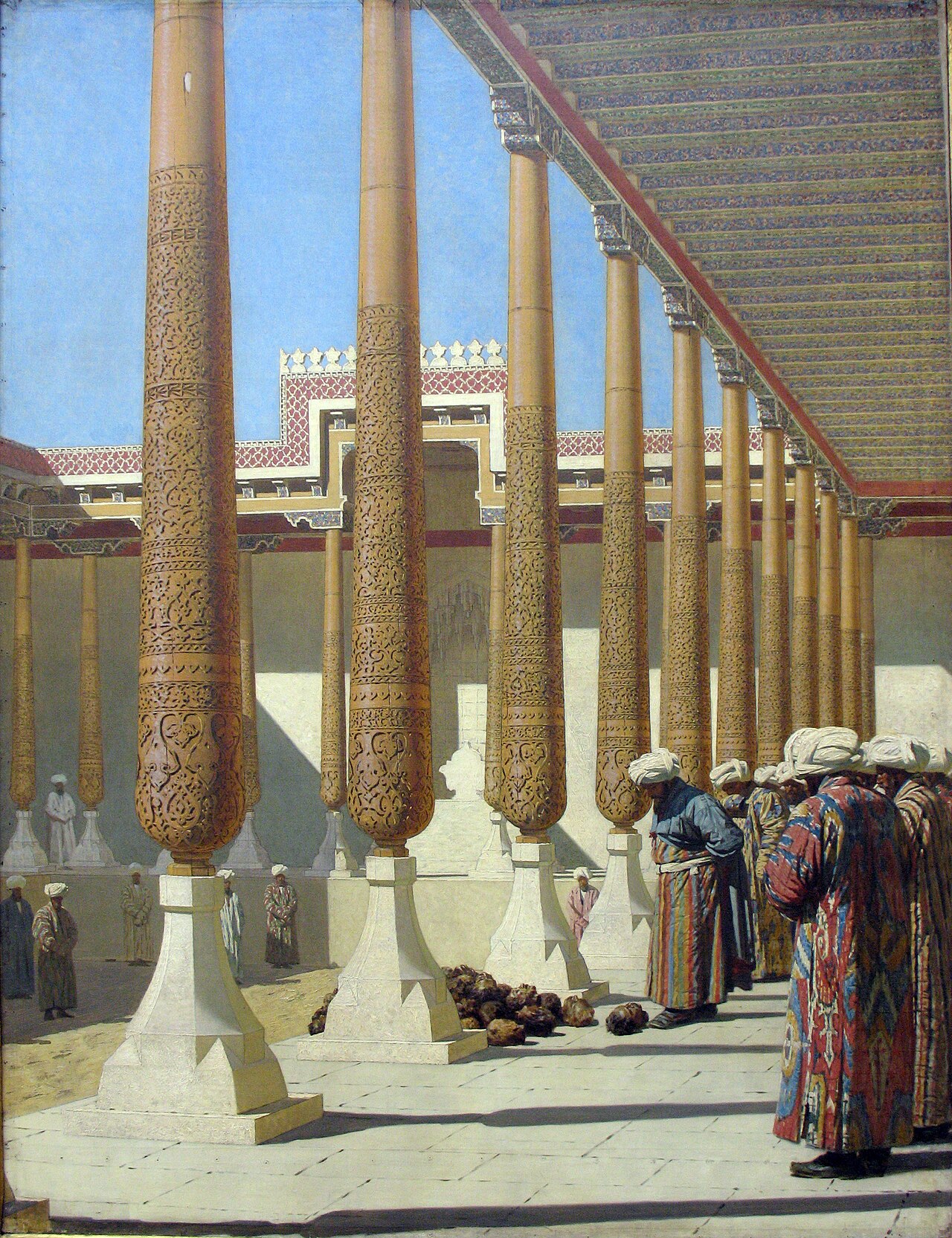
Vasily Vereshchagin was a Russian painter, war artist, and traveller born in 1842 at Cherepovets, Novgorod Governorate, Russia.[1][2] He died on 13 April 1904 when the battleship Petropavlovsk struck mines and sank near Port Arthur.[3] A war painter who created graphic and accurate depictions of war scenes, his realist works were often denied exhibition due to their graphic nature.[4][1]
Last updated 2026-10-08 from the source article.
Life and work
He graduated first at the naval school but left service to study drawing, winning a medal from the Imperial Academy of Arts in 1863.[5] He was in the Far East during the First Sino-Japanese War and with Russian troops in Manchuria during the Boxer Rebellion.[5] Born in 1842 at Cherepovets, Novgorod Governorate, Vasily Vereshchagin was the second of three sons; his father owned land and was of noble lineage, while his mother came from common stock with Tatar ancestry.[2] At age eight he was sent to Tsarskoe Selo for the Alexander Cadet Corps, and three years later moved to the Naval Cadet Corps in St. Petersburg; his first sea voyage occurred in 1858.[2][5]
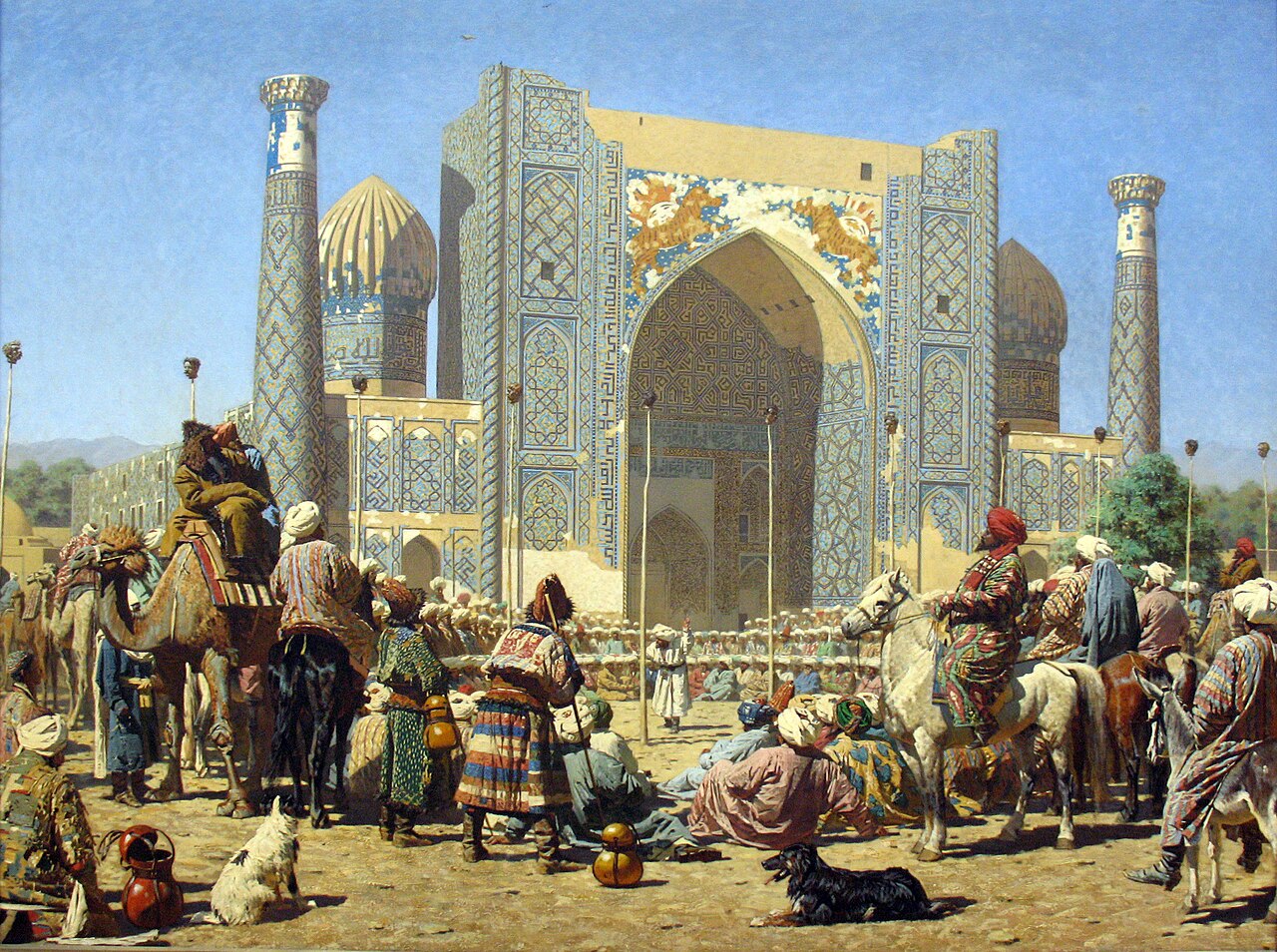
In 1864 he went to Paris and became a pupil of Jean-Léon Gérôme, but he strongly disagreed with his teacher's approach.[5] While preparing to cross the Danube near Rustchuk, he suffered a severe wound.[5] After the war ended, he made Munich his home and turned out war paintings at such a pace that people widely suspected he used assistants.[5] His series about Napoleon's 1812 invasion of Russia was painted in Moscow in 1893, and he eventually took up residence there.[6]
What the cited sources add
Chitralekha reports that Vereshchagin's painting "Jaipur Procession" from 1876 measures 196″ x 274″ and is believed to be the world's second largest oil painting.[4] The same source notes the painting depicts the 1876 Welcome Procession of Prince Albert-Edward passing through Amer Chaupar in Jaipur.[4] Vereshchagin also gave attention to onlookers standing atop balconies waving at the royal guest in that work.[4] John Webley's 2023 research paper "The Orient estranged" discusses Vereshchagin's painting "Blowing from Guns in British India".[7][8]
Vereshchagin wrote a book titled "1812: Napoleon I in Russia" published by William Heinemann in 1899.[9] In 1887 Vereshchagin responded to critics in The Magazine of Art, arguing that if a fresh uprising occurred, the British would again employ execution by blowing from guns.[8] The painting's photographic quality made it seem like an objective documentation of an actual occurrence.[8]
References
- Wikipedia, "Vasily Vereshchagin" (CC BY-SA 4.0), which cites: Kowner, Historical Dictionary of the Russo-Japanese War, p. 408. (original not read by us) en.wikipedia.org
- Wikipedia, "Vasily Vereshchagin" (CC BY-SA 4.0), which cites: ; Heather S. Sonntag, Tracing the Turkestan Series – Vasily Vereshchagin's Representations of Late-19th-century Central Asia, University of Wisconsin-Madison (200; Vladimir Visson, Portraits of Russian Painters, V. Visson (1987), p. 72 (original not read by us) en.wikipedia.org
- Wikipedia, "Vasily Vereshchagin" (CC BY-SA 4.0), which cites: ; "State Historical Museum Opens 'The Year 1812 in the Paintings by Vasily Vereshchagin'," Art Daily, 11 March 2010; "War Lasted 18 Months ... Russian Miscalculat (original not read by us) en.wikipedia.org
- Chitralekha, "The 'Jaipur Procession' that inspired the world's second largest oil painting", The Heritage Lab, 2 June 2020. facts only, no text reused. theheritagelab.in
- Wikipedia, "Vasily Vereshchagin" (CC BY-SA 4.0) en.wikipedia.org
- Wikipedia, "Vasily Vereshchagin" (CC BY-SA 4.0), which cites: ; Verestchagin, ""1812" Napoleon I in Russia; with an Introduction by R. Whiteing", William Heinemann, 1899 (we also read that source) en.wikipedia.org
- John Webley, "The Orient estranged", Manchester University Press eBooks (2023), doi:10.7765/9781526166241.00014. OpenAlex metadata CC0; paper not read. doi.org
- Wikipedia, "Vasily Vereshchagin" (CC BY-SA 4.0), which cites: Webley, John (2023)."The Orient estranged: Vasilii Vereshchagin’s Blowing from Guns in British India" Russian Orientalism in a Global Context Manchester: Manche; "Art in December: M. Verestchagin on his Critics – Art and Politics", The Magazine of Art, 1878–1904, p. ix (following p. 430) (we also read that source) en.wikipedia.org
- Verestchagin, ""1812" Napoleon I in Russia; with an Introduction by R. Whiteing", William Heinemann, 1899. facts only, no text reused. archive.org
Each numbered sentence above was checked against the source it cites before publication. Sentences citing Wikipedia adapt text from the English Wikipedia article Vasily Vereshchagin (contributors), used under CC BY-SA 4.0; this entry is available under the same licence. Other sources were used for facts only; no text or images are copied from them.
More in Painters & Visual Artists
Sources
Compiled from Wikipedia and the sources listed below. Text from Wikipedia is available under CC BY-SA 4.0; this entry is adapted from it.
- Wikipedia: Vasily Vereshchagin (CC BY-SA 4.0).
Spotted an error? Know more?
Reader corrections go straight into our review queue. Suggest an edit · How this site is sourced