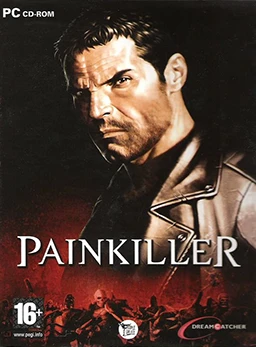
Hellhammer
When the guns fall silent, the hammer speaks for Daniel Dorn.
The Hellhammer is the two-handed melee hammer wielded by Daniel Dorn in the Painkiller franchise, serving as his primary close-quarters weapon against the legions of Hell. Introduced in the original Painkiller (2004), developed by People Can Fly and published by Gearbox Software, it is the weapon the player turns to when firearms run dry or when a demon closes within striking range. It is not a narrative character in its own right, but rather the physical instrument through which the player enacts the game's story: a relentless, visceral march through demonic realms to confront the forces that have dragged Dorn into Hell.
Quick Facts
- Type
- Two-handed melee weapon (hammer)
- Wielded by
- Daniel Dorn (player character)
- Franchise
- Painkiller
- Developer
- People Can Fly
- First appears
- Painkiller (2004)
- Role in gameplay
- Primary melee; close-quarters weapon
- Setting
- Realms of Hell
Lore & Background
In the Painkiller universe, Daniel Dorn is a soldier thrust into the domains of Hell, where the architecture of reality is twisted into obsidian spires, rivers of molten rock, and endless plains of ash. The Hellhammer exists within this context as a tool of brutal, immediate force — no ammunition to track, no reloading to manage, just the weight of a two-handed mace swung with full-body momentum. It represents the most primal tier of combat in a game otherwise defined by increasingly fantastical firearms: chainsaw shotguns, rocket launchers, and energy weapons. The hammer grounds the player in physicality, a reminder that beneath the supernatural spectacle, Dorn is still a man swinging iron.
Reader's Guide
The Hellhammer is the player's safety net in every Painkiller encounter. It requires no ammunition, carries no cooldown, and its wide arc makes it forgiving against clustered enemies. In the 2004 campaign, it is typically available early and remains in the weapon rotation throughout, so the player should develop the habit of switching to it the moment a firearm's magazine empties mid-combat rather than fumbling for a reload under fire.
Narratively, the hammer's omnipresence mirrors the game's structure: Dorn is constantly pushed forward through Hell's corridors, and the weapon's simplicity mirrors the story's relentless momentum. There is no cutscene where the hammer is forged or blessed; it is simply there, in Dorn's hands, as natural as a soldier's bayonet. The level design leans on this — tight chokepoints, close-quarters arenas, and moments where a swarm of smaller demons closes the distance before the player can backpedal. In those moments, the Hellhammer is not a fallback; it is the intended tool.
Thematically, the hammer anchors the franchise's central tension. The Painkiller world is saturated with eldritch power — demon lords, hellfire, reality-warping architecture. The Hellhammer is the one weapon that answers all of it with the most basic human principle: enough mass, enough speed, enough will. It is the narrative argument that Dorn's humanity, his stubborn physicality, is what ultimately lets him stand in Hell and swing.
Did You Know?
- The Hellhammer is the only weapon in Painkiller (2004) that requires no ammunition whatsoever, making it the player's last resort in every encounter.
- Painkiller (2004) was developed by the Polish studio People Can Fly, whose later work includes Gears of War and Bulletstorm.
- The hammer's two-handed swing animation in the 2004 game uses a full-body rotation, making it visually distinct from the one-handed knife and giving it a wider effective arc.
More in Story & Campaigns
Elsewhere in Painkiller
Spotted an error? Know more?
Reader corrections go straight into our review queue. Suggest an edit · How this site is sourced