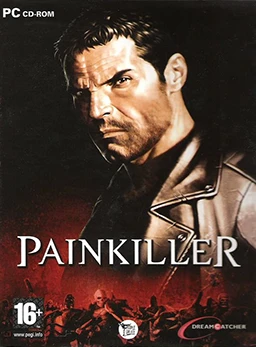
Hell Knight
A son of Hell walks into his father's throne room with a sword and no apologies.
Hell Knight is the silent, sword-wielding protagonist of the Painkiller first-person shooter franchise, developed by People Can Fly. Across the series he is a warrior thrust into the abyssal realms of Hell, tasked with battling legions of demons and ultimately confronting the God of Hell himself. His identity as the God of Hell's own son is the narrative engine that drives the conflict: every level he tears through is a step toward a familial reckoning that redefines what 'victory' means in a world of eternal torment.
He appears in the original 2004 title, the 2013 sequel, and the 2016 standalone expansion Painkiller: Hell & Damnation. Though he rarely speaks, his design—armored, sword-clad, unflinching—has made him the franchise's visual and thematic anchor, a figure who walks into the worst of Hell not as a hero sent by heaven, but as a son walking into his father's house.
Quick Facts
- Role
- Protagonist; Warrior
- Affiliation
- Son of the God of Hell
- First appears
- Painkiller (2004)
- Primary weapon
- Sword (melee)
- Developer
- People Can Fly
- Setting
- Hell and its layered realms
Lore & Background
The Painkiller mythos places Hell not as a single pit but as a vast, architecturally layered afterlife—cathedrals of bone, rivers of molten slag, frozen wastes, and towering spires of black iron. Hell Knight is a figure who does not arrive as a chosen one blessed by angels; he is a warrior whose very bloodline ties him to the throne at the top of that hierarchy. In the 2004 original, the narrative reveals that he is the offspring of the God of Hell, making his crusade through the demon ranks a homecoming turned into a war. The demons he slaughters are, in a sense, his uncles, his cousins, the court of his own father.
This familial framing elevates the combat beyond 'shoot the bad guys.' Each realm Hell Knight conquers peels back another layer of the God of Hell's domain, and the final confrontation is less a boss fight than a son standing before his parent with a blade. The 2013 sequel deepens this by expanding the cast of demonic nobility and giving the God of Hell more presence as a figure of terrible, almost paternal authority. Hell & Damnation (2016) pushes the tone further into dark humor and meta-commentary while keeping the core relationship intact.
Hell Knight himself is deliberately mute in most of his appearances. He does not monologue, does not plead. He draws his sword, fills the Pain Meter through damage taken, and releases that accumulated suffering as a burst of devastating force. His silence is part of the design: in a world of screaming demons and bellowing gods, the son simply walks forward.
Reader's Guide
The campaign structures itself as a vertical ascent through Hell's realms. Early levels introduce the core loop: sword combat, the Pain Meter (fill it by taking damage, release it for a power burst), and environmental traversal through corridors, chasms, and arenas. The level design mirrors the narrative escalation—each realm is visually distinct (frozen wastes, molten forges, bone cathedrals) and introduces a new class of demon or a new arena mechanic, so the player's growing familiarity with the combat system is justified by the increasing variety of threats.
Mid-campaign, the story layers in the God of Hell's court. Named demonic nobles appear as mini-bosses, each with a short narrative beat that establishes their relationship to the throne. This is where the 'son' reveal lands: the player learns Hell Knight is not an outsider but family, which reframes every prior encounter as a domestic dispute played out at the scale of a war. The level design reflects this—corridors narrow, architecture becomes more personal, more throne-room-like.
The final act strips away the variety. The arena is the God of Hell's own domain, the combat is a single sustained duel, and the Pain Meter mechanic becomes the emotional climax: the damage the player has absorbed across the entire campaign is literally the fuel for the killing blow. The mythology ties back to the broader Painkiller world by establishing that Hell is not a place to be 'saved' but a family to be reckoned with, and that the franchise's recurring violence is, at its core, a son clearing his father's house.
Did You Know?
- Hell Knight is deliberately silent in the 2004 and 2013 titles; he has no voice lines, reinforcing his role as a pure action figure rather than a talking hero.
- The Pain Meter mechanic—where taking damage charges a releaseable power burst—was a signature design choice of People Can Fly that distinguishes Painkiller from other FPS titles of the era.
- Painkiller: Hell & Damnation (2016) was released as a standalone expansion that could be played without owning the 2013 base game, expanding the campaign with new levels and a darker comedic tone.
- The God of Hell, as Hell Knight's father, serves as the franchise's central antagonist across multiple titles, making the series' core conflict a familial one rather than a purely theological one.
More in Story & Campaigns
Elsewhere in Painkiller
Spotted an error? Know more?
Reader corrections go straight into our review queue. Suggest an edit · How this site is sourced