Duma (epic)
Oral epic poems of the Ukrainian Cossack era, sung by itinerant bards.

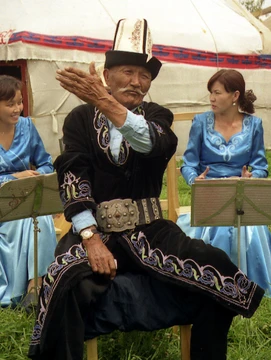
A duma is an oral epic poem originating in Ukraine during the Cossack era, possibly based on earlier Kyivan epic forms. Performed by itinerant bards called kobzari (who accompanied themselves on a kobza or bandura) or by lirnyks (players of the lira, a Ukrainian hurdy-gurdy), dumy are sung in recitative in the so-called 'duma mode,' a variety of the Dorian mode with a raised fourth degree. Historically, dumy dealt with military action and religious themes, imparting moral messages about proper conduct toward family, community, and church, rather than promoting courage in battle.
- First historical mention
- 16th century, attributed to Polish historian Marcin Kromer or later sources (not 1506)
Lore & Background
Dumy were vocal works built around historical events, many dealing with military action, but embedded with religious and moralistic elements. Themes include the struggle of Cossacks against enemies of different faiths or events on religious feast-days. The relationship between military and religion in dumy predates the Cossack rebellion of 1648; while that conflict intensified religious themes, they were already present in earlier epics. Dumy celebrate both victories and defeats, often highlighting heroic deeds and moral lessons rather than focusing solely on death and loss.
Reader's Guide
Dumas have played an important role in the development of Ukrainian folklore and musical craft. The first modern publication of Ukrainian dumas was made in 1819 by Nikolai Tsertelev, and the term was introduced into scientific usage by Mykhailo Maksymovych. Notable ethnographers who collected and studied dumy include Platon Lukashevych, Panteleimon Kulish, Mykola Lysenko, Pavlo Zhytetsky, and Filaret Kolessa. Duma songs produced a major effect on Ukrainian art and literature, influencing authors such as Nikolai Gogol, Taras Shevchenko, and Mykhailo Starytsky, as well as composers like Mykola Lysenko (particularly in the opera Taras Bulba) and Borys Liatoshynsky. The genre is chronologically classified into two major groups: older examples related to the fight against Turks and Tatars, and newer ones connected to Khmelnytsky's uprising against Polish rule, with an intermediary group dedicated to social topics and everyday Cossack life.
Did You Know?
- The word 'duma' originates from Polish, not Ukrainian, and was used in Old Polish literature before being applied to Ukrainian epic songs.
- Dumy are connected with holosinnia, traditional Ukrainian laments for the dead similar to keening.
- The first known recording of a duma text is the 1684 Duma of Cossack Holota.
Roots in the Spoken Word
The earliest epics emerged in societies that had not yet developed writing, making them fundamentally creatures of the voice. Bards composed and performed these lengthy narratives using intricate rhetorical and metrical patterns that allowed them to retain the traditional material while simultaneously embellishing it during live performances. The transmission was purely oral—passed from one singer to the next and then to the listening audience without any written intermediary. In the early twentieth century, scholars Milman Parry and Albert Lord studied living oral traditions in the Balkans and identified what they called the paratactic model: oral epics are built from a series of short, self-contained episodes, each carrying roughly equal weight. This modular structure made memorization practical, since a performer could recall each segment in sequence and stitch them together during a performance. Parry and Lord further proposed that the written Homeric texts we possess most likely originated from someone dictating an oral performance. In this way, the spoken word was not merely a delivery mechanism but the very engine of composition itself.
A World of Epics
The epic tradition stretches across every major civilization and spans more than three millennia. The oldest surviving example is the Epic of Gilgamesh, composed in ancient Sumer during the Neo-Sumerian period and dating to roughly 2500–1300 BCE, which chronicles the adventures of the legendary king of Uruk. At the other extreme of scale stands the Indian Mahabharata, assembled between the third century BCE and the third century CE. With approximately 100,000 ślokas amounting to over 200,000 verse lines plus extended prose sections, it reaches around 1.8 million words—roughly twice the Persian Shahnameh, four times the Rāmāyaṇa, and about ten times the combined length of Homer's Iliad and Odyssey. Beyond these two poles, the canon includes works in Tamil, Finnish, Old English, Old French, Spanish, Portuguese, Armenian, Old East Slavic, Mongolian, Kyrgyz, and Malian languages, as well as modern contributions such as Derek Walcott's Omeros and William Carlos Williams's Paterson, which drew inspiration from Ezra Pound's The Cantos.
Form and Formal Rules
Aristotle, in his Poetics, placed epic alongside lyric poetry and drama as one of the principal forms of verse. He noted that epic shares with tragedy its imitation of elevated characters rendered in meter, yet it differs in three key respects: it permits only a single metrical scheme, it is narrative rather than dramatic in structure, and it imposes no restriction on the span of time its action covers, unlike tragedy which strives to fit within a single day. Every structural element of an epic can be found within tragedy, but the reverse is not true. Centuries later, Harmon and Holman codified the genre's defining features into a checklist of ten hallmarks. These include opening in medias res, a setting that spans nations or the entire cosmos, an invocation calling upon a muse, an early declaration of the poem's theme, the use of fixed epithets, extended catalogues, lengthy formal speeches, and the presence of divine forces intervening in human affairs. Together these conventions create a recognizable architecture that distinguishes the epic from other poetic forms.
From Greek Word to Global Adjective
The English term "epic" traces back through Latin epicus to the Ancient Greek adjective epikos, rooted in epos, which simply meant "word," "story," or "poem." In classical Greek usage, the category was far broader than modern readers might expect: any poetry composed in dactylic hexameter—whether Homer's heroic tales, Hesiod's wisdom verses, the pronouncements of the Delphic oracle, or the enigmatic theological fragments attributed to Orpheus—could be called epic. It was only in later tradition that the label narrowed to designate specifically heroic narrative poetry. The genre's cultural footprint extends well beyond the page. The adjective "epic" itself entered everyday language to describe anything of grand scale, and the term has spawned derivative works in other media, such as epic films, that deliberately evoke or imitate the grandeur and formal qualities of the original poems. The Iliad, the Odyssey, the Aeneid, and Beowulf remain the touchstones that anchor the Western tradition, with nearly every subsequent Western epic consciously positioning itself as an heir to that lineage.
Frequently Asked Questions
What is a duma (epic)?
A duma is a Ukrainian oral epic poem that flourished during the Cossack period, likely evolving from older Kyivan-era storytelling traditions. It is performed as song rather than read, making it a living musical-literary form rather than a fixed written text.
Who performed dumy and what instruments did they use?
Itinerant bards known as kobzari sang dumy while accompanying themselves on a kobza or bandura, while another group called lirnyks used a Ukrainian hurdy-gurdy called a lira. Both groups traveled from village to village, keeping the tradition alive through live performance.
What musical mode do dumy use?
Dumy are sung in a distinctive recitative style called the 'duma mode,' which is a variant of the Dorian scale with its fourth degree raised. This gives the melodies a particular emotional character that sets them apart from other folk-song traditions.
What themes and messages do dumy convey?
Rather than glorifying battlefield heroism, dumy focus on military events and religious subjects to deliver moral lessons about proper behavior toward one's family, community, and the Church. The emphasis is on ethical conduct and social responsibility rather than raw martial courage.
When did the duma tradition first appear in historical records?
The earliest documented references to dumy date to the 16th century, with attribution to the Polish historian Marcin Kromer or to slightly later sources. This places the tradition firmly in the era of the Zaporozhian Cossacks, though scholars believe the underlying storytelling may stretch back to the Kyivan period.
More in Oral literature 1-24
Spotted an error? Know more?
Reader corrections go straight into our review queue. Suggest an edit · How this site is sourced