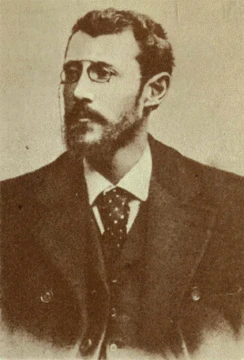
Claudius Bombarnac
Reporter seeking a hero on the Grand Transasiatic Railway.

Claudius Bombarnac is a fictional character and the protagonist of the adventure novel *Claudius Bombarnac* (1893) by Jules Verne. He is a reporter assigned by the newspaper *Twentieth Century* to cover the inaugural journey of the Grand Transasiatic Railway, which runs from Uzun Ada on the Caspian Sea to Peking, China. The novel follows his quest to find a compelling story beyond a routine travelogue.
Quick Facts
- Title Orig
- Claudius Bombarnac
- Author
- Jules Verne
- Illustrator
- Léon Benett
- Country
- France
- Language
- French
- Series
- The Extraordinary Voyages #38
- Genre
- Adventure novel, Science fiction
- Publisher
- Pierre-Jules Hetzel
- Pub Date
- 1893
- English Pub Date
- 1894
- Media Type
- Print (Hardback)
- Preceded By
- Carpathian Castle
Facts from the source article.
Lore & Background
Claudius Bombarnac is a reporter assigned by the *Twentieth Century* to cover the travels of the Grand Transasiatic Railway, which runs between Uzun Ada, a harbour on the eastern coast of the Caspian Sea, and Peking, China. He is accompanied by an interesting collection of characters, including one trying to beat the round-the-world record and another who is a stowaway. Claudius hopes one of them will become the hero of his piece, so his story won't be just a boring travelogue.
During the journey, a special car guarded by troops is added to the train, said to be carrying the remains of a great Mandarin. The great Mandarin actually turns out to be a large consignment being returned to China from Persia. The train must travel through a large part of China controlled by unscrupulous robber-chiefs. Before the journey is over, Claudius finds his hero.
Reader's Guide
Claudius Bombarnac is significant as a representative of Jules Verne's later adventure novels, blending travelogue with mystery and danger. The novel explores themes of journalism, exotic locales, and the search for a compelling narrative. Its publication history shows multiple English titles, including *The Special Correspondent* and *The Adventures of a Special Correspondent*, reflecting its appeal to English-speaking audiences. The story's setting on the fictional Grand Transasiatic Railway highlights Verne's fascination with technological progress and global connectivity. The character's role as a reporter seeking a hero underscores the narrative's meta-commentary on storytelling itself. The novel remains a lesser-known but engaging entry in Verne's oeuvre, offering a glimpse into late 19th-century perceptions of Central Asia and China.
Did You Know?
- The novel was first published in French in 1893.
- The Grand Transasiatic Railway runs between Uzun Ada on the Caspian Sea and Peking, China.
- A special car on the train supposedly carries the remains of a great Mandarin, but it actually contains a large consignment returning to China from Persia.
- The novel has been published under at least four different English titles.
Plot and Narrative Arc
Claudius Bombarnac, the 1893 adventure novel by Jules Verne, follows a newspaper reporter who receives an assignment from the Twentieth Century to document the travels of the Grand Transasiatic Railway. The route stretches from Uzun Ada, a harbour on the eastern coast of the Caspian Sea, all the way to Peking in China. What begins as a straightforward travel assignment quickly becomes more complicated. A special car, guarded by troops, is added to the train, supposedly carrying the remains of a great Mandarin. The truth, however, is far less dignified: the supposed remains are actually a large consignment being returned to China from Persia. The journey grows increasingly dangerous as the train must pass through a large part of China controlled by unscrupulous robber-chiefs. By the end of the story, Claudius finds the hero he was searching for, ensuring his piece rises well above the status of a mere travelogue.
The Ensemble Cast and the Search for a Hero
Claudius Bombarnac is not a solitary journey. The reporter travels alongside a varied and colorful group of passengers, each bringing their own complications to the narrative. Among them is a determined individual attempting to beat the round-the-world record, and another who has stowed away aboard the train entirely. Claudius, ever the journalist, watches these figures with a particular eye: he hopes that one of them will emerge as the hero of his article, saving his story from becoming what he fears most, a boring travelogue. This desire for a compelling protagonist drives much of the narrative tension. The addition of the troop-guarded special car, initially believed to carry the remains of a great Mandarin, further heightens Claudius's anticipation. The ensemble cast, combined with the shifting dangers of the route, creates a layered adventure in which the reporter's professional ambition and the passengers' personal stakes intertwine throughout the journey.
Publication History and the Puzzle of English Titles
The novel's journey into English-speaking markets reveals an unusual pattern of titling. First published in French in 1893, Claudius Bombarnac reached the UK in 1894 through Sampson Low in London, a 279-page edition. That same year, Lovell, Coryell and Co. in New York issued the first United States edition, also 279 pages, but under a different name: The Special Correspondent, or The Adventures of Claudius Bombarnac. Over time, the work accumulated several additional English titles, including The Adventures of a Special Correspondent, The Adventures of a Special Correspondent in Central Asia, and Claudius Bombarnac: Special Correspondent. This proliferation of titles suggests that the novel's identity shifted depending on the publisher and the audience, with some emphasizing the reporter's role and others foregrounding the Central Asian setting. The consistent 279-page length across both first editions points to a unified original text, even as its public face varied considerably.
The Grand Transasiatic Railway and Its Route
The Grand Transasiatic Railway serves as both the engine of the plot and the primary setting of Claudius Bombarnac. The line connects Uzun Ada, described as a harbour on the eastern coast of the Caspian Sea, to Peking in China, a vast stretch of territory that carries the reader across multiple countries and landscapes. The route passes through Persia, as evidenced by the consignment being returned to China from that region, and traverses a large part of China itself. It is in this latter stretch that the narrative's danger peaks, as the train must travel through territory controlled by unscrupulous robber-chiefs. The railway is not merely a backdrop; it structures the entire story, determining the pace of events, the encounters Claudius makes, and the escalating threats he faces. The special car added to the train, the ensemble of passengers, and the shifting political landscape all unfold within the confined, moving world of the railway, making the Grand Transasiatic Railway the true stage upon which Verne's adventure plays out.
Frequently Asked Questions
Who is Claudius Bombarnac?
He is the protagonist of Jules Verne's 1893 adventure novel of the same name, a journalist employed by the newspaper *Twentieth Century*. His assignment is to ride and report on the inaugural crossing of the Grand Transasiatic Railway.
What is Bombarnac's personal goal in the story?
Beyond simply filing a routine travel dispatch, he is determined to uncover a genuinely dramatic, newsworthy event that will make his article stand out. This quest for a compelling narrative drives the plot and his interactions with the other passengers.
What is the setting of the novel?
The entire story unfolds aboard the Grand Transasiatic Railway, a fictional transcontinental line running from Uzun Ada on the Caspian Sea to Peking, China. The train journey and its various stops form the backdrop for every adventure Bombarnac encounters.
Why is *Claudius Bombarnac* considered a notable Verne work?
It is one of Verne's more compact, character-driven adventures, focusing on a single railway journey rather than an elaborate scientific expedition. Fans often recommend it as a shorter entry point into his catalog that still showcases his signature blend of transportation technology and human drama.
More in Novels by Jules Verne 1-24
Spotted an error? Know more?
Reader corrections go straight into our review queue. Suggest an edit · How this site is sourced