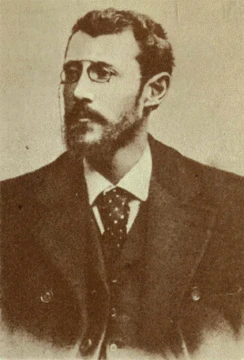
Captain Antifer
Breton sea captain in a Jules Verne treasure hunt.

Captain Antifer is the protagonist of Jules Verne's 1894 adventure novel *Mirifiques Aventures de Maître Antifer* (literally 'The Wonderful Adventures of Captain Antifer'). The novel follows the treasure hunt of Pierre Antifer, a Breton sea captain from Saint-Malo, as he and a diverse group of companions pursue clues left by an Egyptian pasha across multiple continents and seas.
Quick Facts
- Title Orig
- Mirifiques Aventures de Maître Antifer
- Author
- Jules Verne
- Illustrator
- Georges Roux
- Country
- France
- Language
- French
- Series
- The Extraordinary Voyages #40
- Genre
- Adventure novel
- Publisher
- Pierre-Jules Hetzel
- Pub Date
- 1894
- English Pub Date
- 1895
- Media Type
- Print (Hardback)
- Oclc
- 11889609
Facts from the source article.
Lore & Background
Captain Antifer is a gruff and impulsive seaman from Saint-Malo. In 1862, he meditates on a document bequeathed by his father—a letter from Kamylk-Pasha, whose life the father had saved in 1799 during the French campaign in Egypt and Syria. The document gives the latitude of an island where the pasha buried his treasures in 1831, with the longitude to be revealed later. When the Egyptian notary Ben-Omar and the pasha's heir Saouk arrive with the longitude, Antifer embarks with his nephew Juhel and friend Gildas Tregomain, postponing Juhel's marriage to Enogate.
Reader's Guide
Captain Antifer is a notable example of Jules Verne's later adventure fiction, combining a global treasure hunt with themes of obsession, frustration, and the unpredictability of nature. The novel's dramatic conclusion hinges on the real historical disappearance of Julia Island (also known as Graham Island), which emerged from volcanic activity in 1831 and sank the following year. Verne's use of this actual event adds a layer of historical verisimilitude to the fictional narrative. The story also reflects Verne's interest in diverse cultures and settings, moving from Tunisia to the Persian Gulf, the Gulf of Guinea, Edinburgh, Spitzbergen, and Sicily. The character of Captain Antifer—impulsive, gruff, and ultimately humbled—serves as a vehicle for exploring the futility of greed and the value of family and contentment. The novel was serialized in 1894 and translated into English in 1895, appearing in *The Boy's Own Paper* and as a paperback from R.F. Fenno.
Did You Know?
- The novel was completed in 1893 and serialized in *Magasin d'éducation et de récréation* from 1 January to 15 December 1894.
- The treasure is hidden on Julia Island, a real volcanic island that emerged in 1831 and disappeared in 1832.
- The villain Saouk ends up in a British prison after tying up and robbing the Reverend Tyrcomel.
- The final clue is solved by Enogate, Juhel's wife, who interprets a half-illegible document.
A Name Born of Compromise: Origins and Identity
Born from a publishing dispute as much as from literary imagination, Captain Nemo's very identity was shaped by commercial pressures. Jules Verne originally conceived the submarine captain as a Polish patriot, a participant in the January Uprising against Russian imperial occupation, destined to sink Russian warships. His publisher, Pierre-Jules Hetzel, vetoed this plan outright, warning that Russian censorship would ban the book and that the work would damage French-Russian diplomatic relations and cost Verne access to the lucrative Russian market. The compromise produced a figure of deliberately ambiguous origin in Twenty Thousand Leagues Under the Seas (1870), only to be later recast in The Mysterious Island (1875) as Prince Dakkar, son of a Hindu raja of Bundelkhand and nephew of Tipu Sultan of Mysore. The name itself is a deliberate echo: Nemo is Latin for 'no one,' the direct translation of the Greek Outis, the pseudonym Odysseus used to deceive the Cyclops Polyphemus. In The Mysterious Island, when Cyrus Smith addresses him by that name, the captain simply replies, 'I have no name!' The character also makes a brief appearance in Verne's 1882 play Journey Through the Impossible, co-written with Adolphe d'Ennery.
The Nautilus and a Polyglot Mind
Captain Nemo is, above all, a man of the deep and a master of engineering. His submarine, the Nautilus, was not built in a single shipyard but painstakingly assembled from components manufactured across several different nations, each part shipped to a secret address where the vessel was put together. This polyglot construction mirrors the captain's own intellectual range. Having received a Western education and spent his youth touring and studying throughout Europe, Nemo speaks French, English, Latin, and German with equal fluency—Professor Aronnax notes his French carries no accent whatsoever. The Nautilus's interior reflects this cosmopolitanism: its library, lounge, and art collections testify to a man intimately steeped in European culture, while his skill at the organ reveals a refined artistic sensibility. Yet for all his erudition, Nemo lives almost entirely by the sea. He avoids dry land, venturing ashore only to uninhabited places such as Antarctica or remote desert islands. His food, clothing, and even his tobacco are drawn from marine sources, a deliberate rejection of surface civilization's commodities. Physically, Aronnax describes him as a tall, self-contained man with a straight nose, broad brow, and wide-set eyes. By The Mysterious Island, the captain is in his late sixties, distinguished by a long white beard.
Vengeance, Solidarity, and the Sinking of Empires
Beneath Nemo's scientific brilliance burns a fierce, personal hatred of imperial oppression, a wound rooted in the loss of his wife and two young children. In The Mysterious Island, this grief is tied to the Indian Rebellion of 1857, after which Prince Dakkar lost both his family and his kingdom, retreating into research and the construction of the Nautilus. Verne wove references to real anti-imperialist uprisings—Kościuszko's revolt and the 1857 Rebellion—into the captain's backstory, grounding his rage in historical struggle. Nemo's defiance takes concrete form: he sinks warships, an act Aronnax condemns as a violation of maritime law. Yet the same man who torpedoes vessels of empire also quietly extends his hand to the oppressed. He channels salvaged bullion—gathered from oceanic shipwrecks, most notably the hulks of the Spanish treasure fleet destroyed at the Battle of Vigo Bay—into the hands of Cretan insurgents fighting Turkish rule between 1866 and 1869. He rescues a Ceylonese pearl diver from a shark, providing both physical salvation and financial aid, and shelters castaways on two separate occasions. His identification with the oppressed extends even to the natural world; he aligns himself with right whales under attack by sperm whales, seeing in their struggle a mirror of every colonized people's fight against a dominant power.
Death in the Grotto and an Endless Afterlife
Captain Nemo's final hours are as dramatic as his life. He dies of unspecified natural causes aboard the Nautilus, moored permanently inside Dakkar Grotto on Lincoln Island in the South Pacific. Cyrus Harding, leader of the castaways the captain had covertly protected, performs the last rites and submerges the vessel in the grotto's waters. The act is cut short by catastrophe: the volcanic island erupts, magma floods the grotto, and the resulting steam explosion shatters both the island and the Nautilus into fragments. Yet the character's afterlife has proven far more durable than his submarine. Nemo has been portrayed on screen by a remarkable roster of actors—James Mason, Herbert Lom, Patrick Stewart, Naseeruddin Shah, Ben Cross, Omar Sharif, and Michael Caine—each bringing a distinct cultural lens to the role. Beyond film, the figure has been seized upon by writers across genres: Alan Moore and Kevin O'Neill wove him into The League of Extraordinary Gentlemen; Philip José Farmer reimagined him in The Other Log of Phileas Fogg; Kevin J. Anderson explored his backstory in Captain Nemo: The Fantastic History of a Dark Genius; and both Thomas F. Monteleone's The Secret Sea and Howard Rodman's The Great Eastern built narratives around the captain's shadow. A character born from a publisher's market calculation has become one of literature's most endlessly reinvented figures.
Frequently Asked Questions
Who is Captain Antifer?
Pierre Antifer is a Breton sea captain from Saint-Malo who serves as the central figure in Jules Verne's 1894 adventure novel. He is the one who sets out to track down a hidden fortune based on clues bequeathed by an Egyptian pasha.
What is the premise of Captain Antifer?
The story is a globe-trotting treasure hunt in which Antifer and his companions follow a chain of clues left by an Egyptian pasha across several continents and oceans. Rather than focusing on a single technology or location, the novel emphasizes the journey and the shifting cast of characters encountered along the way.
When and where was Captain Antifer first published?
The novel appeared as a serialization in 1894 in the French periodical Magasin d'éducation et de récréation, a popular magazine aimed at young readers. It was later gathered into book form, following the standard practice for Verne's serialized works.
Who are Antifer's companions on the treasure hunt?
Antifer travels with a varied ensemble of characters who join him at different points during the multi-continent pursuit. This rotating cast is a defining feature of the novel, giving each leg of the journey a different flavor and set of challenges.
How does the treasure hunt conclude?
After crossing multiple continents and seas, Antifer and his group ultimately succeed in locating the treasure the Egyptian pasha had concealed. The resolution brings the long, winding chase to a close and reuniting the scattered companions.
More in Novels by Jules Verne 1-24
Spotted an error? Know more?
Reader corrections go straight into our review queue. Suggest an edit · How this site is sourced