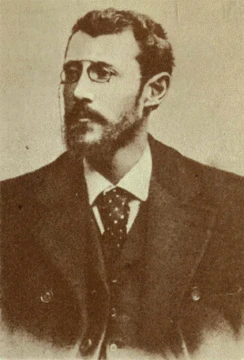
César Cascabel
Novel about a French circus family's overland journey home.

César Cascabel is a novel by Jules Verne, published in 1890 as part of the Voyages Extraordinaires series. The story follows a French family of circus artists who, after their savings are stolen in Sacramento in 1867, attempt to return to France overland via Alaska, Siberia, and Central Russia.
Quick Facts
- Title Orig
- César Cascabel
- Author
- Jules Verne
- Illustrator
- Georges Roux
- Country
- France
- Language
- French
- Series
- The Extraordinary Voyages #35
- Genre
- Adventure novel
- Publisher
- Pierre-Jules Hetzel
- Release Date
- 1890
- Media Type
- Print (Hardback)
- Preceded By
- The Purchase of the North Pole
- Followed By
- Mistress Branican
Facts from the source article.
Lore & Background
The Cascabels are a French family of circus artists who have spent several years touring the United States. In 1867, while in Sacramento, their savings are stolen, preventing them from affording ship fare home. César Cascabel decides to travel overland with their horse-drawn carriage, the Belle-Roulotte, via Alaska and the Bering Straits, through Siberia and Central Russia, expecting no dangers.
Reader's Guide
On their journey, the family crosses the Alaskan border and, with the help of a native girl named Kayette, rescues a Russian political fugitive, Count Narkine. The count adopts Kayette as his daughter. In Sitka, the group witnesses the transfer of Alaska to the United States. Later, while traveling from Port Clarence, they end up on a floating iceberg that drifts to the Lyakhovsky Islands, where they are captured by natives. After further troubles, including political ones, the Cascabels manage to cross the Urals to Perm and then travel easily to France.
Did You Know?
- The novel was published in English in two-volume form with subtitles 'The Show on Ice' and 'The Travelling Circus'.
- The Cascabels' horse-drawn carriage is named the Belle-Roulotte (the Fair Rambler).
- An animated TV series inspired by the book was produced in 2001 in France.
- The story includes the transfer of Alaska to the United States, witnessed by the characters in Sitka.
A Place in Verne's Extraordinary Voyages
César Cascabel arrived in 1890 as the latest installment in Jules Verne's celebrated Voyages Extraordinaires collection, a series that had become synonymous with bold, globe-spanning adventure narratives. Verne, by this point a veteran of the genre, chose to send his protagonists not across oceans by steamship but across the frozen breadth of the Northern Hemisphere by horse-drawn carriage. The novel found its English-speaking audience in a distinctive two-volume format, with the first half subtitled "The Show on Ice" and the second "The Travelling Circus," a pairing that hints at the dual tone of the story: the perilous, almost surreal drift across Arctic waters, and the more grounded, human comedy of a displaced performing family trying to make a living on the road. Within the broader Verne canon, the book occupies a somewhat quieter niche, yet its commitment to a single, unbroken overland route from California to France gives it a structural unity that sets it apart from many of its series-mates.
The Cascabels' Impossible Route
The story opens in Sacramento in the year 1867, where a French family of circus performers has spent several years touring the American West. Their plans are simple: sell their act one final time, board a ship, and return to France. But a theft of their savings shatters that plan overnight, leaving them unable to purchase passage across the Pacific. César Cascabel, the family's leader, devises an audacious alternative. Rather than sail, he will drive. The family loads their horse-drawn carriage, the Belle-Roulotte—literally the Fair Rambler—and sets out overland. The intended route threads through Alaska, across the Bering Straits, and then deep into Siberia and Central Russia before finally reaching France. Verne notes that the Cascabels expect to encounter no serious dangers along this path, a line of narrative irony that the rest of the novel proceeds to dismantle with spectacular thoroughness.
Adventures Along the Way
Despite the Cascabels' optimistic expectations, the journey quickly spirals into a cascade of unexpected encounters. Near the Alaskan border, a native girl named Kayette assists the group in rescuing count Narkine, a Russian political fugitive who has been fleeing authorities. The family takes him in so he can reunite with his father back in Russia, and Narkine in turn adopts Kayette as his daughter, weaving an unlikely family bond into the travelling troupe. In Sitka, the group witnesses the formal transfer of Alaska to the United States, a moment of geopolitical history unfolding in real time around them. The most harrowing episode comes after Port Clarence, when the travellers find themselves stranded on a floating iceberg that drifts across the Arctic Ocean toward the Lyakhovsky Islands. There they are captured by local inhabitants. Political complications follow, but the Cascabels press on through the Urals, reach Perm, and from there make the comparatively easy final stretch to France.
Life Beyond the Page
Although César Cascabel has never achieved the same household recognition as some of Verne's more famous titles, it has continued to find new audiences well beyond the printed page. In 2001, a French production team adapted the novel into an animated television series, bringing the Cascabel family's overland odyssey to a new generation of viewers and giving the story a visual vocabulary that the 1890 text could only suggest through prose. The series has since been catalogued on IMDb, where it stands as a record of the book's ongoing cultural afterlife. The original French text remains accessible to readers who wish to encounter Verne's language directly, and the novel's two-volume English edition, with its evocative subtitles, continues to circulate among collectors of the Voyages Extraordinaires series. Together, these adaptations and editions ensure that a story about a circus family driving a carriage across the frozen north remains a living piece of Verne's legacy rather than a forgotten footnote.
Frequently Asked Questions
Who is César Cascabel?
He is the eponymous protagonist of Jules Verne's 1890 adventure novel, a French circus performer who leads his family on a desperate overland journey back to France after their savings are stolen in Sacramento, California.
What is the premise of César Cascabel?
The novel follows a French family of traveling circus artists who, after losing their life savings to thieves in 1867 Sacramento, attempt to cross the continent through Alaska, Siberia, and Central Russia to reach their homeland.
What route does the Cascabel family take to get home?
Rather than sailing back across the Pacific, the family travels overland north through Alaska, then east across Siberia and through Central Russia to eventually reach France.
When was César Cascabel published and what series does it belong to?
Jules Verne released the novel in 1890 as part of his long-running Voyages Extraordinaires collection, and it has appeared in English under the subtitles 'The Show on Ice' and 'The Travelling Circus'.
What is César Cascabel's role in the story?
As the head of the circus troupe, Cascabel is the central figure whose family's misfortune in Sacramento sets the entire transcontinental adventure in motion, and his determination to get them home drives the narrative forward.
More in Novels by Jules Verne 1-24
Spotted an error? Know more?
Reader corrections go straight into our review queue. Suggest an edit · How this site is sourced