
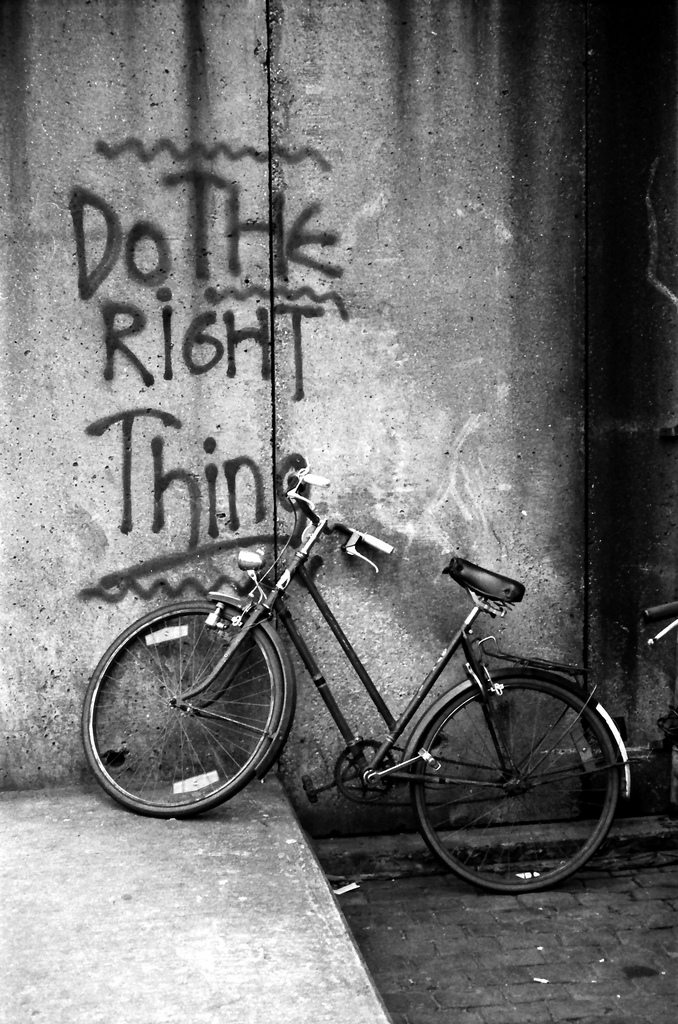
Do the Right Thing
A film about racial tension on a hot summer day.

Mouryan · CC BY-SA 4.0
Do the Right Thing is a 1989 American independent film blending comedy and drama, written, produced, and directed by Spike Lee. The cast includes Lee, Danny Aiello, Ossie Davis, Ruby Dee, Richard Edson, Giancarlo Esposito, Bill Nunn, John Turturro, and John Savage, and it marks the first film appearances of Martin Lawrence and Rosie Perez. Set in a Brooklyn neighborhood, the plot follows rising racial friction between Black residents and the Italian-American family who run a local pizzeria, which leads to tragedy and violence during a scorching summer day.
The movie premiered at the 42nd Cannes Film Festival on May 19, 1989, and Universal Pictures released it in U.S. theaters on June 30. It succeeded with both critics and at the box office, earning $37.3 million worldwide against a $6.2 million budget. The film mixes comedy, drama, and social commentary, and is known for its bright color palette, stylized camera work, direct-to-camera monologues, and a hip-hop-heavy soundtrack led by Public Enemy’s “Fight the Power.” Lee’s direction uses heightened realism along with theatrical and symbolic methods to show how heat, crowds, and city life affect people psychologically and emotionally. Its ambiguous ending sparked debate after release about protest, responsibility, and moral judgment.
At the 62nd Academy Awards, the film received nominations for Best Original Screenplay and Best Supporting Actor (Aiello). It is now widely seen as one of the most significant American films of the late 20th century; in 1999, the Library of Congress selected it for the National Film Registry as “culturally, historically or aesthetically significant.” In 2022, *Sight and Sound* magazine’s decennial critics’ poll ranked it the 24th greatest film of all time, and it appears on many other all-time best lists.
**Plot**
Mookie, age twenty-five, lives in Brooklyn’s Bedford–Stuyvesant with his sister Jade. He has a toddler son, Hector, with his Latina girlfriend Tina, and works delivering pizzas for Salvatore “Sal” Frangione, an Italian-American. Sal’s older son, Pino, is racist and despises all the Black residents. His younger son, Vito, is friends with Mookie, which Pino thinks weakens their brotherly bond.
Other locals include Da Mayor, a friendly drunk who offers unsolicited advice; Mother Sister, who watches the block from her brownstone; Radio Raheem, who blasts “Fight the Power” from his boombox; Buggin’ Out, a fast-talking man who pushes Black civil rights; Smiley, a mentally disabled man who carries hand-colored pictures of Malcolm X and Martin Luther King Jr.; and DJ Mister Señor Love Daddy.
At Sal’s, Buggin’ Out questions Sal about his “Wall of Fame,” which displays photos of famous Italian-Americans. He demands Sal add pictures of Black celebrities since most customers are Black. Sal refuses, saying he has no obligation, and kicks him out. Buggin’ Out tries to start a boycott, but only Raheem and Smiley join.
During the day, teenagers open a fire hydrant to cool off until white police officers Mark Ponte and Gary Long stop them. Mookie confronts Pino about his hatred of Black people. Later, Pino tells Sal he hates Black people, but Sal insists on keeping the business in the mostly Black neighborhood.
That night, Buggin’ Out, Smiley, and Raheem march into Sal’s and demand Black celebrities on the wall. Sal orders Raheem to turn off his boombox; he refuses. Buggin’ Out insults Sal and threatens to close the pizzeria. Other Black customers join in after Sal calls Buggin’ Out the N-word. Sal snaps and smashes Raheem’s boombox with a baseball bat. Raheem attacks Sal, and a fight spills into the street, drawing a crowd. Police arrive, including Long and Ponte. They break up the fight and arrest Raheem and Buggin’ Out. As officers restrain Raheem, Long chokes him with his nightstick. Despite Ponte and onlookers begging him to stop, Long tightens the chokehold, killing Raheem. To save face, the officers hide his body in a police car and drive off.
The crowd blames Sal for Raheem’s death, even as Da Mayor tries to calm things. Mookie grabs a trash can and throws it through the pizzeria’s window, sparking the mob to destroy it. Da Mayor pulls Sal, Pino, and Vito away. Smiley places the photo of King and Malcolm X on the wall of fame, then sets the building on fire. The mob turns toward the Korean market across the street, but owner Sonny talks them down.
Police return with fire crews and riot patrols to put out the fire and disperse the crowd. Firefighters, after warnings, turn hoses on the mob, causing more violence and arrests. The next day, Mookie goes to Sal and asks for his weekly pay. After an argument, Sal pays him, and they part. Mookie visits Hector as Mister Señor Love Daddy announces that the mayor has formed a committee to investigate the incident and dedicates a song to Raheem.
An epilogue shows two quotes that highlight the film’s theme—one from Martin Luther King Jr., stating that violence is wrong.
- director
- Spike Lee
- genre
- Comedy-drama
- production_budget
- $6.2 million
- worldwide_gross
- $37.3 million
- academy_award_nominations
- Best Original Screenplay, Best Supporting Actor (Danny Aiello)
Quick Facts
- Director
- Spike Lee
- Starring
- Danny Aiello / Ossie Davis / Ruby Dee / Richard Edson / Giancarlo Esposito / Spike Lee / Bill Nunn / John Turturro / John Savage
- Music
- Bill Lee
- Cinematography
- Ernest Dickerson
- Editing
- Barry Alexander Brown
- Studio
- 40 Acres and a Mule Filmworks
- Distributor
- Universal Pictures
- Released
- 1989 · 05 · 19 · Cannes · 1989 · 06 · 30 · United States
- Runtime
- 120 minutes
- Country
- United States
- Language
- English
- Budget
- $6.2 million
Facts from the source article.
Lore & Background
Set in the Bedford-Stuyvesant neighborhood of Brooklyn, the film’s appearance is defined by a vivid, almost hyperreal color palette—bright reds, yellows, and oranges that intensify the oppressive summer heat. The cinematography employs stylized angles and direct-address monologues, where characters speak directly to the camera, breaking the fourth wall. The range of the story is confined largely to a single city block, focusing on the interactions among a diverse ensemble of African-American residents and the Italian-American owners of a local pizzeria. The habitat is a dense, urban streetscape of brownstones, a corner pizzeria, a Korean grocery, and a fire hydrant that local teenagers open for relief. Defining characteristics include the use of Public Enemy’s “Fight the Power” as a recurring sonic motif, blasted from Radio Raheem’s boombox, and the film’s blending of comedy, drama, and social commentary. Lee’s direction combines heightened realism with theatrical and symbolic techniques to convey the psychological effects of heat and crowd dynamics. The narrative culminates in a tragic police chokehold death and a subsequent riot, with the film’s ambiguous conclusion—featuring quotations from Martin Luther King Jr. and Malcolm X—sparking widespread debate about protest, responsibility, and moral judgment. The film was selected for preservation in the National Film Registry as culturally, historically, or aesthetically significant.
Reader's Guide
Do the Right Thing blends comedy, drama, and social commentary, employing vivid color design and stylized cinematography to convey the psychological effects of heat and urban crowd dynamics. The film uses direct-address monologues and a hip-hop-driven soundtrack, most prominently Public Enemy’s “Fight the Power,” to heighten its theatrical and symbolic techniques. Its ambiguous conclusion, which juxtaposes quotations from Martin Luther King Jr. and Malcolm X, sparked widespread debate about protest, responsibility, and moral judgment. The film’s behavior and ecology are rooted in a single hot summer day in a Brooklyn neighborhood, where simmering racial tension between African-American residents and the Italian-American owners of a local pizzeria escalates through a series of confrontations. This tension culminates in tragedy when a police chokehold kills a Black resident, leading Mookie to throw a trash can through the pizzeria’s window, sparking a destructive riot. The film’s significance lies in its critical and commercial success, grossing $37.3 million against a $6.2 million budget, and its lasting cultural impact. It earned Academy Award nominations for Best Original Screenplay and Best Supporting Actor (Danny Aiello). In 1999, it was selected for preservation in the U.S. National Film Registry as culturally, historically, or aesthetically significant, and in 2022 it ranked 24th in Sight and Sound’s decennial critics’ poll of the greatest films. The film relates to its field as a landmark of independent American cinema, noted for its unflinching examination of racial dynamics and its integration of heightened realism with symbolic storytelling.
Did You Know?
- The film is the feature film debut of Martin Lawrence and Rosie Perez.
- Samuel L. Jackson played the role of Mister Señor Love Daddy.
- Roger Guenveur Smith created the character of Smiley, who was not in the original script.
- The film's epilogue shows quotations from Martin Luther King Jr. and Malcolm X.
From Stage to Screen
His stated ambition was to craft a hopeful, happy-ending narrative about being gay, being working class, and coming out. He was driven by a gap he noticed on television: heterosexual teenagers could watch the 'gorgeous guy taking the gorgeous girl to the prom,' yet no comparable role model existed for queer youth. Producer Tony Garnett felt the material translated better to the screen than the stage, and once Channel 4 greenlit the production, David Aukin, the channel's head of drama, brought in stage director Hettie MacDonald to helm the project because the subject matter felt 'foreign' to Garnett. The finished film marked the cinema debuts of Harvey, MacDonald, and actors Glen Berry, Scott Neal, and Tameka Empson.
A Story Set in Thamesmead
The narrative centers on Jamie Gangel, an introverted teenager on a council estate in Thamesmead, south-east London, who is picked on by classmates for his dislike of football. His single mother Sandra is consumed by ambitions to run her own pub and cycles through lovers, most recently a neo-hippie named Tony. Jamie harbors a secret attraction to his neighbor Ste Pearce, a boy regularly beaten by his drug-dealing older brother and alcoholic father. After one such beating, Sandra lets Ste sleep over, and the two end up sharing a bed head-to-toe. On their second night, Jamie applies peppermint lotion to Ste's bruised back, and after learning Ste has never been kissed, Jamie gives him his first. The relationship faces obstacles including a hostile house party, Sandra's discovery of a stolen Gay Times magazine and vandalized schoolbooks, and a confrontation that ultimately leads to her acceptance. The story culminates in the two boys sharing a slow dance in their estate's courtyard to Cass Elliot's 'Dream a Little Dream of Me.'
Production Challenges and On-Set Anecdotes
The production was not without friction. Harvey recalled that the two boys were originally intended to be 15 and 16, but since those ages fell below the age of consent in Britain, the cast was auditioned at 17. Lawyers had to scrutinize the project because of an on-screen kiss, and ultimately all references to specific ages were removed—not for legal reasons, but because Gay Times objected to their magazine appearing in a film that mentioned the characters being underage. On set, first assistant director Susie Liggat recounted that electricians flatly refused to work during the scenes where Jamie and Ste kiss in the woods after leaving The Gloucester pub. A compromise was reached: the electricians would rig the lights and then leave before filming began. Liggat and Harvey both took small uncredited roles; Liggat played a woman at the newsstand, while Harvey appeared as 'Wheelchair Queen' in the Gloucester scene.
Legacy and Audience Impact
The film has since been ranked among the finest LGBTQ cinema, and its atmosphere is shaped by a soundtrack drawn almost entirely from the Mamas & the Papas and Cass Elliot. Producer Tony Garnett recalled the flood of letters that arrived after release, written by young men who thanked the filmmakers for 'saving them,' saying they now knew they were not alone or freaks. In 2016, British playwright Fin Kennedy observed that two decades on, the story was still held in 'near-universal affection among audiences.' The film also left a tangible mark on the drag community: Dave Lynn, who played the performer at The Gloucester, was already a regular act there and was asked on set to appear. He later donated the dress he wore in the film for display at a bar in Brighton, alongside a copy of the script.
Gallery


More in Notable Films 1-21
Spotted an error? Know more?
This is a living reference — every entry is fact-audited, and reader corrections feed straight into our audit queue. Suggest an edit · See this site's audit record