
Chinatown (1974 film)
A neo-noir mystery inspired by the California water wars.

Jakub Hałun · CC BY 4.0
**Chinatown (1974 film)**
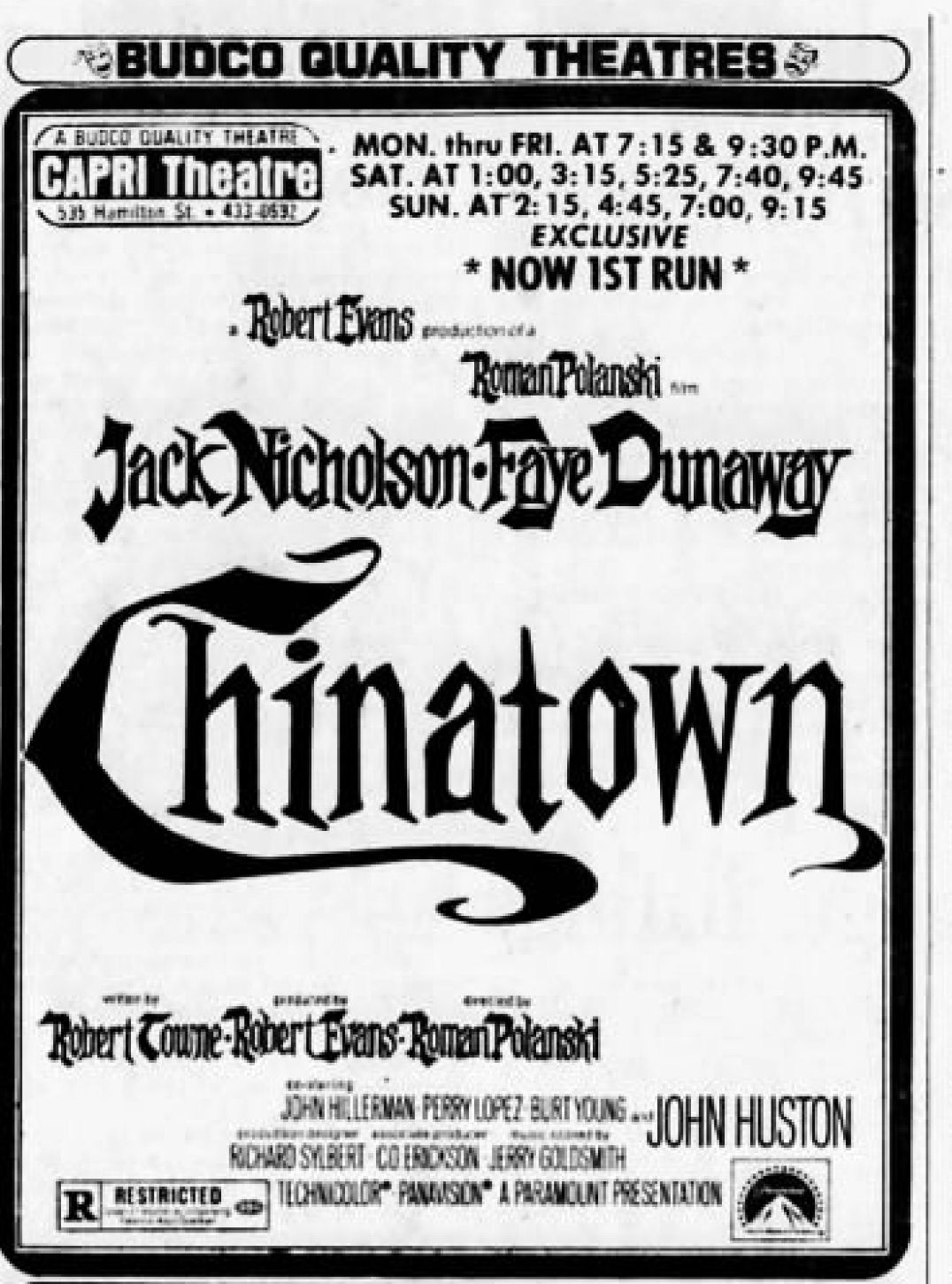
*Chinatown* is a 1974 American neo-noir mystery film directed by Roman Polanski and written by Robert Towne. The cast includes Jack Nicholson and Faye Dunaway in leading roles, with John Huston, John Hillerman, Perry Lopez, Burt Young, Joe Mantell, Bruce Glover, James Hong, and Diane Ladd in supporting parts. The plot draws from the California water wars—early 20th-century conflicts over water in Southern California that allowed Los Angeles to claim rights to the Owens Valley. Robert Evans produced the film, Paramount Pictures distributed it, and it marked Polanski’s last movie made in the United States.
Released on June 20, 1974, the film earned widespread critical praise for its narrative, screenplay, performances by Nicholson and Dunaway, cinematography, and Polanski’s direction. At the 47th Academy Awards, it led with 11 nominations, including Best Picture, Best Director (Polanski), Best Actor (Nicholson), and Best Actress (Dunaway); Towne won for Best Original Screenplay. At the 32nd Golden Globe Awards, it took four awards: Best Motion Picture – Drama, Best Director, and Best Actor – Motion Picture Drama (Nicholson). The 28th British Academy Film Awards saw 11 nominations, including Best Film, with wins for Best Direction (Polanski), Best Screenplay (Towne, also honored for *The Last Detail*), and Best Actor in a Leading Role (Nicholson).
In 2008, the American Film Institute ranked *Chinatown* second on its list of the top ten mystery films. In 1991, the Library of Congress selected it for preservation in the United States National Film Registry, citing its cultural, historical, or aesthetic significance. It is widely considered one of the greatest films ever made. A sequel, *The Two Jakes*, came out in 1990, again starring Nicholson (who also directed), with Towne returning as screenwriter; it did not match the original’s acclaim.
**Plot**
In 1937 Los Angeles, a woman claiming to be Evelyn Mulwray hires private investigator J. J. "Jake" Gittes to follow her husband, Hollis, the chief engineer at the Department of Water and Power. Gittes photographs Hollis with a young woman, and the images appear in the *Post-Record*, exposing an apparent affair. The real Evelyn Mulwray then confronts Gittes, threatening a lawsuit. He realizes the impostor used him to discredit Hollis.
When Hollis’s body is found in a reservoir, Gittes runs into his former colleague, LAPD Lieutenant Lou Escobar. Investigating, Gittes learns that large amounts of water are being drained from the reservoir each night despite a drought. Water Department Security Chief Claude Mulvihill warns him off, and one of Mulvihill’s henchmen slashes Gittes’s nose.
Ida Sessions—the woman who posed as Evelyn—calls Gittes, refusing to name her employer but telling him to check the *Post-Record*’s obituaries. Now working for Evelyn, Gittes probes Hollis’s death. He discovers that Hollis was once a business partner of Evelyn’s wealthy father, Noah Cross. Cross offers to double Gittes’s fee if he finds Hollis’s missing mistress.
Public records show much of the Northwest Valley has recently changed hands. Gittes spots a buyer’s name from the obituary section; the man had been dead for a week when the deal closed. Gittes and Evelyn bluff their way into the buyer’s retirement home and find many other residents listed as buyers, though they know nothing about it. A suspicious staff member alerts Mulvihill, but Gittes and Evelyn escape to her mansion, where they sleep together. Later, Gittes follows Evelyn to a house where she comforts the missing girl. Evelyn claims the girl is her sister, Katherine.
Escobar calls Gittes to Ida’s apartment; she has been murdered. Escobar says Hollis had saltwater in his lungs, meaning he didn’t drown in the reservoir, and suspects Evelyn of the murder. He orders Gittes to produce her quickly. At the Mulwray residence, Gittes retrieves bifocals from the saltwater garden pond.
Gittes confronts Evelyn about Katherine—now said to be her daughter—and about her husband’s death, which she denies. He slaps her repeatedly until she breaks down, revealing that Katherine is both her sister and daughter: Cross impregnated Evelyn when she was 15. The bifocals, she says, weren’t Hollis’s—he didn’t wear them.
Gittes arranges for the women to flee to Mexico and tells Evelyn to meet him at her butler’s home in Chinatown. He summons Cross to the Mulwray estate, having deduced that Cross dropped his bifocals while drowning Hollis in the pond. Cross admits he is behind the water shortage and the land grab. Once the land is his, he will get a city contract to build a reservoir there. He discredited and killed Hollis when Hollis came close to exposing the scheme.
Mulvihill takes the glasses from Gittes at gunpoint. Gittes is forced to drive them to the Chinatown rendezvous, where police wait. Escobar detains Gittes as Cross tries to claim Katherine. Evelyn shoots Cross in the arm and attempts to escape with Katherine, but police open fire, killing her. Cross takes a distraught Katherine away, and Escobar releases Gittes. As Gittes is led off by his associates, one says, "Forget it, Jake. It's Chinatown."
- director
- Roman Polanski
- screenwriter
- Robert Towne
- producer
- Robert Evans
- distributor
- Paramount Pictures
- genre
- Neo-noir mystery
- academy_award_wins
- 1 (Best Original Screenplay)
Lore & Background
Chinatown is a 1974 American neo-noir mystery film directed by Roman Polanski and written by Robert Towne, starring Jack Nicholson and Faye Dunaway, with John Huston in a supporting role. The story is inspired by the early 20th-century California water wars, specifically the disputes that allowed Los Angeles to secure water rights in the Owens Valley. The film was Polanski’s final work made in the United States, produced by Robert Evans and distributed by Paramount Pictures. Upon its June 20, 1974 release, it received critical acclaim for its narrative, screenwriting, performances, cinematography, and direction. It led the 47th Academy Awards with 11 nominations, winning Best Original Screenplay, and won four Golden Globe Awards, including Best Motion Picture – Drama. The American Film Institute later ranked it second on its list of the top ten mystery films, and in 1991 it was selected for preservation in the U.S. National Film Registry for being culturally, historically, or aesthetically significant. The plot follows private investigator J. J. “Jake” Gittes, who is hired by a woman impersonating Evelyn Mulwray to tail her husband, Hollis Mulwray, the chief engineer of the Department of Water and Power. After Hollis is found dead in a reservoir, Gittes uncovers a conspiracy involving nightly water releases, fraudulent land purchases, and the wealthy patriarch Noah Cross, who reveals he fathered a daughter with his own daughter, Evelyn. The film ends tragically in Chinatown, where Evelyn is shot dead by police as Cross takes the girl away. A sequel, *The Two Jakes*, was released in 1990 but failed to match the original’s acclaim.
Reader's Guide
Chinatown is significant for its intricate screenplay, which won Robert Towne the Academy Award for Best Original Screenplay, and for its critical and commercial success. It led the 47th Academy Awards with 11 nominations, including Best Picture, Best Director, Best Actor, and Best Actress. At the 32nd Golden Globe Awards, it won four awards, including Best Motion Picture – Drama, Best Director, and Best Actor – Motion Picture Drama. The film also received 11 nominations at the 28th British Academy Film Awards, winning three: Best Direction, Best Screenplay, and Best Actor in a Leading Role. Its legacy endures as a landmark of neo-noir cinema and a cautionary tale about corruption and power.
Did You Know?
- Chinatown was Roman Polanski's final film made in the United States.
- The film's story is inspired by the California water wars, which resulted in Los Angeles securing water rights in the Owens Valley.
- The character of Hollis Mulwray was loosely based on Irish immigrant William Mulholland, according to Mulholland's granddaughter.
Release and Critical Acclaim
The film, helmed by Roman Polanski, earned what can only be described as worldwide critical acclaim upon its release. It brought together a remarkable trio of screen talent—Jack Nicholson, Faye Dunaway, and John Huston—under one directorial vision. The timing placed it squarely in the heart of a year that would produce some of the most significant films in cinema history. Rather than arriving as a quiet entry in the summer slate, Chinatown announced itself as a major event, the kind of picture that commands attention across international markets simultaneously. The critical reception it garnered positioned it as one of the defining releases of the year, a film whose reputation was established not through slow word-of-mouth but through the immediate, widespread praise it received upon its June debut.
Among the Year's Defining Films
It shared that distinction with The Godfather Part II, Blazing Saddles, The Towering Inferno, Earthquake, and Young Frankenstein—a grouping that spans genres from epic crime drama to satirical western to spectacle-driven disaster cinema. The diversity of that list underscores how varied the year's output was, yet Chinatown's presence among them signals its standing as a work of genuine significance rather than mere commercial appeal. Its June release slot placed it before the autumn wave of big-budget productions, allowing it to establish its reputation on artistic merit in a year otherwise remembered for scale and ambition.
The Creative Assembly
The making of Chinatown represented a convergence of extraordinary individual talents under a single directorial hand. Roman Polanski, the filmmaker behind the project, brought his distinctive sensibility to a cast that included Jack Nicholson, Faye Dunaway, and John Huston. Polanski's role as director placed him in the creative driver's seat, shaping the work of three actors who each commanded their own considerable screen presence. The pairing of Nicholson and Dunaway as leads, with Huston anchoring the ensemble, created a dynamic that critics worldwide would recognize and celebrate. This was not a film assembled around a single marquee name; rather, it was a project in which the interplay between director and cast—and among the cast members themselves—became the defining feature of the finished work.
A Year of Industry Transition
That same year, both Columbia Pictures and Metro-Goldwyn-Mayer marked their fiftieth anniversaries, with MGM celebrating in particular grand fashion through the retrospective documentary That's Entertainment!. Meanwhile, leadership churn swept through the studios: Joseph E. Levine resigned as president of Embassy Pictures in May, Barry Diller was named chairman and CEO of Paramount in September, Frank Yablans announced his departure from Paramount in November, and Gordon Stulberg stepped down as president of 20th Century Fox in December. Even the technology of filmmaking was shifting, as Technicolor ceased its legendary dye-transfer printing process that same November. Into this landscape of celebration, resignation, and technological change, Chinatown arrived as a work of critical distinction—a film whose acclaim seemed to transcend the institutional turbulence surrounding it.
Gallery




More in Notable Films 1-21
Spotted an error? Know more?
This is a living reference — every entry is fact-audited, and reader corrections feed straight into our audit queue. Suggest an edit · See this site's audit record