
Blue Velvet (film)

Umberto Montiroli · Public domain
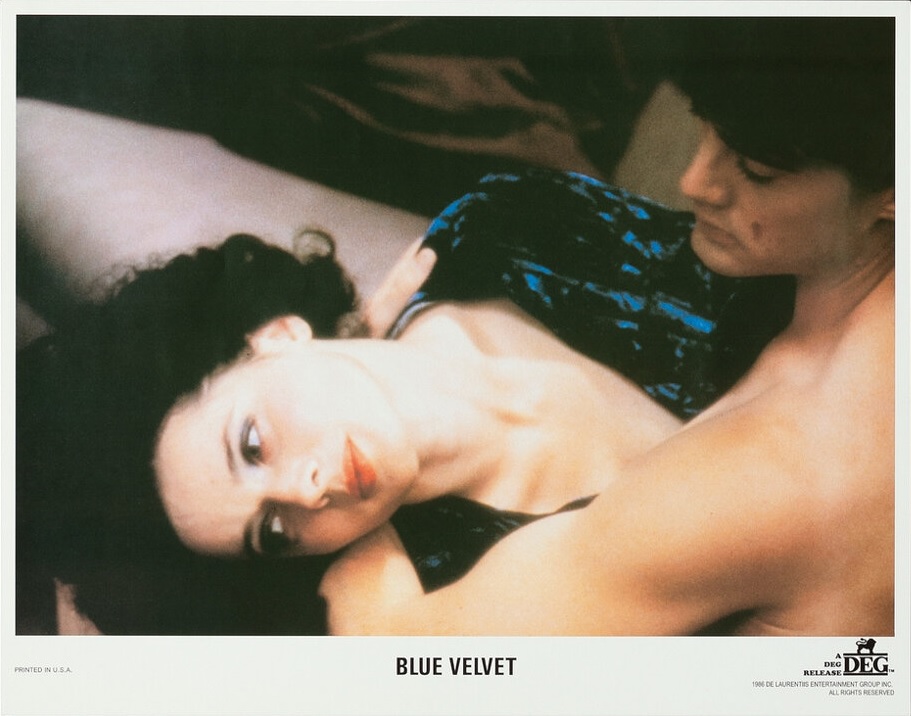
Blue Velvet is a 1986 American neo-noir mystery thriller film written and directed by David Lynch. The film stars Kyle MacLachlan, Isabella Rossellini, Dennis Hopper, and Laura Dern, and takes its title from the 1951 song of the same name. The story follows a college student who returns to his suburban hometown after his father suffers a stroke. While walking home from the hospital, he discovers a severed human ear in a vacant lot. This discovery leads him into a criminal conspiracy involving a troubled nightclub singer. Lynch’s screenplay had been rejected by several major studios in the late 1970s and early 1980s due to its explicit sexual and violent content. After the commercial failure of his 1984 film Dune, Lynch sought to create a more personal story, returning to the surrealist style of his debut, Eraserhead. The independent studio De Laurentiis Entertainment Group, owned by producer Dino De Laurentiis, agreed to finance the project. Upon release, the film received a divided critical response, with many critics arguing its explicit content lacked artistic purpose. Nonetheless, it earned Lynch his second Academy Award nomination for Best Director and won Best Film and Best Director prizes from the National Society of Film Critics. The film revitalized Hopper’s career and provided Rossellini with a dramatic role beyond her modeling and cosmetics work. Over time, it achieved cult status and has been re-evaluated as one of Lynch’s masterpieces, frequently cited among the greatest films of the 1980s. Publications such as Sight and Sound, Time, Entertainment Weekly, and BBC Magazine have ranked it among the greatest American films, and in 2008 the American Film Institute selected it as one of the ten greatest American mystery films.
- Director
- David Lynch
- Notable cast
- Kyle MacLachlan, Isabella Rossellini, Dennis Hopper, Laura Dern
Verified Timeline
Lore & Background
Peter Braatz had worked as a musician fronting the German avant-garde punk band S.Y.P.H. before moving to Berlin in the early eighties to study film. He first contacted Lynch in 1983, sending a critique of Lynch's The Elephant Man with a proposal to interview him to Mel Brooks, who had produced the film. Lynch wrote back several months later, and they exchanged letters over the following two years. In 1985, out of the blue, Lynch invited Braatz to document the making of his new film in Wilmington, North Carolina, which became Blue Velvet. Braatz travelled with a friend and stayed on set for three months, taking only Super 8 cameras and reels (due to cost and weight), a tape recorder and a camera. Lynch granted Braatz unrestricted access to the set, cast and crew, with only some restrictions placed on where Braatz could film Isabella Rossellini as she was still under contract to Lancome. Braatz first released a film based on what he documented as No Frank in Lumberton in 1988. The film was avant-garde in its approach and had limited distribution through the German television station ZDF and a handful of festivals. In 2013, Braatz was in his studio listening to the track "As Below" by British band Cult With No Name. He was inspired to revisit his footage and put together a proposal based on this piece of music for a new film using his archived Blue Velvet footage. The German Film Foundation and the Slovenian Bela-Film provided funding for the film. Before editing began, Braatz commissioned Cult With No Name to produce the soundtrack, as it was always his intention to edit to music as much of his material was silent, having been filmed using Super 8. Cult With No Name invited Tuxedomoon and John Foxx to join them in producing the soundtrack, released on Crammed Discs in 2015 on vinyl and CD a year before the film. The soundtrack received significant press coverage and was met with highly positive reviews, with The Wire describing it as "... evocative, dreamy, dark and dynamic.." The CD included a booklet of previously unreleased photographs taken on set. "No News", the song that closes Blue Velvet Revisited and did not appear on the soundtrack, was subsequently released by the Cult With No Name on their Heir of the Dog album in 2017. Editing and production of the film took over a year in total. The film's Opening and chapter titles were provided by acclaimed graphic designer Jonathan Barnbrook, most famous for his work with David Bowie. Braatz himself dubbed the film "a meditation on a movie", making an important distinction between his approach and a conventional documentary with narration.
Reader's Guide
Blue Velvet Revisited premiered at the Institute of Contemporary Arts as part of the BFI London Film Festival on 7 October 2016. This coincided with the 30th anniversary of the release of the original film. The next day, at Lynch's request, the film received its US premiere at Lynch's Festival of Disruption. A Q+A with Laura Dern and Kyle MacLachlan followed the screening. Since then, the film has appeared in many notable festivals, galleries and cinemas worldwide, including CPH: DOX, Doc NYC, and MALBA. In February 2019, The Criterion Collection announced a deluxe reissue of Blue Velvet on DVD and Blu-ray with Blue Velvet Revisited included as an extra. In 2020, the track "Lumberton" from the soundtrack of Blue Velvet Revisited, was licensed to be used in the HBO series The New Pope, starring Jude Law and John Malkovich. The film gained positive reviews. On the review aggregator website Rotten Tomatoes, 83% of 6 critics' reviews are positive, with an average rating of 7/10. The Hollywood Reporter described the film as "... a quietly mesmerizing sensory experience, with a distinctive rhythm and look that makes it a stand-alone artwork rather than a mimetic mirror of its subject." Sam Gray of The Upcoming went further and commented, "With a terrific soundtrack and its insightful, rare footage, Blue Velvet Revisited is nirvana for Lynch nerds, though even those with a perfunctory interest in filmmaking could do with seeing this fascinating gem."
Did You Know?
- Peter Braatz first contacted David Lynch in 1983 by sending a critique of The Elephant Man to Mel Brooks, who had produced the film.
- Braatz stayed on the Blue Velvet set for three months, taking only Super 8 cameras and reels, a tape recorder, and a camera due to cost and weight.
- Isabella Rossellini had restrictions on where Braatz could film her because she was still under contract to Lancome.
- The soundtrack for Blue Velvet Revisited was released on Crammed Discs in 2015 on vinyl and CD, a year before the film's premiere.
- The film's US premiere took place at Lynch's Festival of Disruption, followed by a Q+A with Laura Dern and Kyle MacLachlan.
Scope and Genre Boundaries
The collection centers on a specific niche of French cinema: softcore erotic films and sex comedy productions. Rather than encompassing the entirety of French filmmaking, the list deliberately narrows its focus to these two overlapping genres, capturing works that blend explicit content with comedic or narrative storytelling. The inclusion of co-productions alongside purely French productions broadens the scope, acknowledging that the French erotic film tradition was not always a solitary national endeavor but sometimes involved international collaboration. This categorization reflects a filmmaking tradition where erotic content and humor were treated as complementary rather than contradictory elements, producing a body of work that occupies a distinct space within French popular cinema. The list serves as a curated index of the most notable entries within this specific genre, distinguishing them from the broader landscape of French film production and offering a focused window into a particular creative sensibility.
The Reference Dictionary and Film Formats
A key scholarly resource underpinning this field is the Dictionnaire des films français pornographiques et érotiques en 16 et 35 mm, published by Serious Publishing in 2011. Directed by Christophe Bier, this dictionary represents a systematic attempt to catalog and document French erotic and pornographic cinema across two distinct film formats: 16 millimeter and 35 millimeter. The distinction between these gauges is significant, as 16mm was historically associated with lower-budget, more experimental, or underground productions, while 35mm was the standard for theatrical releases and more established studio work. By encompassing both formats, Bier's reference work acknowledges the full spectrum of French erotic filmmaking, from modest independent productions to larger-scale theatrical releases. The 2011 publication date suggests a retrospective effort to preserve and organize a body of work that might otherwise risk being forgotten or scattered across various archives and private collections.
Curatorial Judgment and Notability
The list is explicitly framed as a compilation of the most notable works within the French softcore erotic and sex comedy genres. This qualifier of notability implies a curatorial judgment has been applied, distinguishing landmark or culturally significant productions from the sheer volume of films that fall under these genre labels. Not all French erotic or sex comedy films are included; rather, the selection represents those works that have achieved a particular standing within the genre, whether through critical recognition, cultural impact, or enduring popularity. The co-production aspect further complicates the notion of notability, as some of the most significant works in this space may have been created through international partnerships, blending French sensibilities with other national traditions. The list thus functions not merely as a comprehensive inventory but as a guided tour through the highlights of a specific cinematic tradition, offering readers a starting point for exploring the most important works in French erotic and comedic filmmaking.
Continuity Across Eras
Among the broader references associated with this field is the concept of pairing unforgettable French erotic movies from both old and new periods, a framing that suggests a continuity between different eras of French erotic filmmaking. The juxtaposition of older and newer works implies that the tradition has evolved across decades while maintaining certain recognizable qualities that allow productions from different periods to be discussed in the same breath. This temporal pairing highlights that French erotic cinema is not a static or period-bound phenomenon but a living tradition that has produced memorable works across multiple generations. The emphasis on works being unforgettable underscores the lasting cultural imprint of certain productions, suggesting that specific films have transcended their genre to become reference points in popular culture. Together with the comprehensive dictionary and the curated list of notable works, these references paint a picture of a filmmaking tradition that, while niche, has been taken seriously enough to warrant dedicated scholarship, systematic cataloging, and ongoing cultural discussion.
Gallery


More in Notable Films 1-21
Spotted an error? Know more?
This is a living reference — every entry is fact-audited, and reader corrections feed straight into our audit queue. Suggest an edit · See this site's audit record