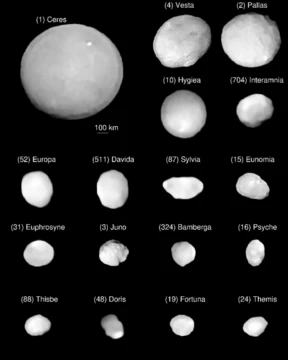
31 Euphrosyne
Third-roundest asteroid, discovered from North America in 1854.

31 Euphrosyne ranks among the largest asteroids, roughly tied for seventh place depending on measurement margins. Discovered by James Ferguson on September 1, 1854, it was the first asteroid ever found from North America. Its name comes from Euphrosyne, one of the three Charites in Greek mythology. A small moon was detected around it in 2019. It is the third most spherical known asteroid, after 1 Ceres and 10 Hygiea; scientists believe this shape resulted from the body re-accreting after a collision shattered it, though it is not close to hydrostatic equilibrium.
The asteroid is fairly dark and orbits near the outer edge of the main belt. Because of this, it never becomes bright enough for binoculars—its maximum apparent magnitude at the best opposition (for example, November 2011) is about +10.2, fainter than any of the thirty asteroids discovered before it. Its orbit has high inclination and eccentricity, with its nodes near perihelion and aphelion; at perihelion, the asteroid is at the northernmost point of its orbit. During perihelic oppositions, it appears very high in the sky from northern latitudes and is invisible from southern countries like New Zealand and Chile.
Euphrosyne is a C-type asteroid with a primitive surface, possibly covered by a thick ejecta blanket from the collision that created its moon and its collisional family. No deep basins are visible, and any craters larger than 40 km in diameter must have flat floors to avoid detection in VLT images—consistent with an icy C-type composition. The lack of craters could also indicate a young surface.
The discovery of its satellite in 2019 allowed the first accurate mass measurement in 2020: (1.7 ± 0.3) × 10¹⁹ kg, yielding a density of 1.7 ± 0.2 g/cm³. This low density suggests that, assuming 20% internal porosity, Euphrosyne is about half water ice.
Euphrosyne gives its name to a complex family of roughly two thousand asteroids with similar spectral properties and orbital elements, thought to have formed from a recent collision about 280 million years ago. All members have relatively high orbital inclinations. The second-largest body in the group, 895 Helio, is likely an interloper.
The small satellite discovered in 2019 probably resulted from the same collision that created the family.
- Discovery date
- 1 September 1854
- Discoverer
- James Ferguson
- Discovery location
- North America
- Approximate rank by size
- tied for 7th largest
- Roundness rank
- third-roundest known asteroid (after 1 Ceres and 10 Hygiea)
- Mass
- (1.7±0.3)×10^19 kg
- Density
- 1.7±0.2 g/cm³
Lore & Background
31 Euphrosyne is a fairly dark body near the belt's outer edge. Consequently, it is never visible with binoculars, having a maximum apparent magnitude at the best possible opposition of around +10.2 (as in November 2011), which is fainter than any of the thirty asteroids previously discovered. Euphrosyne has a high orbital inclination and eccentricity; having nodes near perihelion and aphelion, its perihelion lies at the northernmost point of its orbit. During perihelic oppositions, Euphrosyne is very high in the sky from northern latitudes and invisible from southern countries such as New Zealand and Chile.
Euphrosyne is a C-type asteroid with a primitive surface possibly covered by thick ejecta blanket from the collision that created its moon and collisional family. There are no deep basins. Any craters larger than 40 km in diameter must have flat floors to not be visible in the VLT images, consistent with an icy C-type composition. The lack of craters could also be due to the young age of the surface. The discovery of its satellite enabled the first accurate measure of Euphrosyne's mass in 2020, at (1.7±0.3)×10^19 kg, and thus a density of 1.7±0.2 g/cm³. The low density suggests that Euphrosyne is half water ice if internal porosity is 20%.
Euphrosyne is the namesake of a complex family of about two thousand asteroids that share similar spectral properties and orbital elements. They are thought to have arisen from a recent collision approximately 280 million years ago. All members have relatively high orbital inclinations. The second largest body in this group, 895 Helio, is most likely an interloper. In 2019 a small satellite was discovered, likely resulting from the same collisional event that created the family. Preliminary orbit computations indicated an orbital period of approximately 1.2 days and a semi-major axis of 670 km. VLT images indicate that the moon is 4 km in diameter, assuming it has the same albedo as Euphrosyne.
Reader's Guide
31 Euphrosyne holds significance as one of the largest asteroids, approximately tied for 7th place, and as the first asteroid discovered from North America. Its discovery by James Ferguson on 1 September 1854 marked a milestone in asteroid hunting. The asteroid's notable roundness—third only to 1 Ceres and 10 Hygiea—is thought to result from re-accretion after a disruptive collision, though it is not close to hydrostatic equilibrium. The 2019 discovery of a small satellite enabled the first accurate mass measurement in 2020, yielding a density of 1.7±0.2 g/cm³, which suggests a composition of half water ice if internal porosity is 20%. Euphrosyne is the namesake of a family of about two thousand asteroids, likely formed from a collision about 280 million years ago. Its dark, primitive surface shows no deep basins, possibly due to a young surface or icy composition. The asteroid's high orbital inclination and eccentricity make it visible only from northern latitudes during perihelic oppositions, and it is never visible with binoculars, with a maximum apparent magnitude of +10.2. Its legacy includes providing insights into asteroid composition, collisional families, and the history of the outer main belt.
Did You Know?
- 31 Euphrosyne was the first asteroid discovered from North America, by James Ferguson on 1 September 1854.
- It is the third-roundest known asteroid, after 1 Ceres and 10 Hygiea.
- Its density of 1.7±0.2 g/cm³ suggests it is half water ice if internal porosity is 20%.
- A small satellite, 4 km in diameter, was discovered in 2019, likely from the same collision that created its family.
More in Notable Asteroids 1-24
Spotted an error? Know more?
Reader corrections go straight into our review queue. Suggest an edit · How this site is sourced