Asteroid belt
A torus-shaped region between Mars and Jupiter containing many asteroids.

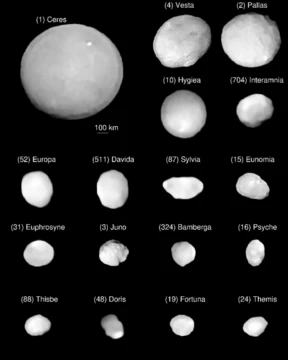
The main asteroid belt is a doughnut-shaped region of the Solar System, centered on the Sun, that lies roughly between the orbits of Mars and Jupiter. It is packed with countless solid, irregularly shaped objects known as asteroids or minor planets. This region is the closest and smallest circumstellar disc in our Solar System. Despite the huge number of objects, they are spread very thinly—on average, about one million kilometers apart. The belt’s total mass is only about 3% of the Moon’s, and roughly 60% of that mass is locked up in its four largest members: Ceres, Vesta, Pallas, and Hygiea.
Ceres is the only asteroid large enough to be considered a dwarf planet, with a diameter of about 950 kilometers. Vesta, Pallas, and Hygiea are all smaller, with average diameters under 600 kilometers. The rest of the identified bodies range in size down to just a few meters. The material is so sparse that many uncrewed spacecraft have passed through the belt without any trouble. Still, collisions between large asteroids do happen, sometimes creating an “asteroid family”—a group of objects with similar orbits and compositions. Astronomers sort individual asteroids by their spectra, with most falling into three main types: carbonaceous (C-type), silicate (S-type), and X-type, which includes metal-rich ones.
The belt formed from the primordial solar nebula as a collection of planetesimals, the building blocks of protoplanets. But gravitational tugs from Mars and Jupiter prevented these bodies from merging into a full-sized planet. Instead, the extra energy shattered colliding planetesimals and most of the young protoplanets. As a result, 99.9% of the belt’s original mass was lost within the first 100 million years of the Solar System’s history. Some of those fragments later drifted into the inner Solar System, causing meteorite impacts on the inner planets. Asteroid orbits are still strongly affected whenever their orbital period forms a resonance with Jupiter. At those distances, a Kirkwood gap appears as asteroids get swept into different paths.
The story of the belt’s discovery began in 1596, when Johannes Kepler wrote in his *Mysterium Cosmographicum* that he would place a planet between Mars and Jupiter, because his model of planetary orbits left too big a gap there.
- Total mass relative to moon
- 3%
- Mass in four largest asteroids
- 60%
- Largest object
- Ceres, about 950 km in diameter
- Other large asteroids
- Vesta, Pallas, Hygiea (mean diameters less than 600 km)
- Average spacing between asteroids
- about one million kilometers (six hundred thousand miles)
- Original mass lost in first 100 million
- 99.9%
Lore & Background
The asteroid belt formed from the primordial solar nebula as a group of planetesimals, but gravitational perturbations from Mars and Jupiter disrupted their accretion into a planet, shattering most protoplanets. As a result, 99.9% of the belt's original mass was lost in the first 100 million years of the Solar System's history. Individual asteroids are categorized by their spectra, with most falling into three basic groups: carbonaceous (C-type), silicate (S-type), and X-type, which includes metal-rich asteroids.
In 1596, Johannes Kepler predicted a planet between Mars and Jupiter. The Titius-Bode law later suggested a missing planet in that region, leading to the discovery of Ceres on January 1, 1801, by Giuseppe Piazzi. Within 15 months, Heinrich Olbers discovered Pallas. William Herschel suggested the name 'asteroids' in 1802, meaning 'star-like', because they appeared as points of light even under high magnification. By 1807, Juno and Vesta were found, but the Napoleonic Wars halted further discoveries until 1845.
The expression 'asteroid belt' came into use in the early 1850s. Over 100 asteroids were known by mid-1868, and astrophotography accelerated discovery after 1891. By 2000, 100,000 asteroids had been found. On 22 January 2014, the Herschel Space Observatory detected water vapor on Ceres for the first definitive time, blurring the lines between comets and asteroids.
Reader's Guide
The asteroid belt is significant as the primary reservoir of asteroids in the inner Solar System, providing key insights into planetary formation and the early history of the Solar System. Its formation from planetesimals was disrupted by Jupiter and Mars, leaving a sparse population of bodies that have been studied by numerous uncrewed spacecraft without incident. The belt's composition, dominated by carbonaceous, silicate, and metal-rich types, reflects the primordial solar nebula. The discovery of Ceres in 1801, following the Titius-Bode law, led to the identification of many more objects, eventually forcing astronomers to reclassify them as asteroids rather than planets. The detection of water vapor on Ceres in 2014 challenged traditional distinctions between asteroids and comets. The belt's orbital resonances with Jupiter create Kirkwood gaps, where asteroids are swept into other orbits. Its legacy includes the ongoing automated surveys that continue to discover new minor planets, and its study has deepened understanding of the Solar System's dynamical evolution and the origins of meteorites that impact Earth.
Did You Know?
- The asteroid belt's total mass is only 3% that of the Moon.
- Ceres, the largest object in the belt, is about 950 km in diameter and is classified as a dwarf planet.
- The term 'asteroid' was coined by William Herschel in 1802, meaning 'star-like'.
- On 22 January 2014, water vapor was definitively detected on Ceres by the Herschel Space Observatory.
The Hierarchy of Size and Mass
Measuring the true dimensions of asteroids remains one of the most challenging tasks in planetary science. Their lumpy, irregular geometries, wildly varying surface reflectivity, and minuscule angular sizes as seen from Earth all conspire to make diameter estimates imprecise. Even so, observations carried out with the Very Large Telescope and published between 2019 and 2021 have sharpened our picture considerably. Infrared data from the IRAS satellite suggest roughly 140 main-belt bodies exceed 120 kilometers in diameter, a threshold that researchers regard as the dividing line between original, never-fragmented asteroids and the rubble produced by later collisions.
The inner belt, defined as the region inside the 3:1 Kirkwood gap at 2.50 AU, is strikingly poor in large bodies. Only five objects—Vesta, Fortuna, Hebe, Iris, and Metis—qualify. Mass distribution is even more lopsided: Ceres alone accounts for roughly a third of the belt's estimated total mass of 2.39 × 10²¹ kg, making it more massive than the next fifteen asteroids combined. Precise masses come from spacecraft flybys (Dawn measured Ceres and Vesta) or from satellite dynamics (as with Sylvia), while the rest rely on perturbation modeling, where overlapping estimates blur the ranking beyond the top four.
A Faint Glow: Brightness and Visibility
From Earth, the asteroid belt is almost invisible. Vesta stands alone as the only asteroid routinely bright enough for the unaided eye. Under exceptionally dark skies and at rare perihelic oppositions, a sharp observer might glimpse Ceres, Pallas, or Iris, but these are fleeting rewards. Several other belt members can briefly outshine Titan at its brightest (+8.3 magnitude)—a benchmark that is notable because Titan was catalogued 145 years before the first asteroid was ever discovered, thanks to its proximity to the easily spotted Saturn.
No asteroid in the outer belt can ever reach that level of brilliance. Hygiea and Interamnia, for instance, seldom climb above magnitude 10.0. The reason is compositional: the highest-albedo, most reflective asteroids cluster near the inner belt close to Mars, while the outer regions are dominated by dark C-type and D-type bodies. A separate class of brightness events involves highly eccentric orbits. Asteroids like Eros, Apophis, and several others only flash to their peak brightness when their perihelion aligns closely with a heliocentric conjunction with Earth. Apophis, for example, will hit its maximum apparent magnitude on a single date—April 13, 2029—while its everyday magnitude hovers between 20 and 22, far beyond naked-eye reach.
Spinning at the Limits: Rotation Extremes
Most asteroids tumble through space with rotation periods falling between two and twenty hours, a comfortable middle ground. At both ends of that spectrum, however, the numbers become extraordinary. The slowest known rotators spin no faster than once every 1,000 hours—roughly forty-one and two-thirds days—making them barely distinguishable from objects that are not spinning at all.
At the opposite extreme, a handful of tiny near-Earth objects complete a full rotation in under 100 seconds, a pace of 0.0277 hours. Remarkably, every one of these ultra-fast spinners is an unnumbered near-Earth object smaller than 100 meters across, suggesting that only the smallest, most fragile bodies can sustain such violent rotation without breaking apart. Among numbered asteroids with a confidently determined period, the record holders include 2014 EK24, a 60-meter stony near-Earth object spinning in 352 seconds, and two main-belt residents—2005 UW163 at 0.86 kilometers and 2000 GD65 at 2.25 kilometers—whose periods stretch to 1.29 and 1.95 hours respectively. Objects whose rotation quality rating falls below 2 are flagged as uncertain, reminding us that even these extreme measurements carry significant observational caveats.
The Rarest Orbits: Retrograde Motion
Of the roughly 800,000 minor planets catalogued as of March 2018, a mere 99—just 0.01 percent—travel in a retrograde direction, meaning their orbital inclination sits at or above 90 degrees, with 180 degrees representing a perfectly reversed path. This makes retrograde minor planets the rarest orbital category in the entire Solar System. By contrast, more than 2,000 comets are known to follow retrograde trajectories, underscoring how unusual such motion is among rocky bodies.
The high-inclination asteroids that do exhibit retrograde behavior tend to fall into two broad groups. Some are Mars-crossers, potentially in the process of being ejected from the Solar System entirely. Others are classified as damocloids, a population whose origins remain debated. A subset of these high-inclination objects appears to be temporarily captured in retrograde resonance with one of the gas giants, a gravitational arrangement that may be transient rather than permanent. The sheer scarcity of these bodies—nearly one in ten thousand—means that each new confirmation adds a valuable data point to our understanding of how the Solar System's architecture was assembled and how it continues to evolve.
Frequently Asked Questions
What is the Asteroid belt?
It is a doughnut-shaped zone of countless irregular rocky bodies that orbits the Sun between Mars and Jupiter. It represents the closest circumstellar disc to Earth in our Solar System.
Where is the Asteroid belt located?
It sits in the gap between the orbits of Mars and Jupiter, forming a torus centered on the Sun. The region is filled with minor planets of varying sizes and shapes.
What is the largest asteroid in the belt?
Ceres, at roughly 950 km in diameter, is the biggest member and the only one classified as a dwarf planet. Vesta, Pallas, and Hygiea trail behind it, each under 600 km across.
How far apart are asteroids in the belt?
On average, neighboring asteroids sit about a million kilometers (roughly 600,000 miles) apart from one another. The region is far more empty than popular culture suggests.
How much mass does the Asteroid belt actually contain?
The entire belt weighs only about 3% as much as the Moon, with roughly 60% of that small total locked inside Ceres, Vesta, Pallas, and Hygiea. An estimated 99.9% of its original mass was shed during the first 100 million years of the Solar System.
More in Notable Asteroids 1-24
Spotted an error? Know more?
Reader corrections go straight into our review queue. Suggest an edit · How this site is sourced