Near-Earth asteroid
Near-Earth asteroids are small bodies whose orbits bring them close to Earth.

A near-Earth asteroid (NEA) is a small Solar System body orbiting the Sun whose closest approach to the Sun (perihelion) is less than 1.3 astronomical units (AU). NEAs are a subset of near-Earth objects (NEOs), which also include comets. They are notable because their orbits can bring them close to Earth, and those larger than 140 meters across that cross Earth's orbit are classified as potentially hazardous objects (PHOs).
- Known neas
- over 37,000
- Pho size threshold
- 140 meters (460 ft)
- First nea discovered
- 433 Eros in 1898
- First nea observed by radar
- 1566 Icarus on June 14, 1968
- First nea closer than moon
- 1991 BA, a 5–10 m body passing at 170,000 km
- Closest approach without impact
- 2025 UC11 on October 30, 2025, at about 6,600 km from Earth's center
Lore & Background
The first near-Earth asteroid discovered was 433 Eros in 1898, which was extensively observed to help determine the Earth-Sun distance. In 1937, the 800-meter asteroid 69230 Hermes passed Earth at twice the lunar distance. On June 14, 1968, the 1.4 km asteroid 1566 Icarus passed at 0.0425 AU and became the first minor planet observed by radar. The first NEA known to pass closer than the Moon was 1991 BA, a 5–10 meter body that came within 170,000 km. As surveys improved, at least one such object was observed each year from 2001, and over a hundred from 2020.
Reader's Guide
Near-Earth asteroids are significant because collisions in the past have shaped Earth's geological and biological history. Asteroids as small as 20 meters can cause local damage, while larger ones can produce craters or tsunamis. Interest in NEAs increased since the 1980s due to awareness of impact risk. The Spaceguard survey, initiated in 1998 by the United States, European Union, and other nations, aimed to catalog at least 90% of NEAs 1 km or larger (sufficient for global catastrophe), a goal met by 2011. Later efforts expanded to smaller objects. As of December 2024, six near-Earth asteroids have been visited by spacecraft, samples of three have been returned to Earth, and one successful deflection test was conducted. Two scales—the Torino and Palermo scales—rate the risk of identified NEAs based on impact probability and consequences.
Did You Know?
- Asteroids as small as 20 meters in diameter can cause significant local damage.
- The closest approach without impact was asteroid 2025 UC11 on October 30, 2025, at about 237 km above Earth's surface.
Naming and Classification in the Minor Planet Census
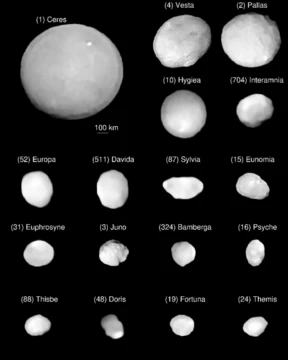
Asteroids occupy a specific tier within the broader family of minor planets, defined as objects orbiting out to Neptune's path but explicitly excluding the trans-Neptunian populations of the Kuiper belt, scattered disc, and inner Oort cloud. This category encompasses the dwarf planet Ceres, the Jupiter trojan swarms, and the centaurs, yet it deliberately leaves out comets, which follow entirely separate naming conventions. Most asteroids cluster between 2 and 3 astronomical units from the Sun, with a secondary concentration at Jupiter's 5-AU orbit. Each asteroid receives a unique sequential number only after its orbit has been precisely determined. Until that milestone, an object carries merely a provisional designation—a string like 1950 DA that signals its discovery year and position in the observing sequence. This numbering system is shared with Kuiper belt objects, which also receive minor planet numbers despite residing far beyond the traditional asteroid belt at 30 to 60 AU. The distinction matters: not every minor planet is an asteroid, and the boundaries of the category are defined by orbital region rather than composition alone.
Weighing the Belt: Mass and Scale
Determining the true size and mass of an asteroid is far from straightforward. Irregular shapes, wildly varying surface reflectivity, and the tiny angular diameters these bodies subtend from Earth all conspire to make direct measurement unreliable. The Very Large Telescope campaigns that published results between 2019 and 2021 represent a significant step in refining size estimates for the largest members of the population. Infrared data from the IRAS satellite suggest roughly 140 main-belt asteroids exceed 120 kilometers in diameter, a threshold marking the boundary between bodies that likely survived as primordial fragments and those that are shattered debris. Mass estimation is even more challenging. Most asteroid masses are inferred from gravitational perturbations they impose on neighboring orbits, a method complicated by the collective pull of thousands of smaller bodies. Only a handful have been measured directly: the Dawn spacecraft provided precise masses for Ceres and Vesta, while natural satellites allow direct calculation for 87 Sylvia, 107 Camilla, and 130 Elektra. Ceres alone accounts for roughly a third of the belt's estimated 2.39×10²¹ kg, outweighing the next fifteen massive asteroids combined by half again. Beyond the top four, the ranking remains uncertain because overlapping error bars make definitive ordering impossible.
A Glimpse from Earth: Brightness and Albedo
Of all the asteroids, only Vesta is consistently bright enough for the unaided human eye. Under exceptionally dark skies and at rare perihelic oppositions, a sharp observer might also catch Ceres, Pallas, or Iris, but these are fleeting opportunities. The benchmark for comparison is telling: several asteroids can outshine Titan at its brightest (+8.3 magnitude), even though Saturn's moon was discovered 145 years before the first asteroid was ever identified. The distribution of brightness across the belt is not random. High-albedo asteroids concentrate in the inner regions closer to Mars's orbit, while the outer belt is dominated by darker C-type and D-type bodies. As a result, no asteroid in the outer belt can ever reach the bright magnitudes of its inner-belt counterparts; even Hygiea and Interamnia seldom climb above magnitude 10.0. Objects with very high orbital eccentricities, such as 433 Eros and 99942 Apophis, achieve peak brightness only during rare geometries—either a close heliocentric conjunction with Earth or an exceptionally close flyby. Apophis, for instance, will reach its maximum apparent magnitude on just one date: April 13, 2029. On any other night it sits at a faint 20 to 22 magnitude, invisible without serious equipment.
Orbital Oddities: Spin Speeds and Retrograde Motion
The rotation periods of known minor planets span an astonishing range. Most bodies complete a turn in two to twenty hours, yet the extremes push far beyond that comfort zone. The slowest-rotating catalogued objects take at least 1,000 hours—over forty-one days—to spin once. At the other end, the fastest rotators complete a full revolution in under 100 seconds. Remarkably, every one of these sub-100-second spinners is an unnumbered near-Earth object smaller than 100 meters across. Among numbered bodies with confirmed periods, (459872) 2014 EK24, a 60-meter stony NEO, spins in 352 seconds, while main-belt asteroids (335433) 2005 UW163 and (60716) 2000 GD65 manage periods of 1.29 and 1.95 hours respectively. Retrograde orbits, where inclination reaches or exceeds 90 degrees, are even rarer. Out of nearly 800,000 known minor planets, only 99—a mere 0.01 percent—orbit in the retrograde direction, making them the rarest subgroup in the entire census. By contrast, more than 2,000 comets share this trait. These high-inclination asteroids tend to be Mars-crossers possibly in the process of being ejected, or damocloid objects, some of which are temporarily locked in retrograde resonances with the gas giants.
Frequently Asked Questions
What exactly is a near-Earth asteroid?
A near-Earth asteroid is a small rocky body orbiting the Sun whose orbit dips inside 1.3 astronomical units at perihelion. It is a specific subset of near-Earth objects, a broader group that also includes comets, and is defined by its asteroid-like composition and proximity to our planet.
How many near-Earth asteroids have been catalogued so far?
More than 37,000 near-Earth asteroids have been identified and tracked to date. That tally keeps climbing as ground-based surveys and radar programs continue to spot previously unknown objects.
What makes a near-Earth asteroid 'potentially hazardous'?
An NEA is flagged as a potentially hazardous object when it measures at least 140 meters (about 460 feet) across AND its orbital path intersects Earth's orbit. Bodies smaller than that threshold or those whose orbits never cross ours do not receive the PHO designation.
What was the first near-Earth asteroid ever discovered?
The title belongs to 433 Eros, spotted in 1898 and recognized as the first asteroid of this class. Over a century later, 1566 Icarus became the first NEA to be observed by radar on June 14, 1968.
How close has a near-Earth asteroid come to Earth without impacting?
The closest recorded non-impacting flyby is 2025 UC11, which passed at roughly 6,600 kilometers from Earth's center on October 30, 2025. Before that milestone, the record was held by 1991 BA, a mere 5-to-10-meter body that slipped past at about 170,000 kilometers in 1991.
More in Notable Asteroids 1-24
Spotted an error? Know more?
Reader corrections go straight into our review queue. Suggest an edit · How this site is sourced