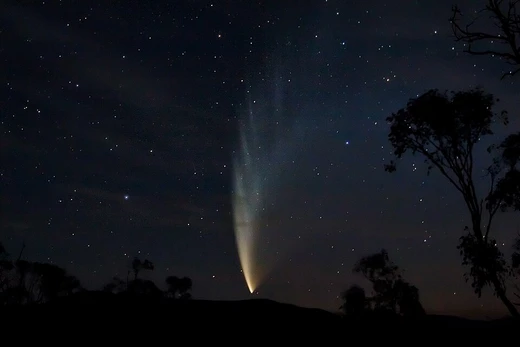
C/1729 P1 (Sarabat)
Possibly the largest comet ever observed, with absolute magnitude −3.
Last updated
C/1729 P1, also known as Comet Sarabat, is an assumed parabolic comet discovered in 1729. It is notable for its exceptionally high absolute magnitude of −3, making it possibly the brightest comet ever observed and potentially the largest cometary nucleus ever seen, estimated at about 100 km in diameter.
Background
The comet was discovered in the early morning of August 1, 1729, by Father Nicolas Sarabat, a professor of mathematics, in the constellation Equuleus. At discovery, it was at its closest approach to Earth at 3.1 AU and had a solar elongation of 155 degrees. Sarabat initially saw a faint, nebulous star-like object and was unsure if it was a comet or part of the Milky Way; moonlight interfered with his observations until August 9. After recovering the object and detecting its motion without instruments, he became convinced it was a new comet.
News reached Jacques Cassini in Paris, who confirmed the position with extreme surprise at how little the comet had moved in nearly a month. Cassini continued observations until January 18, 1730, when the comet was in Vulpecula, an extraordinarily long observation period for a comet, though it never rose above apparent magnitude 3–4, about the brightness of the Andromeda Galaxy.
Ranked in
More in Named Comets
Sources
Compiled from Wikipedia and the sources listed below. Text from Wikipedia is available under CC BY-SA 4.0; this entry is adapted from it.
- Wikipedia: C/1729 P1 (Sarabat) (CC BY-SA 4.0).
- Word definitions: the , each quoted from its Wikipedia article.
Spotted an error? Know more?
Reader corrections go straight into our review queue. Suggest an edit · How this site is sourced